Paspalum vaginatum
Seashore paspalum
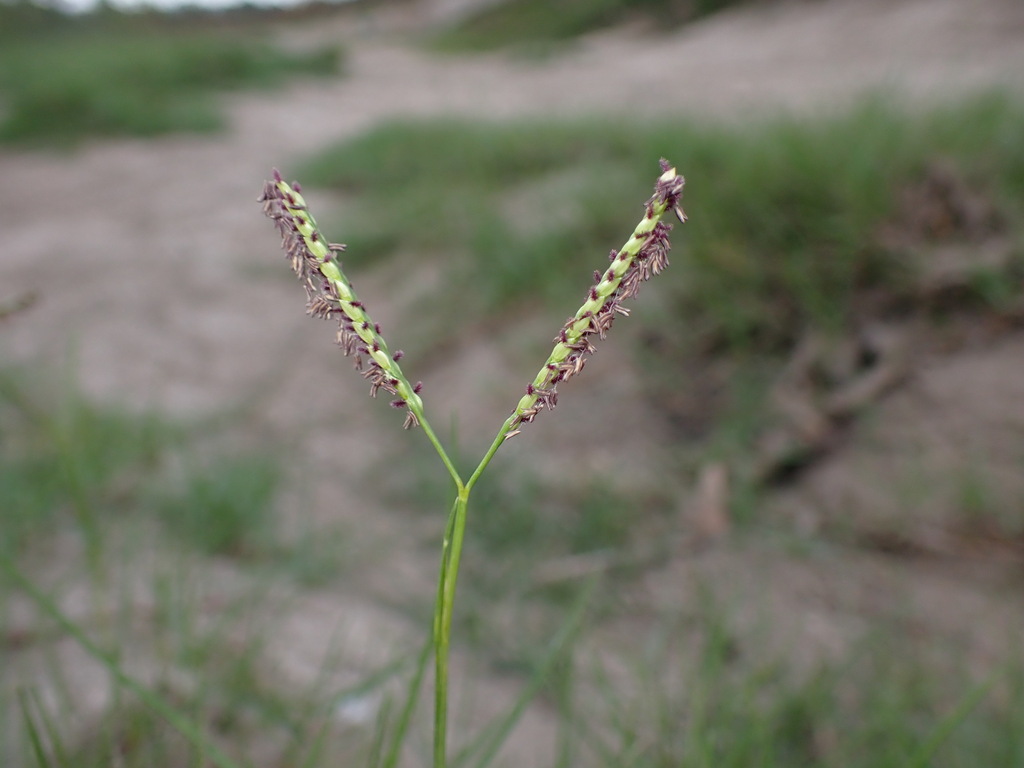
(c) W Rao, some rights reserved (CC BY) · licence
Family: Poaceae · Type: Grass · Not Native
Conservation status: Cal-IPC Yes
Paspalum vaginatum (Seashore paspalum) is a non-native California grass in the Poaceae family, recognized by salt marsh habitat, glabrous spikelets, and larger fruit size.
Seashore paspalum is a naturalized perennial found in southern California coastal and desert regions in brackish and salt marshes at elevations below 100 meters. Flowering from August to December, this plant produces white fertile florets in light straw-colored spikelets 3 to 4.5 millimeters long. Growing with creeping or clustered stems 10 to 79 centimeters tall, it spreads with glabrous nodes and ascending to erect growth. Its leaf blades extend up to 19 centimeters long, 1.4 to 8 millimeters wide, and are flat or slightly folded with glabrous or pubescent surfaces and incurved tips. The fruit is yellow, measuring 2.8 to 3.1 millimeters long.
Identification and appearance
Key characters: 3 sympatric species; key features are salt marsh habitat, glabrous spikelets, and larger fruit size
Habitat and range
Habitat: Brackish and salt marshes
Elevation: < 100 m
Outside California: southern and eastern United States, warm areas worldwide
Bloom period
Paspalum vaginatum blooms Aug-Dec.
Conservation status
Cal-IPC Yes
How to tell it apart
vs Setaria: Paspalum has hardened leathery spikelets in rows; foxtail has soft spikelets with bristles beneath each one.; vs Eleusine: Paspalum has spikelets in two rows per branch; goosegrass has spikelets in a single row on each branch.; vs Cynodon: Paspalum has thick leathery spikelets in neat rows; bermudagrass has tiny spikelets in a single row.; vs Bromus: Paspalum has single-flowered leathery spikelets; brome has multi-flowered membranous spikelets with awns.; vs Plantago: Paspalum is a grass with leathery spikelets; plantain has broad ribbed leaves and spike-like seed heads.
Frequently asked questions
Is Paspalum vaginatum native to California?
No. Paspalum vaginatum is not native to California (recorded as not native).
When does Paspalum vaginatum bloom?
Paspalum vaginatum blooms Aug-Dec.
What plant family does Paspalum vaginatum belong to?
Paspalum vaginatum is in the Poaceae family, genus Paspalum.
Is Paspalum vaginatum invasive in California?
Paspalum vaginatum is listed by Cal-IPC with an invasiveness rating of Yes.
What habitat does Paspalum vaginatum grow in?
Paspalum vaginatum grows in Brackish and salt marshes.
Related species
Other California species in the same genus, family, or bioregion.
Sources: Jepson eFlora · CalPhotos
Last updated 2026-10-07
Data from The California Species Project — 14,000+ California species with verified data from CNPS, CDFW, USFWS, Cal-IPC, and more.