Pectis papposa var. papposa
Common chinch-weed, Chinch-Weed
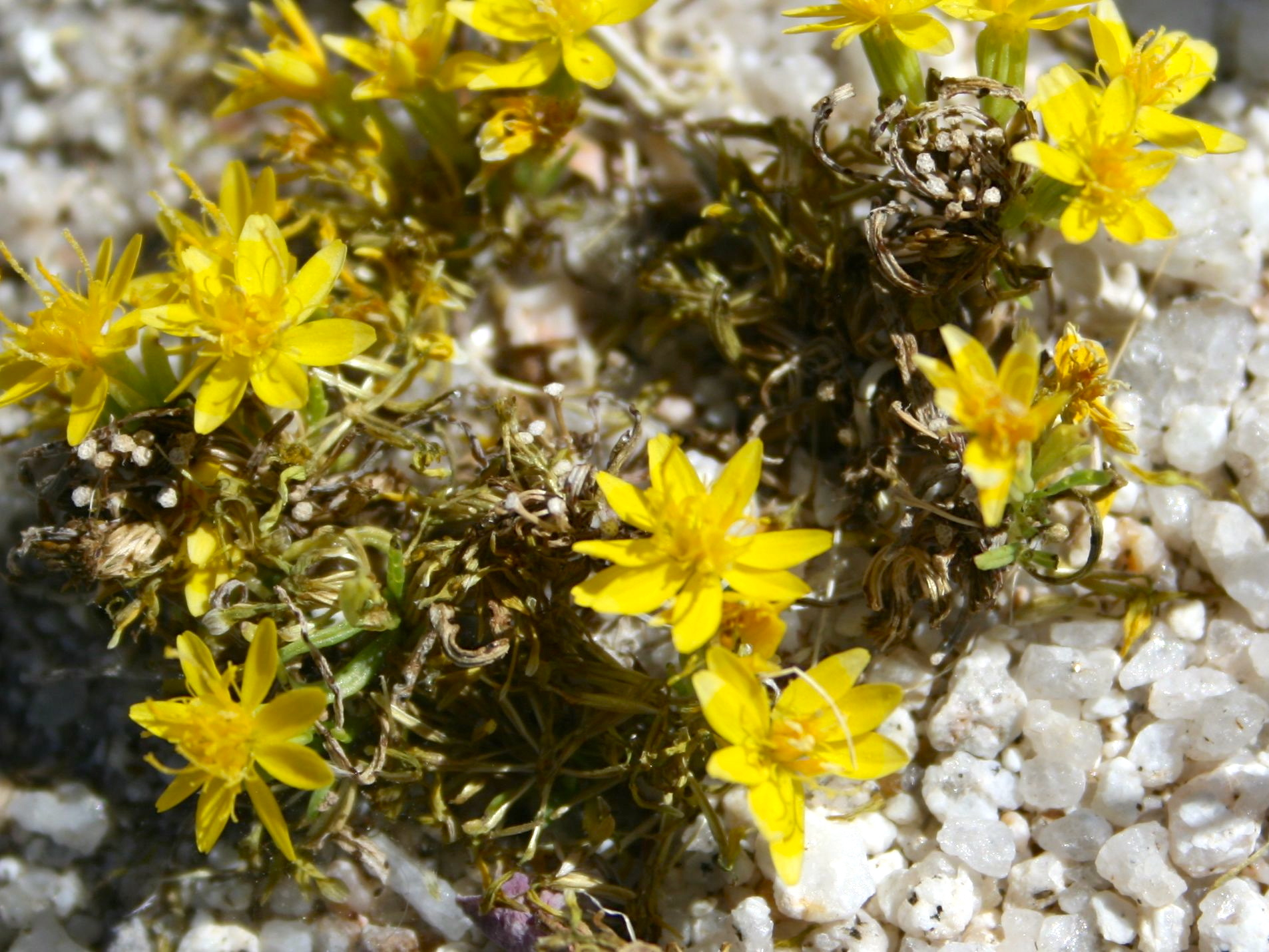
Photo by Chez Brungraber
Family: Asteraceae · Type: Herb · Native
Pectis papposa var. papposa (Common chinch-weed) is a native California herb in the Asteraceae family, recognized by Desert distribution at edge of range, distinctive aromatic desert annual.
Common chinch-weed is a native annual herb found in the Mojave Desert and western Inyo County on arid plains and rocky slopes in creosote-bush scrub at elevations below 1,500 meters. Flowering after summer rain from August to November, this plant produces yellow ray flowers in compact clusters 6 to 10 millimeters wide with a distinctive spicy scent. Growing as a small mound-shaped plant 1 to 20 centimeters tall, it develops multiple stems from its base that are simple or extensively branched. Its leaves are narrow and linear, marked with gland-dotted margins that contribute to its aromatic character. The fruits are small, ranging from 2 to 4.5 millimeters long, with ray fruits having a low crown and disk fruits featuring approximately 20 plumose bristles.
Identification and appearance
Key characters: Desert distribution at edge of range, distinctive aromatic desert annual
Habitat and range
Habitat: Arid plains, rocky slopes, in creosote-bush scrub
Elevation: < 1500 m
Outside California: to southwestern Utah, southwestern New Mexico, northwestern Mexico
Bloom period
Pectis papposa var. papposa blooms After summer rain, (Jun)Aug-Nov(Jan).
How to tell it apart
vs Gutierrezia: Pectis has bristly leaf bases and strongly aromatic foliage; Gutierrezia lacks both features.; vs Eriophyllum: Pectis leaves are smooth and narrow with bristly bases; Eriophyllum has woolly coating throughout.; vs Lessingia: Crush a leaf - Pectis releases strong pungent odor; Lessingia has little to no scent.; vs Lasthenia: Pectis flowers in summer/fall in deserts; Lasthenia blooms in spring in wetter habitats.; vs Lepidium: Pectis has daisy flowers with yellow rays; Lepidium has tiny 4-petaled white flowers.
Frequently asked questions
Is Pectis papposa var. papposa native to California?
Yes. Pectis papposa var. papposa is native to California (recorded as native).
When does Pectis papposa var. papposa bloom?
Pectis papposa var. papposa blooms After summer rain, (Jun)Aug-Nov(Jan).
What plant family does Pectis papposa var. papposa belong to?
Pectis papposa var. papposa is in the Asteraceae family, genus Pectis.
What habitat does Pectis papposa var. papposa grow in?
Pectis papposa var. papposa grows in Arid plains, rocky slopes, in creosote-bush scrub.
Related species
Other California species in the same genus, family, or bioregion.
Sources: Jepson eFlora · Index of California Plant Names · CalPhotos
Last updated 2026-10-07
Data from The California Species Project — 14,000+ California species with verified data from CNPS, CDFW, USFWS, Cal-IPC, and more.