Pectocarya linearis subsp. ferocula
Narrow-toothed pectocarya, Narrow-Toothed Pectocarya
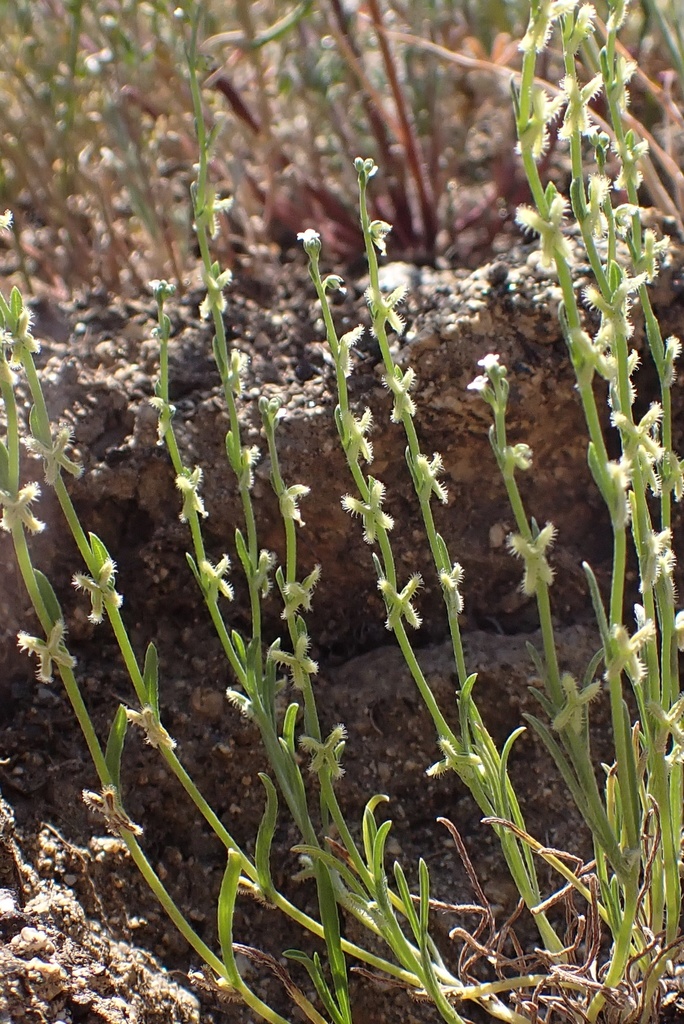
(c) Madeleine Claire, some rights reserved (CC BY), uploaded by Madeleine Claire · licence
Family: Boraginaceae · Type: Herb · Native
Pectocarya linearis subsp. ferocula (Narrow-toothed pectocarya) is a native California herb in the Boraginaceae family, recognized by narrow, free-based marginal teeth.
Narrow-toothed pectocarya is a California native annual found in southern Sierra Nevada foothills, Tehachapi, San Joaquin Valley, central western California, southwestern California, eastern Mojave Desert, and western Colorado Desert in grassy slopes, roadsides, and clearings at elevations of 5 to 2,100 meters. Flowering from February to May, this plant produces small white flowers in delicate clusters. Growing with prostrate to decumbent stems 6 to 26 centimeters long, it spreads across the ground in low, sprawling formations. Its leaves are small and narrow, adapting to the plant's low-growing habit and diverse habitats. The fruit consists of distinctive linear-oblong nutlets with teeth along the margins, giving the plant its characteristically delicate appearance.
Identification and appearance
Key characters: 6 sympatric species; diagnostic narrow, free-based marginal teeth
Habitat and range
Habitat: Roadsides, grassy slopes, clearings
Elevation: 5-2100 m
California counties: Kern, San Bernardino, Los Angeles, San Diego, Riverside, San Benito, Monterey, Orange, Santa Barbara, Inyo, Ventura, Fresno, Kings, Stanislaus, San Joaquin, San Luis Obispo, Imperial
Outside California: northern Baja California, also southern South America
Bloom period
Pectocarya linearis subsp. ferocula blooms Feb-May.
How to tell it apart
vs Plagiobothrys: Pectocarya sepals stay equal and separate; Plagiobothrys sepals become unequal or partly fused in fruit.; vs Cryptantha: Pectocarya nutlets have hooked bristles on edges; Cryptantha nutlets are smooth or rough, not hooked.; vs Harpagonella: Pectocarya has 4 nutlets with equal sepals; Harpagonella has 2 nutlets with huge arching spiny sepals.; vs Johnstonella: Pectocarya has flattened nutlets with marginal hooks; Johnstonella has rounded nutlets with covering bristles.; vs Greeneocharis: Pectocarya has hooked marginal bristles; Greeneocharis has smooth or minutely rough nutlets without hooks.
Frequently asked questions
Is Pectocarya linearis subsp. ferocula native to California?
Yes. Pectocarya linearis subsp. ferocula is native to California (recorded as native).
When does Pectocarya linearis subsp. ferocula bloom?
Pectocarya linearis subsp. ferocula blooms Feb-May.
Where in California does Pectocarya linearis subsp. ferocula grow?
Pectocarya linearis subsp. ferocula occurs in Kern, San Bernardino, Los Angeles, San Diego, Riverside, San Benito, Monterey, Orange and other counties, at elevations of 5-2100 m.
What plant family does Pectocarya linearis subsp. ferocula belong to?
Pectocarya linearis subsp. ferocula is in the Boraginaceae family, genus Pectocarya.
What habitat does Pectocarya linearis subsp. ferocula grow in?
Pectocarya linearis subsp. ferocula grows in Roadsides, grassy slopes, clearings.
Related species
Other California species in the same genus, family, or bioregion.
Sources: Jepson eFlora · Index of California Plant Names · CalPhotos
Last updated 2026-10-07
Data from The California Species Project — 14,000+ California species with verified data from CNPS, CDFW, USFWS, Cal-IPC, and more.