Pedicularis densiflora
Warrior's plume, Warrior's Plume
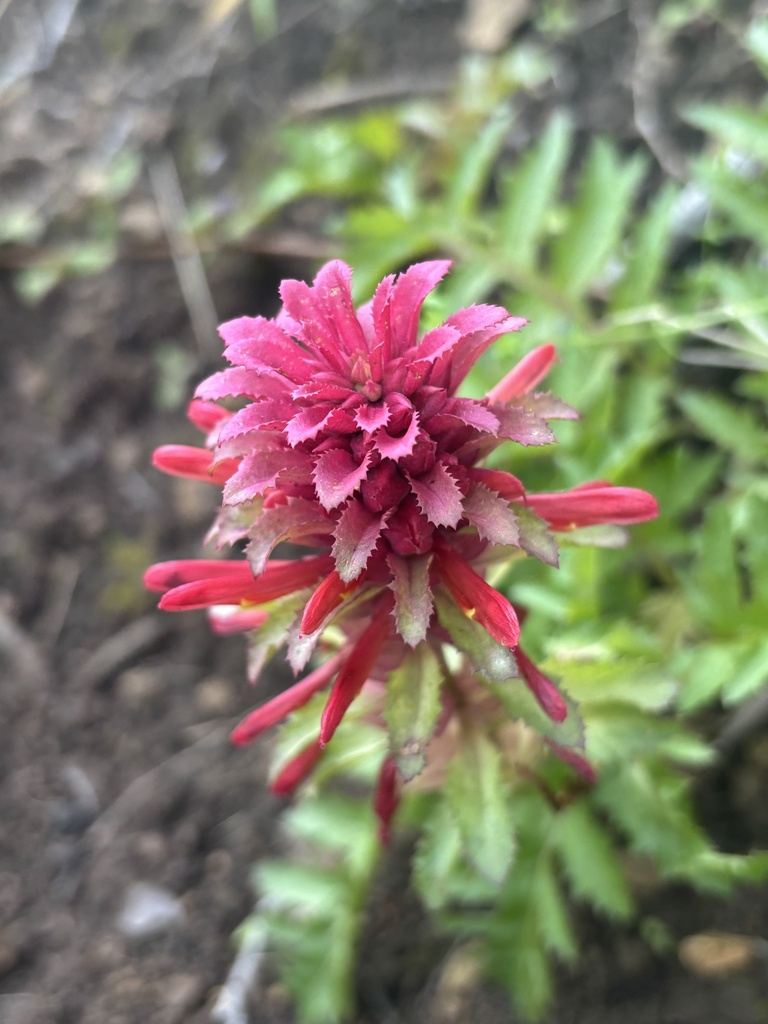
(c) Skyler K, some rights reserved (CC BY), uploaded by Skyler K · licence
Family: Orobanchaceae · Type: Herb · Native
Pedicularis densiflora (Warrior's plume) is a native California herb in the Orobanchaceae family, recognized by distinctive red drooping flowers.
Warrior's plume is a California native perennial found in northwestern, northern California, Sierra Nevada foothills, Tehama County, central western, and southwestern regions in chaparral, oak and pine woodlands, and mixed forests at elevations of 30 to 1,200 meters. Flowering from February to May, this plant produces deep red to red-purple (occasionally orange-yellow or white) flowers with a distinctive downward-bent corolla 23 to 43 millimeters long. Growing 6 to 55 centimeters tall with stems that range from nearly smooth to soft or coarse brown-hairy, it develops a robust, upright form. Its basal leaves are 5 to 28 centimeters long with 13 to 41 crowded segments that are often linear to ovate, deeply lobed and toothed. The flowers feature a hooded upper lip 15 to 25 millimeters long and a lower lip with nearly equal lobes, creating a striking silhouette in its woodland habitats.
Identification and appearance
Key characters: 8 sympatric species; distinctive red drooping flowers
Habitat and range
Habitat: Chaparral, oak/pine woodland, mixed forest
Elevation: 30-1200 m
California counties: Humboldt, Mendocino, Santa Barbara, Los Angeles, Colusa, Plumas, Fresno, Contra Costa, Orange, Santa Clara, Monterey, Napa, Riverside, Marin, Sonoma, San Mateo, Solano, Trinity, Lake, San Luis Obispo, Santa Cruz, Tehama, San Benito, San Diego, Glenn, Kern, Butte, Ventura, San Bernardino, Shasta, Siskiyou, Amador, Modoc, Mariposa, Yuba, Nevada, Tulare, Alameda, Calaveras, Stanislaus, Madera, Sierra, Yolo, Alpine, Inyo, Mono
Outside California: southern Oregon
Bloom period
Pedicularis densiflora blooms Feb-May.
How to tell it apart
vs Castilleja: Leaves deeply dissected and fern-like with 7+ lobes, not simple or few-lobed.; vs Phacelia: Flowers have closed hood concealing stamens, not open bell/funnel shape.; vs Anigozanthos: Upper lip forms distinctive elephant-head hood, leaves deeply divided fern-like.; vs Melaleuca: Herbaceous perennial with hooded flowers, not woody shrub with brush-like blooms.; vs Achillea: Flowers individually hooded and two-lipped, not tiny in flat-topped clusters.
Frequently asked questions
Is Pedicularis densiflora native to California?
Yes. Pedicularis densiflora is native to California (recorded as native).
When does Pedicularis densiflora bloom?
Pedicularis densiflora blooms Feb-May.
Where in California does Pedicularis densiflora grow?
Pedicularis densiflora occurs in Humboldt, Mendocino, Santa Barbara, Los Angeles, Colusa, Plumas, Fresno, Contra Costa and other counties, at elevations of 30-1200 m.
What plant family does Pedicularis densiflora belong to?
Pedicularis densiflora is in the Orobanchaceae family, genus Pedicularis.
What habitat does Pedicularis densiflora grow in?
Pedicularis densiflora grows in Chaparral, oak/pine woodland, mixed forest.
Related species
Other California species in the same genus, family, or bioregion.
Sources: Jepson eFlora · Index of California Plant Names · CalPhotos
Last updated 2026-10-07
Data from The California Species Project — 14,000+ California species with verified data from CNPS, CDFW, USFWS, Cal-IPC, and more.