Pediomelum castoreum
Beaver dam breadroot, Beaver Dam Breadroot
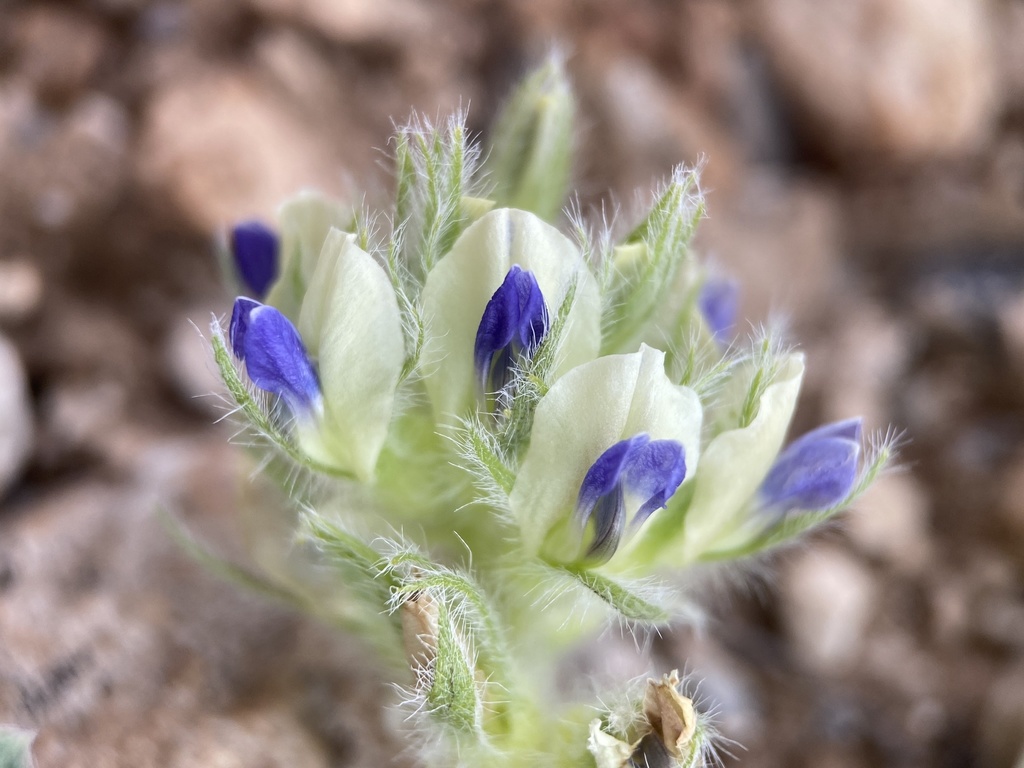
(c) Matt Berger, some rights reserved (CC BY) · licence
Family: Fabaceae · Type: Herb · Native
Conservation status: CNPS 1B.2
Pediomelum castoreum (Beaver dam breadroot) is a native California herb in the Fabaceae family, recognized by . Distinguished by desert habitat and triangular fruit beaks 8-11 mm long.
Beaver dam breadroot is a rare (CNPS 1B.2) California native perennial found in the Mojave Desert in San Bernardino County, typically growing in open areas and roadcuts at elevations below 1,750 meters. Flowering from April to May, this plant produces white to purple flowers 9 to 13 millimeters long with distinctive banner petals. Growing with erect stems up to 45 centimeters tall, it develops a robust root system characteristic of breadroot species. Its leaves are complex, with 5 to 6 leaflets and long petioles measuring 6.8 to 15 centimeters, accompanied by conspicuous stipules 5 to 13.5 millimeters long. The fruit is notable for its ovate to elliptic shape, with a body 6 to 8 millimeters long and a slightly curved beak 8 to 11 millimeters in length.
Identification and appearance
Key characters: Geographically isolated with 0 sympatric species. Distinguished by desert habitat and triangular fruit beaks 8-11 mm long.
Habitat and range
Habitat: Open areas, roadcuts
Elevation: < 1750 m
California counties: San Bernardino, Inyo
Outside California: Nevada, Arizona
Bloom period
Pediomelum castoreum blooms Apr-May.
Conservation status
CNPS 1B.2
How to tell it apart
vs Lupinus: Pediomelum has leaves clustered basally; Lupinus has leaves evenly distributed along stems.; vs Trifolium: Pediomelum has fruits mostly hidden in calyx; Trifolium has small round pods in dense heads.; vs Astragalus: Pediomelum has basal leaf clusters; Astragalus has leaves distributed along stems.; vs Lotus: Pediomelum has leaves clustered at base; Lotus has leaves along stems.; vs Ladeania: Pediomelum has basal leaf clusters; Ladeania has leaves distributed along stems.
Frequently asked questions
Is Pediomelum castoreum native to California?
Yes. Pediomelum castoreum is native to California (recorded as native).
When does Pediomelum castoreum bloom?
Pediomelum castoreum blooms Apr-May.
Where in California does Pediomelum castoreum grow?
Pediomelum castoreum occurs in San Bernardino, Inyo, at elevations of < 1750 m.
What plant family does Pediomelum castoreum belong to?
Pediomelum castoreum is in the Fabaceae family, genus Pediomelum.
Is Pediomelum castoreum rare or endangered?
Pediomelum castoreum carries California Rare Plant Rank 1B.2, state rank S2.
Related species
Other California species in the same genus, family, or bioregion.
Sources: Jepson eFlora · CNPS Rare Plant Inventory · Index of California Plant Names · CalPhotos · CDFW CNDDB
Last updated 2026-10-07
Data from The California Species Project — 14,000+ California species with verified data from CNPS, CDFW, USFWS, Cal-IPC, and more.