Pellaea mucronata var. mucronata
Bird's foot fern
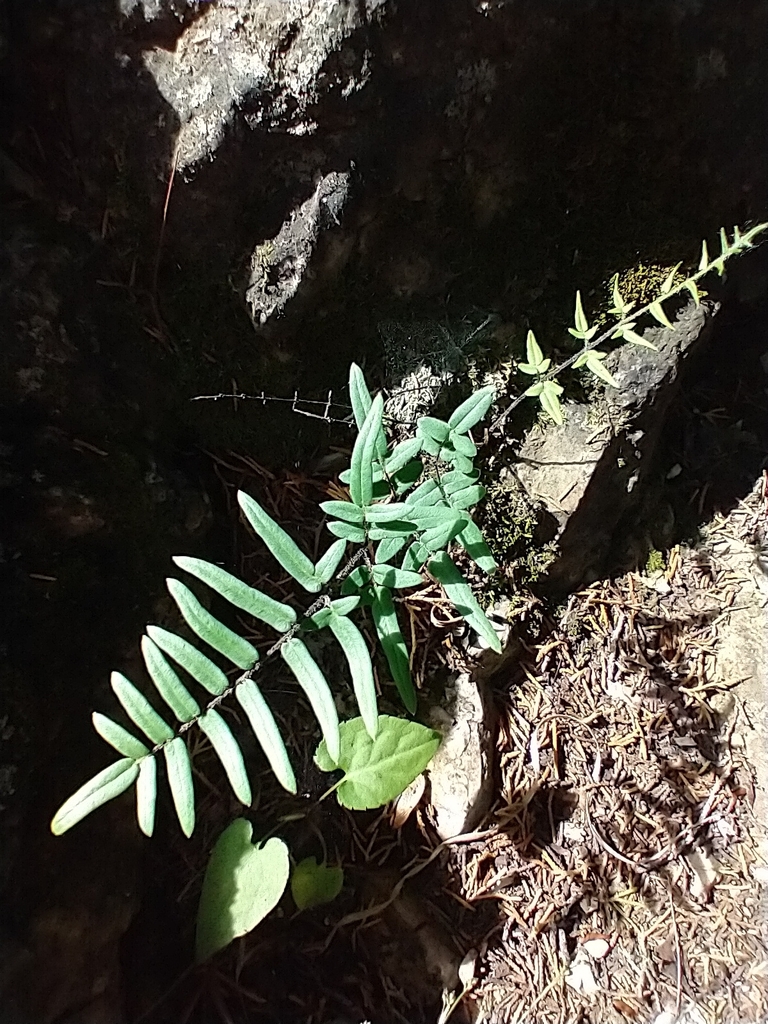
Photo: parent species Pellaea mucronata · (c) Tom Norton, some rights reserved (CC BY) · licence
Family: Pteridaceae · Type: Herb · Native
Pellaea mucronata var. mucronata (Bird's foot fern) is a native California herb in the Pteridaceae family, recognized by larger size and spreading, non-overlapping pinnae.
Bird's foot fern is a California native perennial found in the Klamath Ranges, northern Coast Ranges, Cascade Range, Sierra Nevada, Great Valley (Sutter Buttes), central western, southwestern, eastern Sierra Nevada, and desert mountain regions in rocky or dry areas at elevations of 20 to 2,400 meters. Its large, distinctive fronds spread 20 to 40 centimeters long and 5 to 15 centimeters wide, with a complex two to three-pinnate blade structure featuring pinnae that spread widely and do not overlap. Growing with an elegant, open growth habit, the fern's fronds ascend gracefully with fertile segments that remain flat and unfolded. Its intricate leaf structure includes pinnae that are generally spreading to widely ascending, creating a delicate, feather-like appearance. The fern's architectural form makes it a striking addition to rocky landscapes and dry habitats across California.
Identification and appearance
Key characters: Co-occurs with 6 species; distinguished by larger size and spreading, non-overlapping pinnae
Habitat and range
Habitat: Rocky or dry areas
Elevation: 20-2400 m
California counties: San Bernardino, San Diego, Riverside, Santa Barbara, Los Angeles, Imperial, Butte, Inyo, Kern, Orange, San Luis Obispo, Ventura, Napa, Monterey, Sacramento, Merced, Amador, Fresno, Nevada, Tehama, Yuba, Colusa, Glenn, Mendocino, Tulare, Alameda, Santa Cruz, Sutter, Mariposa, Tuolumne, Humboldt, Lake, Mono, Sonoma, Marin, Contra Costa, Stanislaus, Calaveras, El Dorado, San Benito, Madera, Placer, Shasta, Solano, Santa Clara, San Mateo, Yolo
Outside California: Baja California
How to tell it apart
vs Myriopteris: Flip a leaflet - Pellaea is smooth underneath, Myriopteris feels fuzzy or scaly with hairs or scales.; vs Adiantum: Pellaea has thick, stiff leaflets; Adiantum leaflets are delicate and paper-thin.; vs Pentagramma: Pellaea spore cases cluster only at vein tips; Pentagramma has them scattered along the entire vein length.; vs Lonicera: Pellaea is a fern with separate leaflets; Lonicera is a woody vine or shrub with flowers.; vs Euphorbia: Pellaea is a fern; Euphorbia has milky sap and small flowers with colorful bracts.
Frequently asked questions
Is Pellaea mucronata var. mucronata native to California?
Yes. Pellaea mucronata var. mucronata is native to California (recorded as native).
Where in California does Pellaea mucronata var. mucronata grow?
Pellaea mucronata var. mucronata occurs in San Bernardino, San Diego, Riverside, Santa Barbara, Los Angeles, Imperial, Butte, Inyo and other counties, at elevations of 20-2400 m.
What plant family does Pellaea mucronata var. mucronata belong to?
Pellaea mucronata var. mucronata is in the Pteridaceae family, genus Pellaea.
What habitat does Pellaea mucronata var. mucronata grow in?
Pellaea mucronata var. mucronata grows in Rocky or dry areas.
Related species
Other California species in the same genus, family, or bioregion.
- Pellaea sp. — Cliff-brake
- Pellaea truncata — Spiny cliff-brake
- Pellaea andromedifolia — Coffee fern
- Pellaea brachyptera — Sierra cliff-brake
- Pellaea breweri — Brewer's cliff-brake
- Pellaea bridgesii — Bridges' cliff-brake
- Pentagramma glanduloviscida — San diego silverback fern
- Pentagramma maxonii — Desert silverback fern
Sources: Jepson eFlora · Index of California Plant Names · CalPhotos
Last updated 2026-10-07
Data from The California Species Project — 14,000+ California species with verified data from CNPS, CDFW, USFWS, Cal-IPC, and more.