Pennisetum villosum
Feathertop
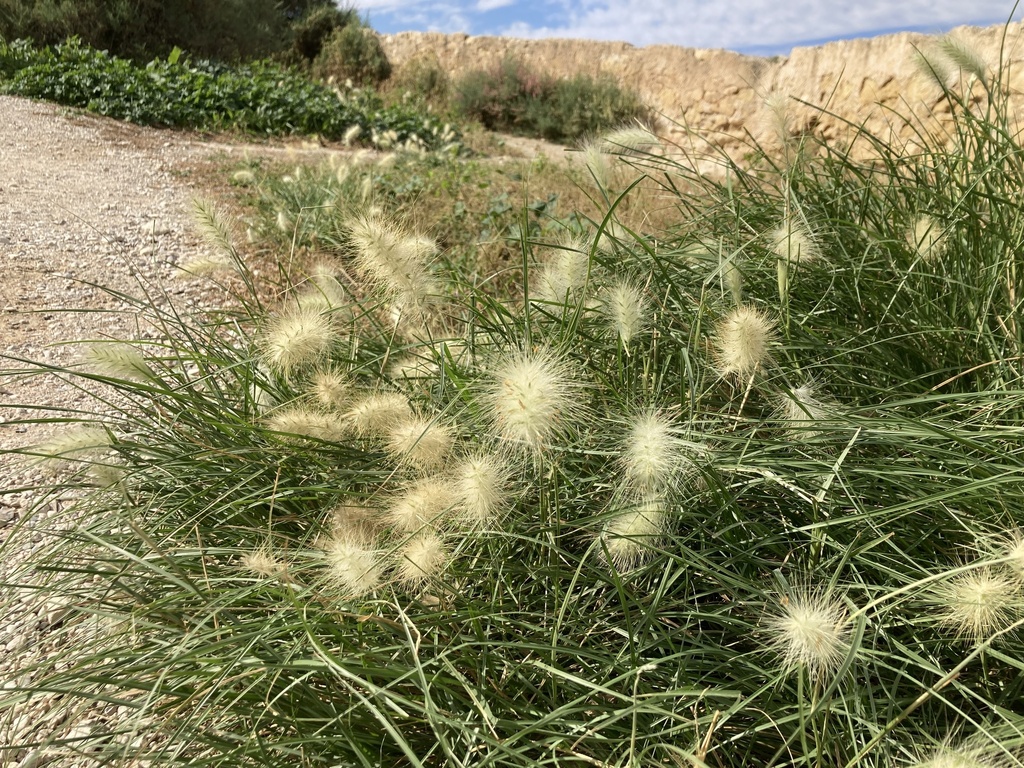
(c) Marc Riera, some rights reserved (CC BY) · licence
Family: Poaceae · Type: Grass · Not Native
Conservation status: Cal-IPC Yes
Pennisetum villosum (Feathertop) is a non-native California grass in the Poaceae family, recognized by distinctive plumose bristles and white coloration.
Feathertop is a naturalized perennial grass found in southern California, San Francisco Bay Area, south coastal ranges, southwestern California, and desert regions at elevations below 200 meters in disturbed areas. Flowering from June to August, this plant produces white to light brown feathery panicle-like inflorescences 2 to 10 centimeters long with delicate bristles up to 5 centimeters long. Growing in dense clumps from elongated rhizomes, it reaches 1.6 to 7.5 decimeters tall with erect stems. Its leaf blades are 5 to 40 centimeters long, 2 to 4.5 millimeters wide, and can be flat or slightly folded with surfaces ranging from glabrous to hairy. The spikelet is 9 to 12 millimeters long, with green to white coloration and distinctive plumose bristles that give the plant its characteristic feathery appearance.
Identification and appearance
Key characters: 3 sympatric species; distinctive plumose bristles and white coloration
Habitat and range
Habitat: Disturbed areas
Elevation: < 200 m
California counties: Los Angeles, San Diego, Alameda, Ventura, Orange, Riverside, Santa Barbara, San Luis Obispo, Marin, San Francisco, San Mateo, Santa Cruz, Santa Clara, San Benito, El Dorado, Contra Costa, Tuolumne, Monterey
Outside California: to eastern United States, native to Africa
Bloom period
Pennisetum villosum blooms Jun-Aug.
Conservation status
Cal-IPC Yes
How to tell it apart
vs Setaria: In Pennisetum the bristles beneath each spikelet fall attached to the spikelet as one unit; in bristlegrass the bristles stay behind on the axis when the seed drops.; vs Cenchrus: Pennisetum bristles are free and plumose, giving a soft fountain-like brush; Cenchrus bristles fuse into a hard spiny burr that clings to fur and clothing.; vs Polypogon: Pennisetum spikes bear fascicles of naked bristles subtending the spikelets; rabbitsfoot grass has soft awned glumes rather than bristle clusters.; vs Phleum: Pennisetum has a bristly, often colorful brush-like spike; timothy is a dense cylindric spike of awn-tipped glumes with no bristle fascicles.; vs Alopecurus: Pennisetum spikelets sit in bristly clusters that shed as a unit; foxtail has soft single spikelets with glumes joined at the base.
Frequently asked questions
Is Pennisetum villosum native to California?
No. Pennisetum villosum is not native to California (recorded as not native).
When does Pennisetum villosum bloom?
Pennisetum villosum blooms Jun-Aug.
Where in California does Pennisetum villosum grow?
Pennisetum villosum occurs in Los Angeles, San Diego, Alameda, Ventura, Orange, Riverside, Santa Barbara, San Luis Obispo and other counties, at elevations of < 200 m.
What plant family does Pennisetum villosum belong to?
Pennisetum villosum is in the Poaceae family, genus Pennisetum.
Is Pennisetum villosum invasive in California?
Pennisetum villosum is listed by Cal-IPC with an invasiveness rating of Yes.
Related species
Other California species in the same genus, family, or bioregion.
- Pennisetum ciliare — Buffel grass
- Pennisetum clandestinum — Kikuyu grass
- Pennisetum setaceum — Crimson fountain grass
- Pennisetum sp. — Fountain grass
- Phalaris angusta — Timothy canary grass
- Phalaris aquatica — Harding grass
- Phalaris arundinacea — Reed canary grass
- Phalaris brachystachys — Short-spiked canary grass
Sources: Jepson eFlora · Index of California Plant Names · CalPhotos
Last updated 2026-10-07
Data from The California Species Project — 14,000+ California species with verified data from CNPS, CDFW, USFWS, Cal-IPC, and more.