Penstemon clevelandii var. connatus
San jacinto beardtongue
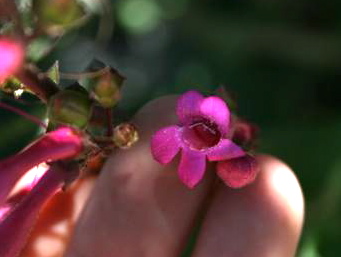
Photo: parent species Penstemon clevelandii · Photo by Chez Brungraber
Family: Plantaginaceae · Type: Subshrub · Native
Conservation status: CNPS 4.3
Penstemon clevelandii var. connatus (San jacinto beardtongue) is a native California subshrub in the Plantaginaceae family, recognized by fused leaf bases around stem diagnostic.
San jacinto beardtongue is a California native perennial ranked 4.3 by CNPS, found on the eastern slopes of the Santa Rosa Mountains in the eastern Peninsular Ranges in rocky hillsides, rock crevices, creosote-bush scrub, juniper and pinyon woodland, and chaparral at elevations of 400 to 1,700 meters. Flowering from March to May, this plant produces bright pink flowers with corolla 19 to 22 millimeters long, creating a vibrant display against rocky landscapes. Growing with stems where the upper leaf bases uniquely fuse around the stem, it forms compact clusters in rugged terrain. Its leaves are sharply serrate, creating a distinctive textured appearance along the stem. The plant's staminode is slightly hairy, adding to its delicate botanical character.
Identification and appearance
Key characters: 11 sympatric species; fused leaf bases around stem diagnostic
Habitat and range
Habitat: Rocky hillsides, rock crevices in creosote-bush scrub, juniper/pinyon woodland, chaparral
Elevation: 400-1700 m
California counties: Riverside, San Diego, San Bernardino
Bloom period
Penstemon clevelandii var. connatus blooms Mar-May.
Conservation status
CNPS 4.3
How to tell it apart
vs Epilobium: Penstemon has tubular two-lipped flowers with five stamens; Epilobium has four-petaled open flowers with eight stamens.; vs Keckiella: Penstemon is herbaceous and dies back; Keckiella has persistent woody stems year-round.; vs Salvia: Penstemon has five stamens (one sterile); Salvia has only two fertile stamens and square stems.; vs Ipomopsis: Penstemon has two-lipped tubular flowers; Ipomopsis has star-shaped flowers with five equal lobes.; vs Antirrhinum: Penstemon has a sterile stamen visible inside; Antirrhinum has only four stamens, none sterile.
Frequently asked questions
Is Penstemon clevelandii var. connatus native to California?
Yes. Penstemon clevelandii var. connatus is native to California (recorded as native).
When does Penstemon clevelandii var. connatus bloom?
Penstemon clevelandii var. connatus blooms Mar-May.
Where in California does Penstemon clevelandii var. connatus grow?
Penstemon clevelandii var. connatus occurs in Riverside, San Diego, San Bernardino, at elevations of 400-1700 m.
What plant family does Penstemon clevelandii var. connatus belong to?
Penstemon clevelandii var. connatus is in the Plantaginaceae family, genus Penstemon.
Is Penstemon clevelandii var. connatus rare or endangered?
Penstemon clevelandii var. connatus carries California Rare Plant Rank 4.3, state rank S3.
Related species
Other California species in the same genus, family, or bioregion.
- Penstemon clevelandii var. mohavensis — Mohave beard's tongue
- Penstemon davidsonii var. davidsonii — Davidson's beardtongue
- Penstemon deustus — Hot-rock penstemon
- Penstemon deustus var. deustus — Scabland penstemon
- Penstemon deustus var. pedicellatus — Hot rock beardtongue
- Penstemon deustus var. suffrutescens — Hot rock beardtongue
Sources: Jepson eFlora · CNPS Rare Plant Inventory · Index of California Plant Names · CalPhotos · CDFW CNDDB
Last updated 2026-10-07
Data from The California Species Project — 14,000+ California species with verified data from CNPS, CDFW, USFWS, Cal-IPC, and more.