Penstemon deustus var. pedicellatus
Hot rock beardtongue
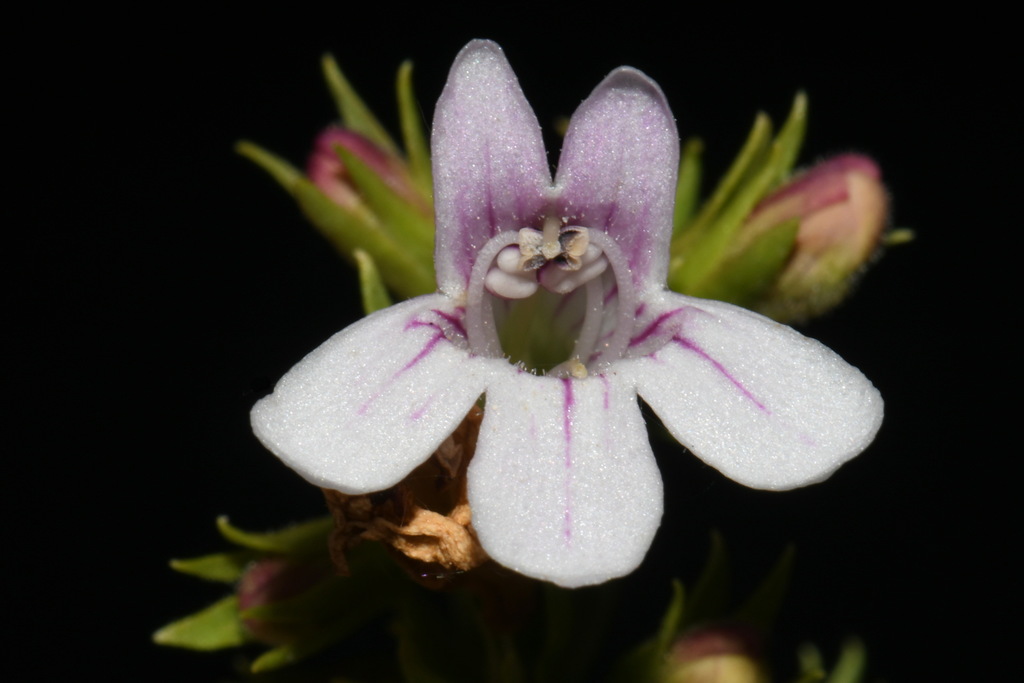
(c) Brian Finzel, some rights reserved (CC BY-SA), uploaded by Brian Finzel · licence
Family: Plantaginaceae · Type: Subshrub · Native
Penstemon deustus var. pedicellatus (Hot rock beardtongue) is a native California subshrub in the Plantaginaceae family, recognized by narrow lanceolate leaves and brown upper lip distinctive.
Hot rock beardtongue is a California native shrub found in the northern Sierra Nevada Mountains, Modoc Plateau, and high-elevation regions of sagebrush scrub and pinyon-juniper woodland at elevations of 900 to 3,000 meters. Flowering from May to July, this plant produces flowers with an unusual brown-tinted upper lip, set against pale petals approximately 10 to 12 millimeters long. Growing with erect stems and a compact structure, it forms dense clusters in rocky, high-elevation landscapes. Its leaves are distinctively narrow and lanceolate, measuring 2.5 to 8 millimeters wide, with a sharp, angular presentation. The plant's delicate calyx, measuring 2.5 to 5 millimeters long, features sharply pointed lanceolate lobes that contribute to its distinctive alpine appearance.
Identification and appearance
Key characters: 38 sympatric species; narrow lanceolate leaves and brown upper lip distinctive
Habitat and range
Habitat: Sagebrush scrub, pinyon/juniper woodland, yellow-pine and montane forests
Elevation: 900-3000 m
California counties: Lassen, Inyo, Mono, Sierra, Modoc, Shasta, Plumas, Siskiyou, Placer, Alpine, Nevada, El Dorado, Butte, Tuolumne
Outside California: Oregon, Nevada, Utah
Bloom period
Penstemon deustus var. pedicellatus blooms May-Jul.
How to tell it apart
vs Epilobium: Penstemon has tubular two-lipped flowers with five stamens; Epilobium has four-petaled open flowers with eight stamens.; vs Keckiella: Penstemon is herbaceous and dies back; Keckiella has persistent woody stems year-round.; vs Salvia: Penstemon has five stamens (one sterile); Salvia has only two fertile stamens and square stems.; vs Ipomopsis: Penstemon has two-lipped tubular flowers; Ipomopsis has star-shaped flowers with five equal lobes.; vs Antirrhinum: Penstemon has a sterile stamen visible inside; Antirrhinum has only four stamens, none sterile.
Frequently asked questions
Is Penstemon deustus var. pedicellatus native to California?
Yes. Penstemon deustus var. pedicellatus is native to California (recorded as native).
When does Penstemon deustus var. pedicellatus bloom?
Penstemon deustus var. pedicellatus blooms May-Jul.
Where in California does Penstemon deustus var. pedicellatus grow?
Penstemon deustus var. pedicellatus occurs in Lassen, Inyo, Mono, Sierra, Modoc, Shasta, Plumas, Siskiyou and other counties, at elevations of 900-3000 m.
What plant family does Penstemon deustus var. pedicellatus belong to?
Penstemon deustus var. pedicellatus is in the Plantaginaceae family, genus Penstemon.
What habitat does Penstemon deustus var. pedicellatus grow in?
Penstemon deustus var. pedicellatus grows in Sagebrush scrub, pinyon/juniper woodland, yellow-pine and montane forests.
Related species
Other California species in the same genus, family, or bioregion.
Sources: Jepson eFlora · Index of California Plant Names · CalPhotos
Last updated 2026-10-07
Data from The California Species Project — 14,000+ California species with verified data from CNPS, CDFW, USFWS, Cal-IPC, and more.