Pentagramma triangularis
Goldback fern
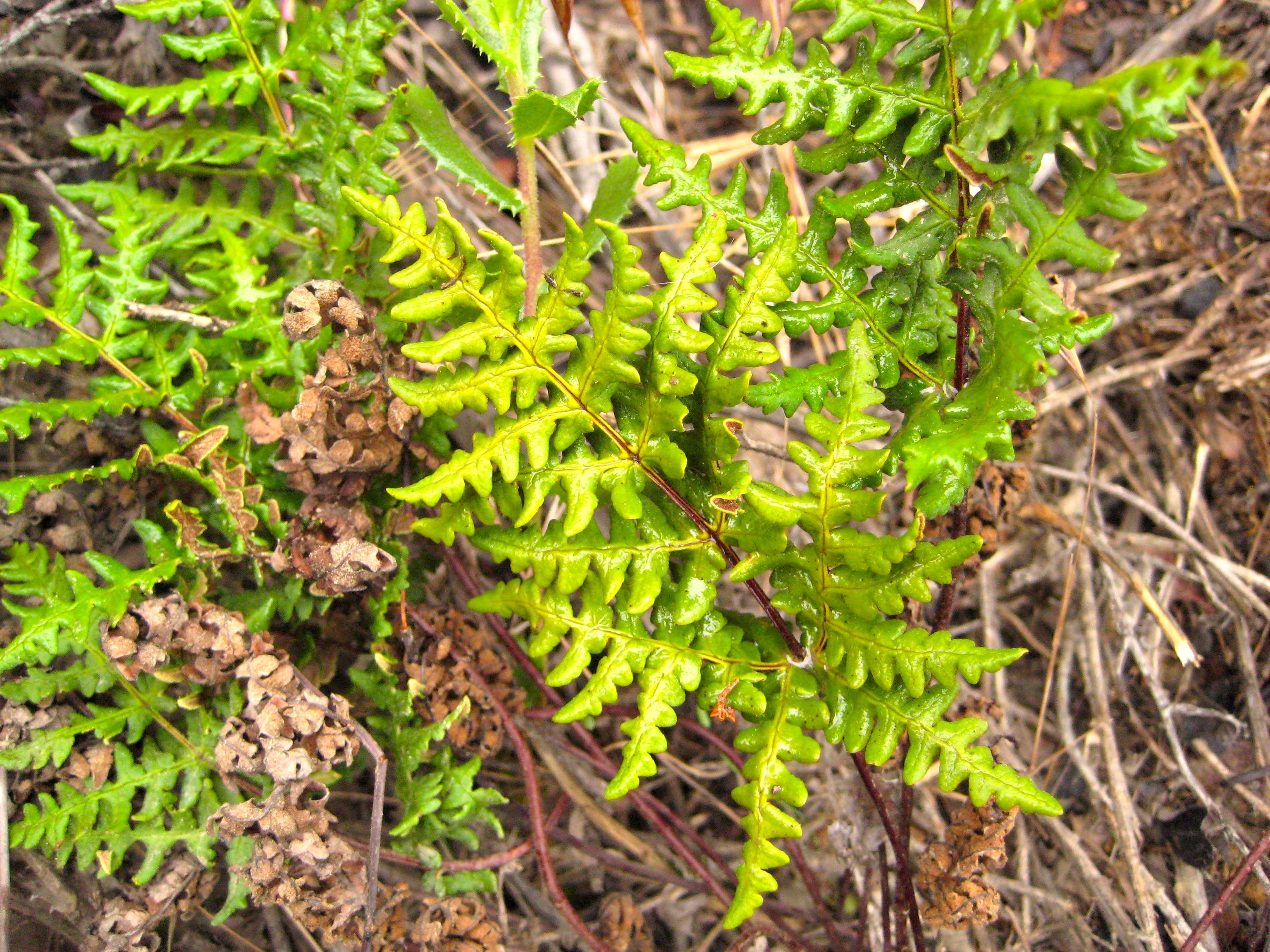
Photo by Chez Brungraber
Family: Pteridaceae · Type: Herb · Native
Pentagramma triangularis (Goldback fern) is a native California herb in the Pteridaceae family, recognized by glabrous adaxial surface and yellow abaxial exudate diagnostic.
Goldback fern is a California native perennial found in the California Floristic Province, Modoc Plateau, Sierra Nevada Eastern Boundary, and Desert Mountains, commonly growing in shaded, sometimes rocky or wooded areas at elevations below 2,300 meters. This distinctive fern features yellow to cream exudate on its underside, creating a distinctive golden sheen on its fronds. Growing with a rhizomatous root system, the fern produces delicate fronds with proximal pinnae 2 to 6 centimeters long, with pinnules that are pinnately lobed on the basal side of the lowest pinnae. Its leaf blades are smooth and glabrous on the upper surface, with margins that remain flat rather than curling under. The fern's unique coloration and growth pattern makes it a striking feature in its native habitats, with scales at the rhizome tip adding to its intricate botanical character.
Identification and appearance
Key characters: 5 sympatric species; glabrous adaxial surface and yellow abaxial exudate diagnostic
Habitat and range
Habitat: Common. Generally shaded, sometimes rocky or wooded areas
Elevation: < 2300 m
California counties: Ventura, Santa Barbara, Riverside, San Bernardino, San Diego, Los Angeles, Marin, Mendocino, Monterey, Placer, Santa Clara, Tulare, Glenn, Inyo, Kern, Orange, Santa Cruz, Shasta, Humboldt, Madera, Mono, San Benito, Mariposa, Sonoma, Solano, Tuolumne, San Luis Obispo, Lake, Butte, Tehama, Fresno, Trinity, Amador, Contra Costa, San Mateo, Napa, Sacramento, Merced, Kings, El Dorado, San Francisco, Sutter, Sierra, Plumas, Del Norte, Alameda, Siskiyou, Calaveras, Colusa, Yuba, Nevada, Yolo, Stanislaus
Outside California: to British Columbia, Idaho, Nevada, Utah, Baja California
How to tell it apart
vs Pteridium: Pentagramma is small (<30 cm) and stays in rock crevices; Pteridium is tall (>50 cm) and spreads in open areas.; vs Polypodium: Pentagramma fronds are finely divided multiple times; Polypodium fronds are simple with one row of undivided leaflets.; vs Dryopteris: Pentagramma has golden/silver coating underneath; Dryopteris undersides are green with kidney-shaped spore covers.; vs Aspidotis: Pentagramma segments attach broadly; Aspidotis segments are bead-like with edges rolled under to protect spores.; vs Myriopteris: Pentagramma undersides are smooth or waxy; Myriopteris undersides are fuzzy with hairs or scales.
Frequently asked questions
Is Pentagramma triangularis native to California?
Yes. Pentagramma triangularis is native to California (recorded as native).
Where in California does Pentagramma triangularis grow?
Pentagramma triangularis occurs in Ventura, Santa Barbara, Riverside, San Bernardino, San Diego, Los Angeles, Marin, Mendocino and other counties, at elevations of < 2300 m.
What plant family does Pentagramma triangularis belong to?
Pentagramma triangularis is in the Pteridaceae family, genus Pentagramma.
What habitat does Pentagramma triangularis grow in?
Pentagramma triangularis grows in Common. Generally shaded, sometimes rocky or wooded areas.
Related species
Other California species in the same genus, family, or bioregion.
- Pentagramma viscosa — Coastal silverback fern
- Pentagramma glanduloviscida — San diego silverback fern
- Pentagramma maxonii — Desert silverback fern
- Pentagramma pallida — Frosty silverback fern
- Pentagramma rebmanii — Rebman's silverback fern
- Pentagramma sp. — Goldback or silverback fern
- Pteridaceae sp. — Brake family
- Pteris cretica — Cretan brake
- Pteris sp. — Brake
Sources: Jepson eFlora · Index of California Plant Names · CalPhotos
Last updated 2026-10-07
Data from The California Species Project — 14,000+ California species with verified data from CNPS, CDFW, USFWS, Cal-IPC, and more.