Persicaria hydropiperoides
False waterpepper, False Waterpepper
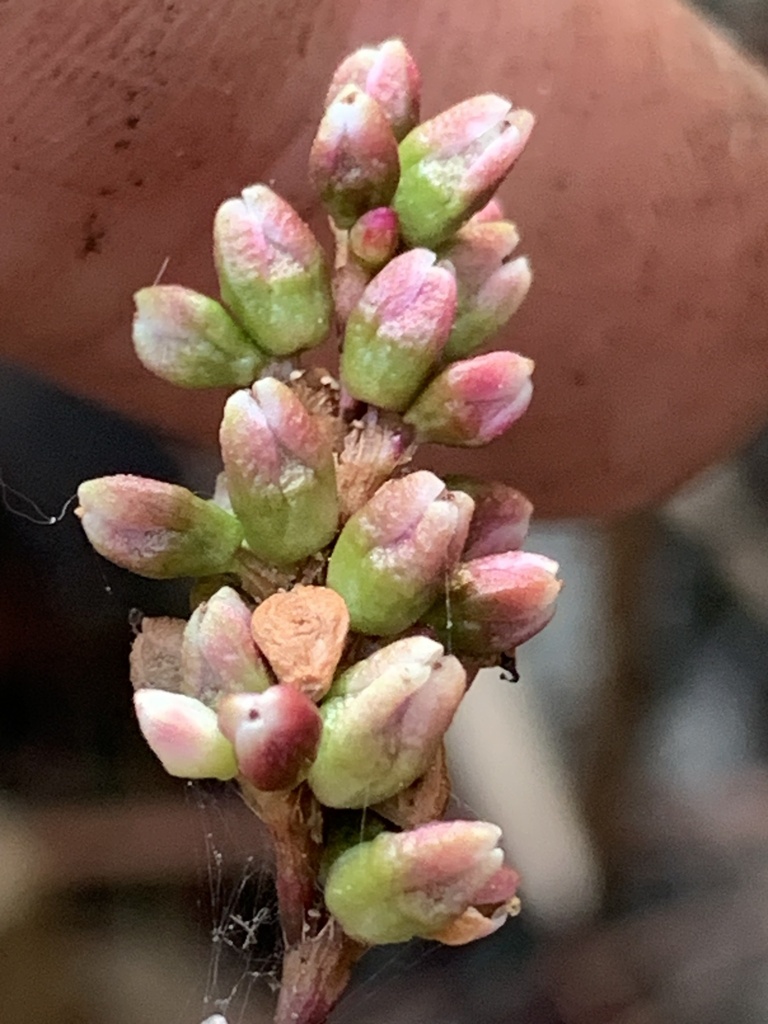
(c) James Hardee, some rights reserved (CC BY) · licence
Family: Polygonaceae · Type: Herb · Native
Persicaria hydropiperoides (False waterpepper) is a native California herb in the Polygonaceae family, recognized by very narrow spikes and long ocrea bristles distinctive.
False waterpepper is a California native perennial found in the California Floristic Province and southern Desert regions in wet banks, shallow water, marshes, and moist prairies at elevations below 1,500 meters. Flowering from June to October, this plant produces pink or white-green flowers in small clusters, each flower bell-shaped and about 2.5 to 4 millimeters long. Growing with decumbent to ascending stems 15 to 100 centimeters tall, it spreads through underground rhizomes and features a distinctive branching habit. Its linear to widely lanceolate leaves are 5 to 25 centimeters long, with brown cylindric stipules and occasionally gland-dotted leaf surfaces. The fruit is a shiny, three-angled structure 1.5 to 3 millimeters long, turning from brown to black when mature.
Identification and appearance
Key characters: 8 sympatric species; very narrow spikes and long ocrea bristles distinctive
Habitat and range
Habitat: Wet banks, shallow water, marshes, moist prairies
Elevation: < 1500 m
California counties: Ventura, Marin, Contra Costa, Inyo, Kern, Kings, Mariposa, Merced, Orange, Riverside, San Mateo, Santa Clara, Santa Cruz, Sutter, Tuolumne, Yuba, Butte, Fresno, Lake, Los Angeles, Mendocino, San Bernardino, San Joaquin, Sonoma, Glenn, Tehama, Siskiyou, Napa, Madera, San Diego, El Dorado, Sacramento, Amador
Outside California: to eastern North America, Mexico
Bloom period
Persicaria hydropiperoides blooms Jun-Oct.
How to tell it apart
vs Polygonum: Persicaria has opaque stem sheaths; Polygonum has translucent sheaths that split into two lobes.; vs Rumex: Persicaria has spike-like pink/white flower clusters; Rumex has branched greenish flower clusters.; vs Trifolium: Persicaria has spike/head flower clusters and papery stem sheaths; Trifolium has clover heads and no sheaths.; vs Salix: Persicaria is an herb with flower spikes; Salix is a woody shrub with catkins.; vs Phytolacca: Persicaria has small pink/white flowers in spikes; Phytolacca has white-green flowers and dark purple berries.
Frequently asked questions
Is Persicaria hydropiperoides native to California?
Yes. Persicaria hydropiperoides is native to California (recorded as native).
When does Persicaria hydropiperoides bloom?
Persicaria hydropiperoides blooms Jun-Oct.
Where in California does Persicaria hydropiperoides grow?
Persicaria hydropiperoides occurs in Ventura, Marin, Contra Costa, Inyo, Kern, Kings, Mariposa, Merced and other counties, at elevations of < 1500 m.
What plant family does Persicaria hydropiperoides belong to?
Persicaria hydropiperoides is in the Polygonaceae family, genus Persicaria.
What habitat does Persicaria hydropiperoides grow in?
Persicaria hydropiperoides grows in Wet banks, shallow water, marshes, moist prairies.
Related species
Other California species in the same genus, family, or bioregion.
Sources: Jepson eFlora · Index of California Plant Names · CalPhotos
Last updated 2026-10-07
Data from The California Species Project — 14,000+ California species with verified data from CNPS, CDFW, USFWS, Cal-IPC, and more.