Persicaria lapathifolia
Willow weed, Willow Weed
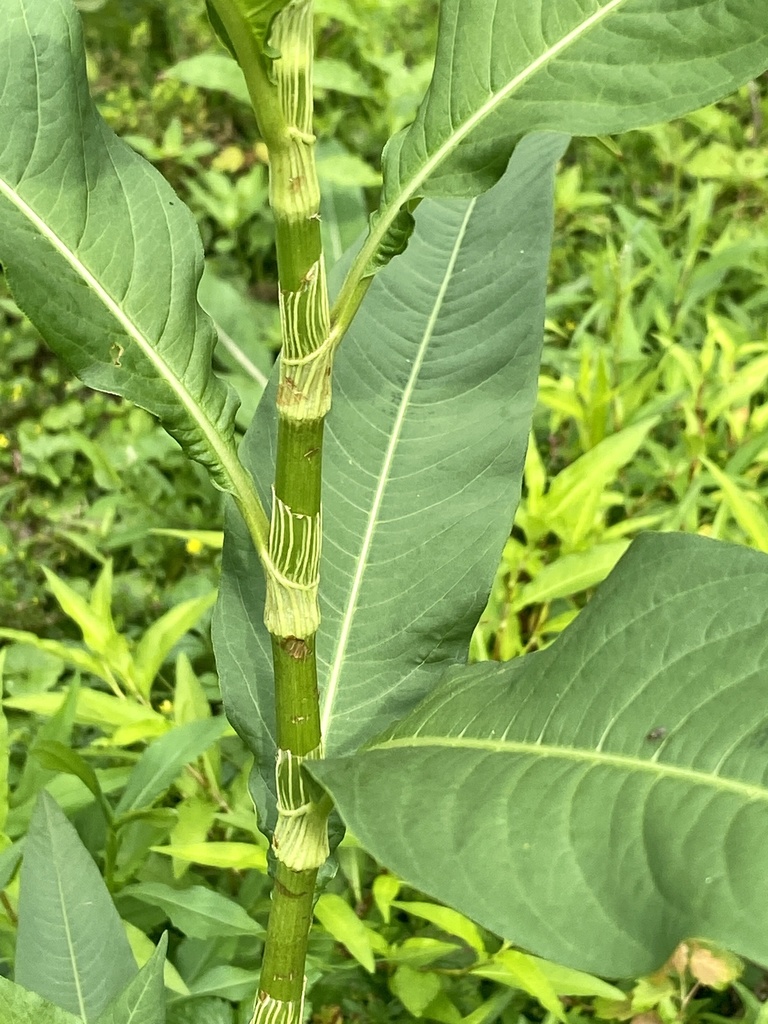
(c) Sandy Wolkenberg, some rights reserved (CC BY), uploaded by Sandy Wolkenberg · licence
Family: Polygonaceae · Type: Herb · Native
Persicaria lapathifolia (Willow weed) is a native California herb in the Polygonaceae family, recognized by short/absent ocrea bristles and anchor-shaped flower veins key.
Willow weed is a California native annual found in moist places, disturbed areas, roadsides, and fields at elevations below 1,500 meters. Flowering from June to October, this plant produces green-white to pink flowers in small nodding clusters 30 to 80 millimeters long. Growing with ascending to erect stems 10 to 100 centimeters tall that are glabrous or appressed-hairy, it has distinctive lance-shaped leaves 4 to 12 centimeters long with dark blotches on the upper surface. Its leaves have truncate brown ocreas (leaf sheaths) 4 to 25 millimeters long, with narrow to wide lanceolate blades that are strigose along the main veins. The fruit is a shiny brown to black lens-shaped achene 1.5 to 3.2 millimeters long.
Identification and appearance
Key characters: 8 sympatric species; short/absent ocrea bristles and anchor-shaped flower veins key
Habitat and range
Habitat: Moist places, disturbed areas, roadsides, fields
Elevation: < 1500 m
California counties: Glenn, Butte, Ventura, Santa Barbara, San Bernardino, Los Angeles, Orange, Shasta, Colusa, Plumas, San Diego, San Luis Obispo, Marin, Monterey, San Mateo, Santa Cruz, Alameda, Contra Costa, San Francisco, Calaveras, El Dorado, Fresno, Imperial, Mariposa, Mono, Nevada, Placer, Sacramento, Siskiyou, Solano, Tehama, Sutter, Tulare, Inyo, Kern, Kings, Lake, Mendocino, Merced, Riverside, San Joaquin, Santa Clara, Sonoma, Yuba, Lassen, Modoc, Trinity, Humboldt, Stanislaus, Del Norte, Tuolumne, Yolo, Napa
Outside California: North America, South America, Europe, Asia, Africa
Bloom period
Persicaria lapathifolia blooms Jun-Oct.
How to tell it apart
vs Polygonum: Persicaria has opaque stem sheaths; Polygonum has translucent sheaths that split into two lobes.; vs Rumex: Persicaria has spike-like pink/white flower clusters; Rumex has branched greenish flower clusters.; vs Trifolium: Persicaria has spike/head flower clusters and papery stem sheaths; Trifolium has clover heads and no sheaths.; vs Salix: Persicaria is an herb with flower spikes; Salix is a woody shrub with catkins.; vs Phytolacca: Persicaria has small pink/white flowers in spikes; Phytolacca has white-green flowers and dark purple berries.
Frequently asked questions
Is Persicaria lapathifolia native to California?
Yes. Persicaria lapathifolia is native to California (recorded as native).
When does Persicaria lapathifolia bloom?
Persicaria lapathifolia blooms Jun-Oct.
Where in California does Persicaria lapathifolia grow?
Persicaria lapathifolia occurs in Glenn, Butte, Ventura, Santa Barbara, San Bernardino, Los Angeles, Orange, Shasta and other counties, at elevations of < 1500 m.
What plant family does Persicaria lapathifolia belong to?
Persicaria lapathifolia is in the Polygonaceae family, genus Persicaria.
What habitat does Persicaria lapathifolia grow in?
Persicaria lapathifolia grows in Moist places, disturbed areas, roadsides, fields.
Related species
Other California species in the same genus, family, or bioregion.
Sources: Jepson eFlora · Index of California Plant Names · CalPhotos
Last updated 2026-10-07
Data from The California Species Project — 14,000+ California species with verified data from CNPS, CDFW, USFWS, Cal-IPC, and more.