Petasites frigidus var. palmatus
Western sweet coltsfoot, Western Sweet Coltsfoot
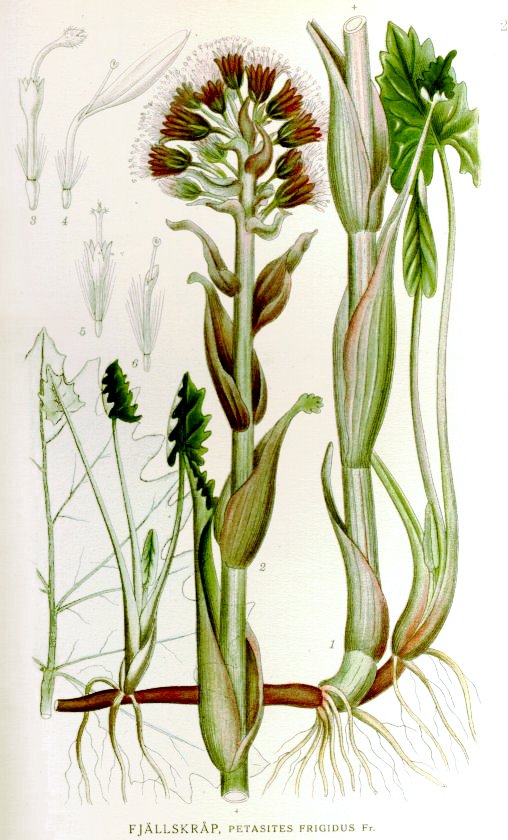
Carl Axel Magnus Lindman (via Wikimedia Commons) · CC0
Family: Asteraceae · Type: Herb · Native
Petasites frigidus var. palmatus (Western sweet coltsfoot) is a native California herb in the Asteraceae family, recognized by Circumboreal distribution, northern forest specialist.
Western sweet coltsfoot is a California native perennial found in northwestern California, northern Sierra Nevada, and northern and north-central Coast Ranges in forest and streambank habitats with wet soil at elevations below 1,400 meters. Flowering from January to April, this plant produces white to pale pink flowers in clusters with 10 to 20 heads, often with purple-tinged bell-shaped involucres. Growing with stems 20 to 80 centimeters tall, it develops distinctive large basal leaves 10 to 40 centimeters wide that are nearly round to heart-shaped with palmate lobes. Its broad leaves have a unique structure with coarsely toothed or lobed edges, appearing smooth on the upper surface and sometimes loosely woolly underneath. The plant produces small fruits 3 to 4.5 millimeters long with a feathery pappus 6 to 13 millimeters long.
Identification and appearance
Key characters: Circumboreal distribution, northern forest specialist
Habitat and range
Habitat: Forest, streambanks, generally wet soil
Elevation: < 1400 m
Outside California: to Yukon Territory, eastern Canada, northeastern United States
Bloom period
Petasites frigidus var. palmatus blooms Jan-Apr.
How to tell it apart
vs Heracleum: Heracleum has compound umbel flowers and celery-scented leaves; Petasites has composite flower heads.; vs Darmera: Darmera flowers appear before leaves on naked stalks; Petasites flowers have sheathing stem leaves present.; vs Tussilago: Tussilago leaves are rounded with shallow lobes; Petasites leaves are deeply palmately divided.; vs Hydrophyllum: Hydrophyllum has bell-shaped flowers in coiled clusters; Petasites has composite flower heads.; vs Psacalium: Psacalium leaves have blades on flowering stems; Petasites stem leaves are bladeless sheaths.
Frequently asked questions
Is Petasites frigidus var. palmatus native to California?
Yes. Petasites frigidus var. palmatus is native to California (recorded as native).
When does Petasites frigidus var. palmatus bloom?
Petasites frigidus var. palmatus blooms Jan-Apr.
What plant family does Petasites frigidus var. palmatus belong to?
Petasites frigidus var. palmatus is in the Asteraceae family, genus Petasites.
What habitat does Petasites frigidus var. palmatus grow in?
Petasites frigidus var. palmatus grows in Forest, streambanks, generally wet soil.
Related species
Other California species in the same genus, family, or bioregion.
Sources: Jepson eFlora · Index of California Plant Names · CalPhotos
Last updated 2026-10-07
Data from The California Species Project — 14,000+ California species with verified data from CNPS, CDFW, USFWS, Cal-IPC, and more.