Petradoria pumila var. pumila
Rock-goldenrod
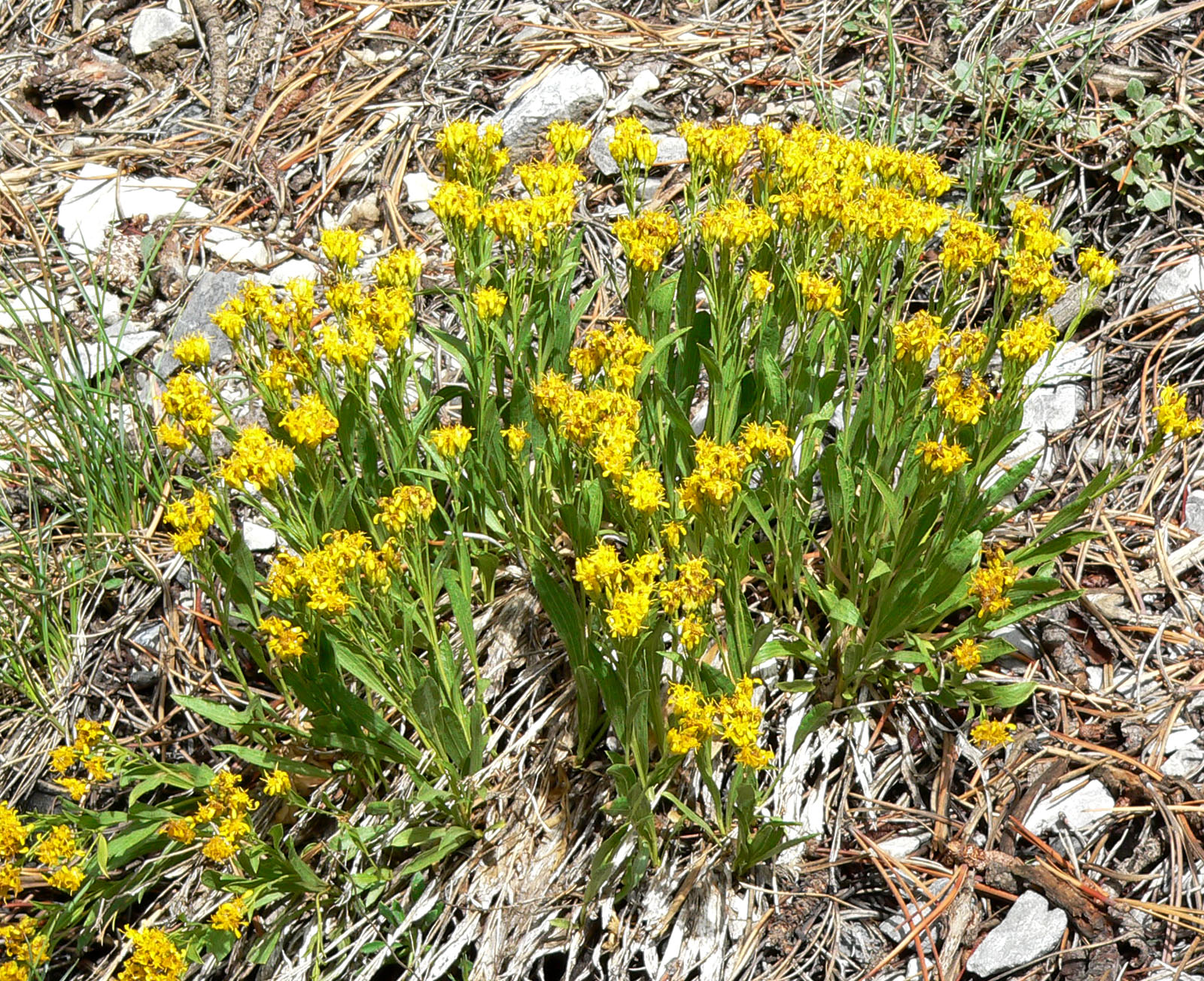
Stan Shebs (via Wikimedia Commons) · CC BY-SA
Family: Asteraceae · Type: Perennial · Native
Conservation status: CNPS 4.3
Petradoria pumila var. pumila (Rock-goldenrod) is a native California perennial in the Asteraceae family, recognized by No sympatric species - geographically isolated. Key features include woody-based perennial habit, resin-dotted leaves, and small yellow….
Rock-goldenrod is a California native perennial ranked 4.3 by CNPS, found in the desert mountains in rocky soils, pine forest, and juniper scrub, often on limestone at elevations of 1,050 to 3,400 meters. Flowering from July to October, this plant produces yellow ray flowers in dense, flat-topped clusters with heads less than 10 millimeters wide. Growing less than 30 centimeters tall with several erect stems that are green and become white to tan with age, it develops from a branched, woody base. Its alternate leaves are linear to lance-shaped, 2 to 12 centimeters long, leathery and resin-dotted with scabrous margins. The fruit is 4 to 5 millimeters long with thread-like tan to brown pappus bristles.
Identification and appearance
Key characters: No sympatric species - geographically isolated. Key features include woody-based perennial habit, resin-dotted leaves, and small yellow flower heads in flat-topped clusters.
Habitat and range
Habitat: Rocky soils, pine forest, juniper scrub, often on limestone
Elevation: 1050-3400 m
California counties: San Bernardino, San Benito
Outside California: to Idaho, Wyoming, New Mexico
Bloom period
Petradoria pumila var. pumila blooms Jul-Oct.
Conservation status
CNPS 4.3
How to tell it apart
vs Solidago: Petradoria has phyllaries in vertical ranks on desert limestone; Solidago has overlapping phyllaries in various habitats.; vs Xanthisma: Petradoria has shingle-like phyllaries in vertical columns; Xanthisma has standard overlapping phyllaries.; vs Tonestus: Petradoria restricted to desert limestone with vertical-ranked phyllaries; Tonestus in alpine areas with overlapping phyllaries.; vs Pyrrocoma: Petradoria is desert-only with phyllaries in vertical ranks; Pyrrocoma grows in alpine areas with angled fruits.; vs Euthamia: Petradoria has vertical-ranked phyllaries in deserts; Euthamia has flat-topped clusters in wetlands.
Frequently asked questions
Is Petradoria pumila var. pumila native to California?
Yes. Petradoria pumila var. pumila is native to California (recorded as native).
When does Petradoria pumila var. pumila bloom?
Petradoria pumila var. pumila blooms Jul-Oct.
Where in California does Petradoria pumila var. pumila grow?
Petradoria pumila var. pumila occurs in San Bernardino, San Benito, at elevations of 1050-3400 m.
What plant family does Petradoria pumila var. pumila belong to?
Petradoria pumila var. pumila is in the Asteraceae family, genus Petradoria.
Is Petradoria pumila var. pumila rare or endangered?
Petradoria pumila var. pumila carries California Rare Plant Rank 4.3, state rank S4?.
Related species
Other California species in the same genus, family, or bioregion.
Sources: Jepson eFlora · CNPS Rare Plant Inventory · Index of California Plant Names · CalPhotos
Last updated 2026-09-26
Data from The California Species Project — 14,000+ California species with verified data from CNPS, CDFW, USFWS, Cal-IPC, and more.