Phacelia cicutaria var. cicutaria
Caterpillar phacelia
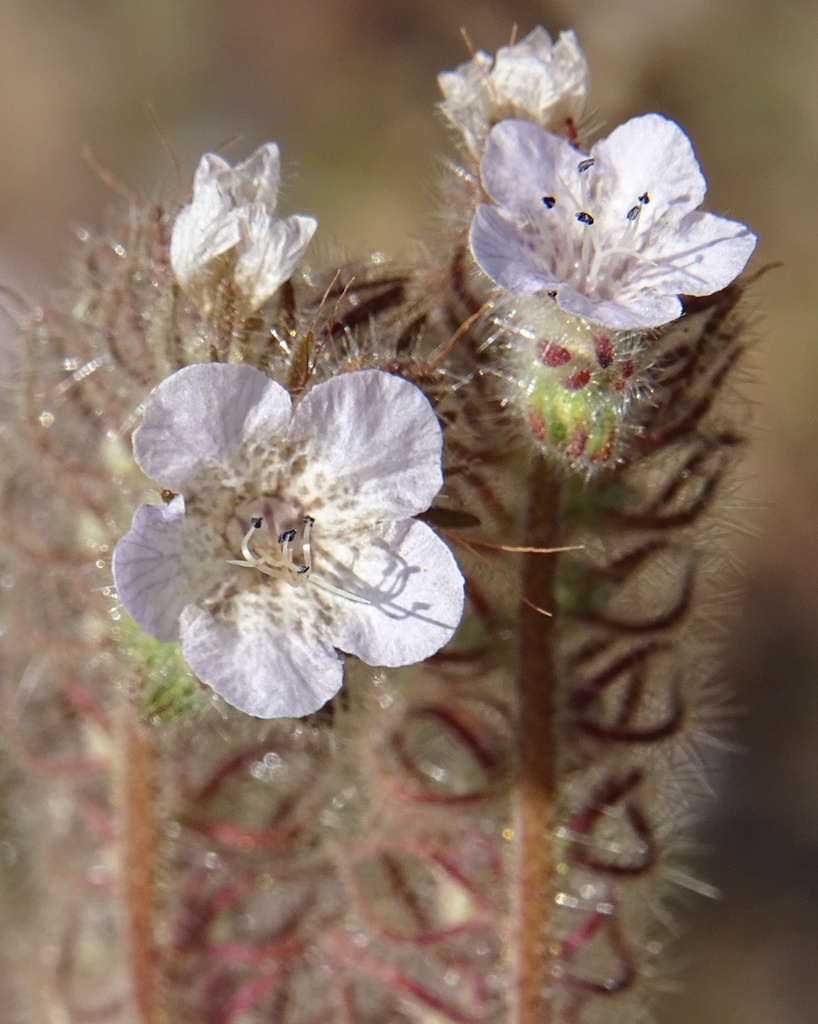
(c) Jesse Rorabaugh, some rights reserved (CC BY), uploaded by Jesse Rorabaugh · licence
Family: Hydrophyllaceae · Type: Herb · Native
Phacelia cicutaria var. cicutaria (Caterpillar phacelia) is a native California herb in the Hydrophyllaceae family, recognized by Yellow-white corolla + pale calyx hairs; SNF/c SNH/Teh (vs lavender, gray-haired var. *hispida*).
Caterpillar phacelia is a California native annual found in the central Sierra Nevada, Tehachapi, and Sierra Nevada Foothills in rocky slopes, oak and pine woodlands, and grasslands at elevations below 1,400 meters. Flowering from February to June, this plant produces distinctive white to yellow flowers with long, stiff hairy calyx lobes. Growing with delicate, branching stems typically 10 to 40 centimeters tall, it spreads in loose, open clusters across its habitat. Its leaves are deeply dissected, with finely divided leaflets that give the plant a feathery, lacy appearance. The flowers have a soft, dirty-white to yellow coloration that blends subtly with its surrounding rocky or woodland environment.
Identification and appearance
Key characters: Yellow-white corolla + pale calyx hairs; SNF/c SNH/Teh (vs lavender, gray-haired var. *hispida*)
Habitat and range
Habitat: Rocky slopes, oak/pine woodland, grassland
Elevation: < 1400 m
California counties: Kern, Fresno, Mariposa, Alameda, Butte, Calaveras, Madera, Monterey, Inyo, El Dorado, Stanislaus, Tulare, Amador, Nevada, Yuba, Tehama, Tuolumne, Contra Costa, San Luis Obispo, Santa Barbara, Ventura, Merced, San Diego, Sacramento
Bloom period
Phacelia cicutaria var. cicutaria blooms Feb-Jun.
How to tell it apart
vs Nemophila: Phacelia has flowers in coiled scorpion-tail clusters; Nemophila has solitary showy flowers at leaf axils.; vs Eucrypta: Phacelia is typically non-sticky with seeds that fall out cleanly; Eucrypta feels very sticky and retains 1-2 seeds in fruit.; vs Pholistoma: Phacelia has coiled flower clusters; Pholistoma has flowers scattered along stems with backward-pointing stem bristles.; vs Echium: Phacelia has coiled clusters of small flowers; Echium has large showy blue-purple flowers in tall spike-like clusters.; vs Gilia: Phacelia has coiled flower clusters and bristly foliage; Gilia has flowers in round heads or loose clusters with smoother foliage.
Frequently asked questions
Is Phacelia cicutaria var. cicutaria native to California?
Yes. Phacelia cicutaria var. cicutaria is native to California (recorded as native).
When does Phacelia cicutaria var. cicutaria bloom?
Phacelia cicutaria var. cicutaria blooms Feb-Jun.
Where in California does Phacelia cicutaria var. cicutaria grow?
Phacelia cicutaria var. cicutaria occurs in Kern, Fresno, Mariposa, Alameda, Butte, Calaveras, Madera, Monterey and other counties, at elevations of < 1400 m.
What plant family does Phacelia cicutaria var. cicutaria belong to?
Phacelia cicutaria var. cicutaria is in the Hydrophyllaceae family, genus Phacelia.
What habitat does Phacelia cicutaria var. cicutaria grow in?
Phacelia cicutaria var. cicutaria grows in Rocky slopes, oak/pine woodland, grassland.
Related species
Other California species in the same genus, family, or bioregion.
Sources: Jepson eFlora · Index of California Plant Names · CalPhotos
Last updated 2026-10-07
Data from The California Species Project — 14,000+ California species with verified data from CNPS, CDFW, USFWS, Cal-IPC, and more.