Phalaris arundinacea
Reed canary grass
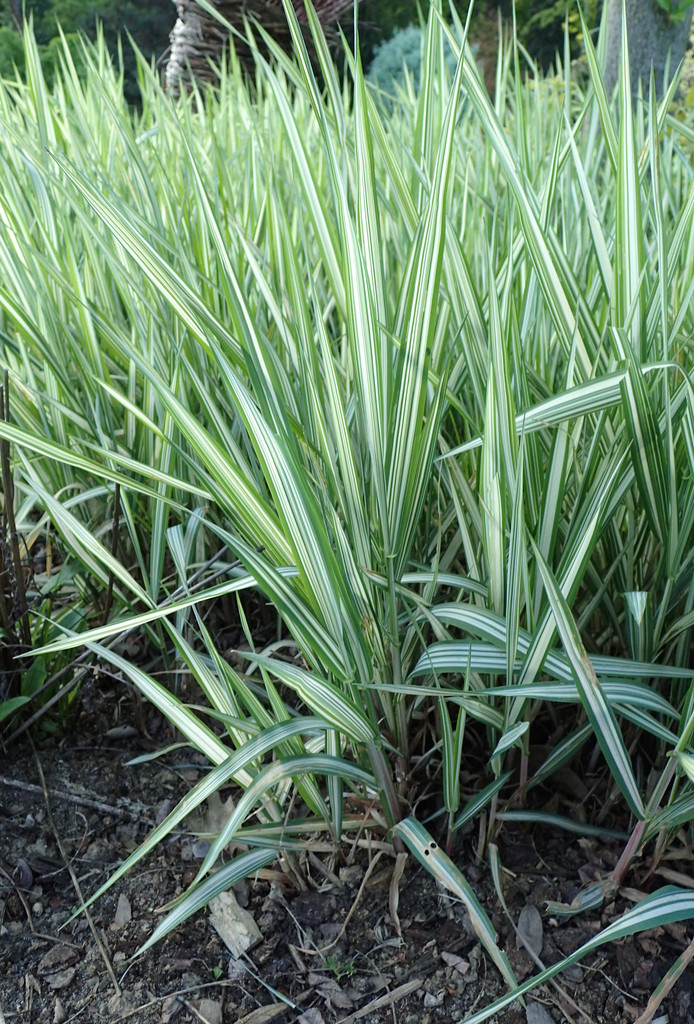
(c) Krzysztof Ziarnek, Kenraiz, some rights reserved (CC BY-SA) · licence
Family: Poaceae · Type: Grass · Native
Phalaris arundinacea (Reed canary grass) is a native California grass in the Poaceae family, recognized by colonial habit from rhizomes and large branched inflorescence.
Reed canary grass is a California native perennial found in northwestern California, the Cascade Range, Sierra Nevada, Great Valley, southern Coast Ranges, North Coast, White and Inyo Mountains, and Mojave Desert in moist woodland habitats at elevations below 1,700 meters. Flowering from May to September, this plant produces pale green to purple-tinged flowers in dense, branching clusters 5 to 40 centimeters long. Growing with robust rhizomatous stems 50 to 250 centimeters tall, it forms extensive spreading patches in wet environments. Its leaves are long, flat, and bright green, with blades typically 10 to 20 millimeters wide, arranged alternately along the stem. The delicate flower clusters have a distinctive feathery texture, with small sterile lemmas creating a soft, purplish appearance.
Identification and appearance
Key characters: 10 sympatric species; key features are colonial habit from rhizomes and large branched inflorescence
Habitat and range
Habitat: Moist habitats, woodland
Elevation: < 1700 m
California counties: Fresno, Los Angeles, San Joaquin, Solano, Mendocino, Lake, Plumas, Lassen, Inyo, Alameda, Modoc, Mono, San Diego, Sonoma, Madera, El Dorado, Contra Costa, Merced, Nevada, Sierra, Siskiyou, Tulare, Shasta, Alpine, Humboldt, Kings, Placer, Yuba, Butte, Del Norte, Marin, Trinity, Tuolumne, Kern, Yolo, Sacramento, Tehama, Santa Cruz
Outside California: temperate North America, Eurasia
Bloom period
Phalaris arundinacea blooms May-Sep.
How to tell it apart
vs Phleum: Phalaris has an ovate to oblong spike-like panicle with keeled, often winged glumes; timothy is a slender cylindric spike with short-awned, stiffly ciliate-keeled glumes.; vs Alopecurus: Phalaris glumes are free and winged and the shiny fertile lemma is flanked by tiny sterile scales; foxtail has glumes joined at the base and a single awned lemma.; vs Anthoxanthum: Both are spike-like, but sweet vernalgrass smells of coumarin and has two awned sterile lemmas; Phalaris is scentless with reduced scale-like sterile florets.; vs Setaria: Phalaris spikes lack bristles entirely; bristlegrass spikelets are each subtended by persistent bristles.; vs Beckmannia: Phalaris spikelets carry prominent winged glumes; sloughgrass has small round, laterally flattened spikelets crowded on one-sided spikes.
Frequently asked questions
Is Phalaris arundinacea native to California?
Yes. Phalaris arundinacea is native to California (recorded as native).
When does Phalaris arundinacea bloom?
Phalaris arundinacea blooms May-Sep.
Where in California does Phalaris arundinacea grow?
Phalaris arundinacea occurs in Fresno, Los Angeles, San Joaquin, Solano, Mendocino, Lake, Plumas, Lassen and other counties, at elevations of < 1700 m.
What plant family does Phalaris arundinacea belong to?
Phalaris arundinacea is in the Poaceae family, genus Phalaris.
What habitat does Phalaris arundinacea grow in?
Phalaris arundinacea grows in Moist habitats, woodland.
Related species
Other California species in the same genus, family, or bioregion.
Sources: Jepson eFlora · Index of California Plant Names · CalPhotos
Last updated 2026-10-07
Data from The California Species Project — 14,000+ California species with verified data from CNPS, CDFW, USFWS, Cal-IPC, and more.