Phalaris caroliniana
Carolina canary grass
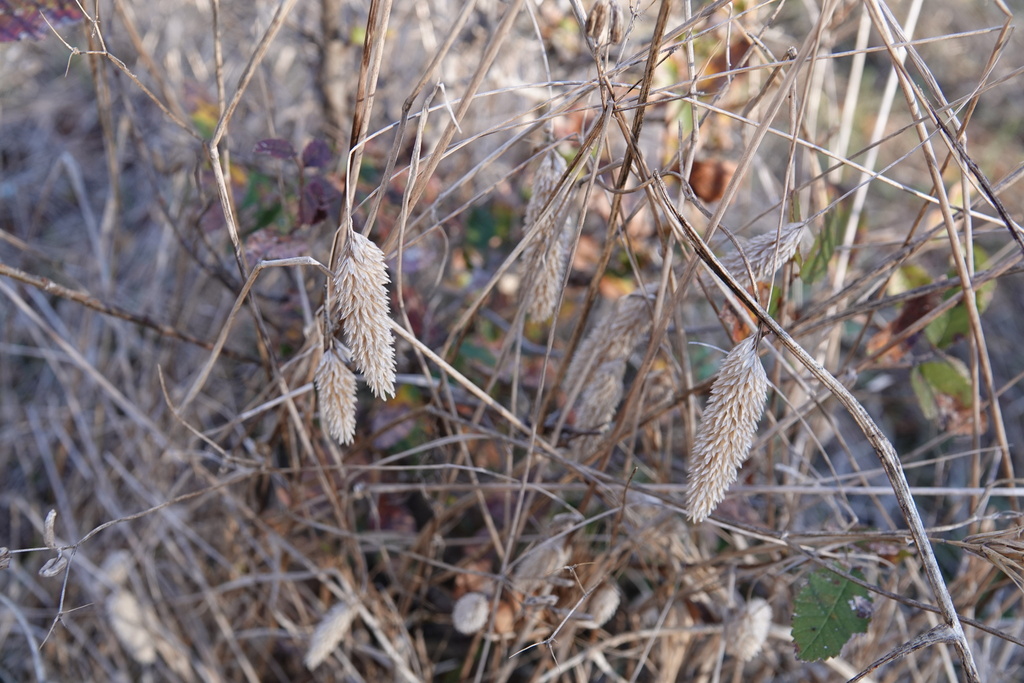
(c) John Thomlinson, some rights reserved (CC BY) · licence
Family: Poaceae · Type: Grass · Not Native
Phalaris caroliniana (Carolina canary grass) is a non-native California grass in the Poaceae family, recognized by intermediate size and sandy soil preference.
Carolina canary grass is a naturalized annual grass found in northern coastal California, northern Sierra Nevada foothills, Central Valley, central and southern coastal areas, and southwestern California in open fields, sandy soils, and moist meadows at elevations below 700 meters. Flowering from April to May, this grass produces dense, ovoid to subcylindric flower clusters 5 to 8 centimeters long with pale green to white spikelets. Growing with upright stems 50 to 150 centimeters tall, it forms robust, branching clumps in disturbed or open landscapes. Its leaves are flat and relatively broad, with smooth green blades typical of grass species. The delicate spikelets feature feathery sterile lemmas that give the inflorescence a soft, intricate appearance.
Identification and appearance
Key characters: 10 sympatric species; key features are intermediate size and sandy soil preference
Habitat and range
Habitat: Uncommon. Open fields, sandy soils, moist meadows
Elevation: < 700 m
Outside California: native to eastern United States, Mexico
Bloom period
Phalaris caroliniana blooms Apr-May.
How to tell it apart
vs Phleum: Phalaris has an ovate to oblong spike-like panicle with keeled, often winged glumes; timothy is a slender cylindric spike with short-awned, stiffly ciliate-keeled glumes.; vs Alopecurus: Phalaris glumes are free and winged and the shiny fertile lemma is flanked by tiny sterile scales; foxtail has glumes joined at the base and a single awned lemma.; vs Anthoxanthum: Both are spike-like, but sweet vernalgrass smells of coumarin and has two awned sterile lemmas; Phalaris is scentless with reduced scale-like sterile florets.; vs Setaria: Phalaris spikes lack bristles entirely; bristlegrass spikelets are each subtended by persistent bristles.; vs Beckmannia: Phalaris spikelets carry prominent winged glumes; sloughgrass has small round, laterally flattened spikelets crowded on one-sided spikes.
Frequently asked questions
Is Phalaris caroliniana native to California?
No. Phalaris caroliniana is not native to California (recorded as not native).
When does Phalaris caroliniana bloom?
Phalaris caroliniana blooms Apr-May.
What plant family does Phalaris caroliniana belong to?
Phalaris caroliniana is in the Poaceae family, genus Phalaris.
What habitat does Phalaris caroliniana grow in?
Phalaris caroliniana grows in Uncommon. Open fields, sandy soils, moist meadows.
Related species
Other California species in the same genus, family, or bioregion.
Sources: Jepson eFlora · CalPhotos
Last updated 2026-10-07
Data from The California Species Project — 14,000+ California species with verified data from CNPS, CDFW, USFWS, Cal-IPC, and more.