Phalaris coerulescens
Sunol grass
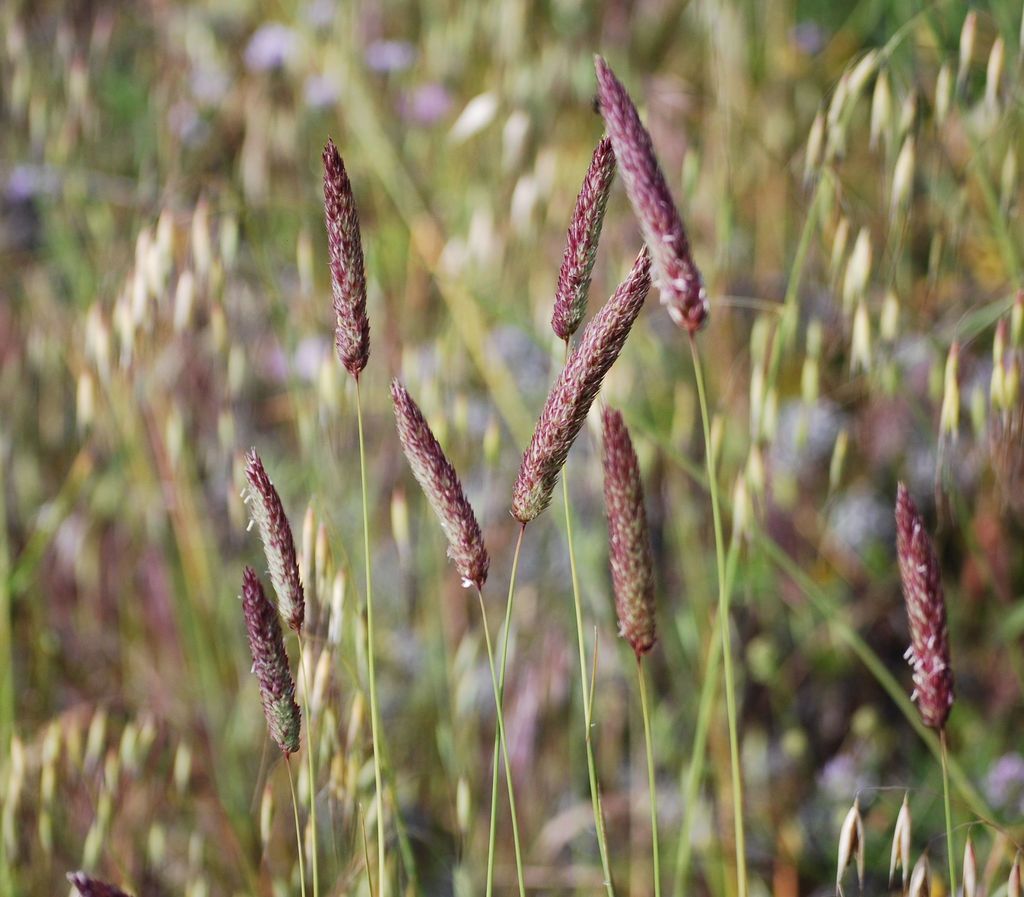
no rights reserved · CC0
Family: Poaceae · Type: Grass · Not Native
Phalaris coerulescens (Sunol grass) is a non-native California grass in the Poaceae family, recognized by clustered spikelet arrangement and tall perennial habit.
Sunol grass is a naturalized perennial herb found in southern Coast Ranges, Santa Catalina Island, and southern desert regions in cultivated fields and moist meadows at elevations below 300 meters. Flowering from April to May, this grass produces pale blue-green flower clusters in dense cylindric inflorescences 4 to 15 centimeters long. Growing in tufted clumps with stems 70 to 200 centimeters tall that are distinctively swollen at the base, it forms dense, clustered vegetation. Its spikelets have glumes 5 to 9 millimeters long with slightly toothed wings and occasionally hairy tips, with fertile lemmas 2.5 to 5 millimeters in length. The fruit is small, approximately 2.5 to 3 millimeters long with a width of about 1.5 millimeters.
Identification and appearance
Key characters: 10 sympatric species; key features are clustered spikelet arrangement and tall perennial habit
Habitat and range
Habitat: Cultivated fields, moist meadows
Elevation: < 300 m
Outside California: native to Mediterranean Europe
Bloom period
Phalaris coerulescens blooms Apr-May.
How to tell it apart
vs Phleum: Phalaris has an ovate to oblong spike-like panicle with keeled, often winged glumes; timothy is a slender cylindric spike with short-awned, stiffly ciliate-keeled glumes.; vs Alopecurus: Phalaris glumes are free and winged and the shiny fertile lemma is flanked by tiny sterile scales; foxtail has glumes joined at the base and a single awned lemma.; vs Anthoxanthum: Both are spike-like, but sweet vernalgrass smells of coumarin and has two awned sterile lemmas; Phalaris is scentless with reduced scale-like sterile florets.; vs Setaria: Phalaris spikes lack bristles entirely; bristlegrass spikelets are each subtended by persistent bristles.; vs Beckmannia: Phalaris spikelets carry prominent winged glumes; sloughgrass has small round, laterally flattened spikelets crowded on one-sided spikes.
Frequently asked questions
Is Phalaris coerulescens native to California?
No. Phalaris coerulescens is not native to California (recorded as not native).
When does Phalaris coerulescens bloom?
Phalaris coerulescens blooms Apr-May.
What plant family does Phalaris coerulescens belong to?
Phalaris coerulescens is in the Poaceae family, genus Phalaris.
What habitat does Phalaris coerulescens grow in?
Phalaris coerulescens grows in Cultivated fields, moist meadows.
Related species
Other California species in the same genus, family, or bioregion.
Sources: Jepson eFlora · CalPhotos
Last updated 2026-10-07
Data from The California Species Project — 14,000+ California species with verified data from CNPS, CDFW, USFWS, Cal-IPC, and more.