Phelipanche ramosa
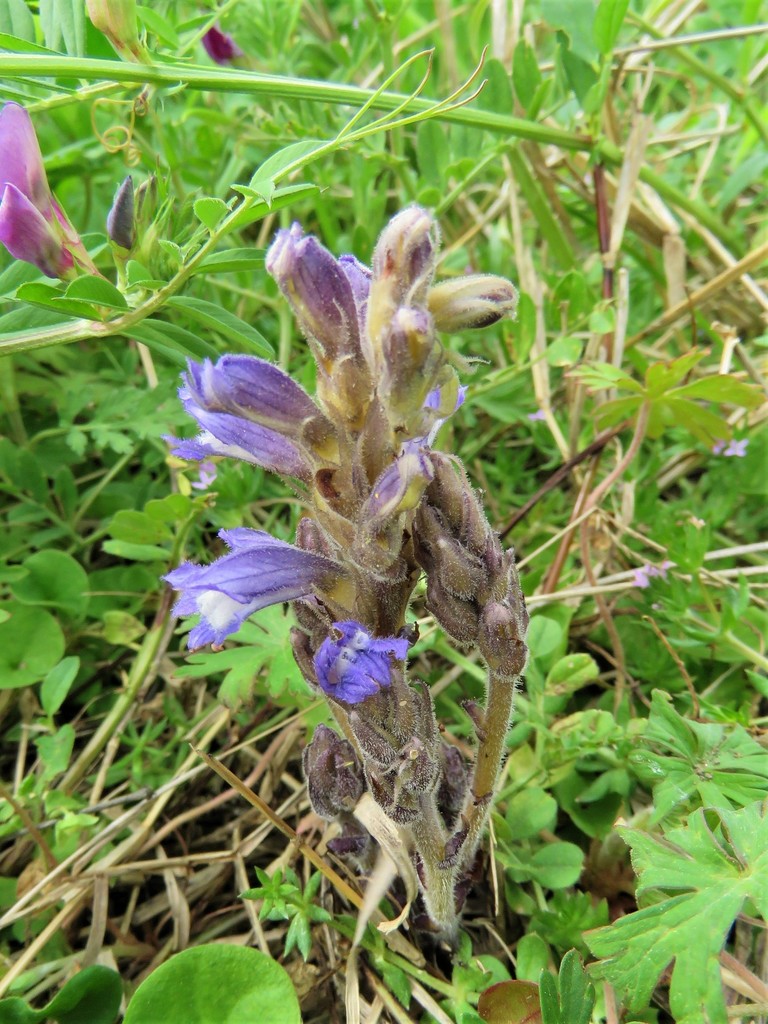
(c) Annika Lindqvist, some rights reserved (CC BY) · licence
Family: Orobanchaceae · Type: Herb · Not Native
Phelipanche ramosa is a non-native California herb in the Orobanchaceae family, recognized by Agricultural weed, European introduction affecting crop plants.
broomrape is a naturalized annual parasitic plant found in northern San Joaquin Valley, San Francisco Bay Area, south coastal ranges, and southern California coastal areas in agricultural landscapes, particularly near tomato fields, at elevations below 50 meters. Flowering from July to September, this plant produces pale blue or lavender flowers with white tubes, emerging from delicate, yellow-tinted stems branching many times near the base. Growing 10 to 60 centimeters tall with multiple slender branches, it lacks chlorophyll and parasitizes host plants in cultivated settings. Its flowers feature pale blue or lavender lobes emerging from a white tubular corolla approximately 10 to 15 millimeters long, with anthers generally lacking hair. This plant is an invasive species that persists in disturbed agricultural environments, adapting to grow alongside cultivated crops.
Identification and appearance
Key characters: Agricultural weed, European introduction affecting crop plants
Habitat and range
Habitat: Persisting in and near cultivated (especially tomato) fields
Elevation: < 50 m
Outside California: worldwide, native to Europe
Bloom period
Phelipanche ramosa blooms Jul-Sep.
How to tell it apart
vs Kopsiopsis: Phelipanche is hairy with separated bracts; Kopsiopsis is hairless with tightly overlapping bracts.; vs Aphyllon: Phelipanche has 4-lobed cup cut deeper above; Aphyllon has 5-lobed cup cut equally or deeper below.
Frequently asked questions
Is Phelipanche ramosa native to California?
No. Phelipanche ramosa is not native to California (recorded as not native).
When does Phelipanche ramosa bloom?
Phelipanche ramosa blooms Jul-Sep.
What plant family does Phelipanche ramosa belong to?
Phelipanche ramosa is in the Orobanchaceae family, genus Phelipanche.
What habitat does Phelipanche ramosa grow in?
Phelipanche ramosa grows in Persisting in and near cultivated (especially tomato) fields.
Related species
Other California species in the same genus, family, or bioregion.
Sources: Jepson eFlora · CalPhotos
Last updated 2026-10-07
Data from The California Species Project — 14,000+ California species with verified data from CNPS, CDFW, USFWS, Cal-IPC, and more.