Philadelphus lewisii
Wild mock orange, Wild Mock Orange
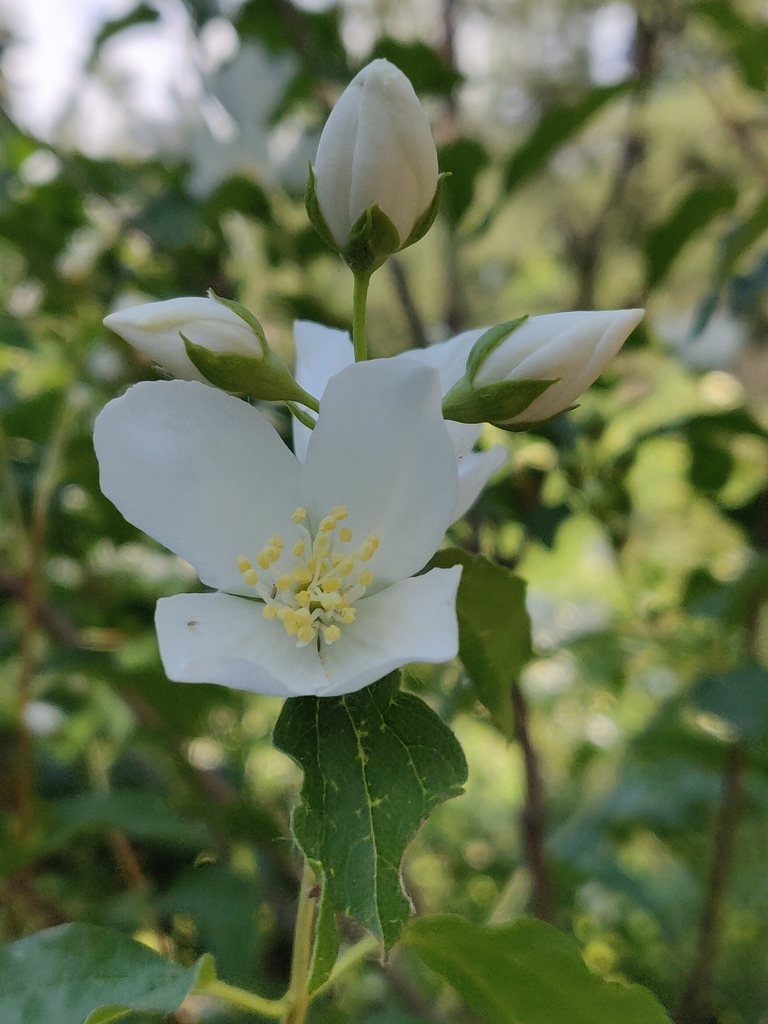
(c) Diane Leeper, some rights reserved (CC BY-SA), uploaded by Diane Leeper · licence
Family: Hydrangeaceae · Type: Shrub · Native
Philadelphus lewisii (Wild mock orange) is a native California shrub in the Hydrangeaceae family, recognized by clear leaf size and margin differences.
Wild mock orange is a California native shrub found in northwestern California, the Cascade Range, northern and central Sierra Nevada, southern Sierra Nevada, Sutter Buttes, southern California mountains, and Peninsular Ranges in slopes and canyons of conifer and hardwood forests and montane chaparral at elevations of 30 to 2,440 meters. Flowering from May to July, this plant produces white flowers with delicate, obovate petals 8 to 12 millimeters long. Growing to a medium height with multiple upright or spreading branches, it forms a rounded, dense shrub structure. Its leaves are ovate with smooth or slightly toothed edges, measuring 20 to 40 millimeters wide, carried on short 3 to 8 millimeter petioles. The shrub produces clusters of fragrant white blossoms that resemble small orange flowers, giving rise to its common name.
Identification and appearance
Key characters: 1 sympatric species; clear leaf size and margin differences
Habitat and range
Habitat: Slopes, canyons in conifer and hardwood forest, montane chaparral
Elevation: 30-2440 m
California counties: Lake, Placer, Trinity, Siskiyou, Amador, Tuolumne, Shasta, Mendocino, Sierra, Butte, Plumas, Humboldt, Del Norte, Mariposa, El Dorado, Kern, Tulare, Yuba, Santa Barbara, Nevada, Calaveras, Fresno, San Mateo, Orange, Los Angeles, Marin, Sonoma, Tehama, Glenn, Sacramento, Sutter, Stanislaus
Outside California: to British Columbia, Montana
Bloom period
Philadelphus lewisii blooms May-Jul.
How to tell it apart
vs Rosa: Philadelphus has simple opposite leaves; roses have alternate compound leaves with leaflets.; vs Carpenteria: Philadelphus has deciduous three-veined leaves; Carpenteria has evergreen leathery leaves with one vein.; vs Cornus: Philadelphus leaves have three veins from the base; dogwoods have pinnate veins arching toward the tip.; vs Pittosporum: Philadelphus has opposite leaves and multiple styles; Pittosporum has alternate leaves and one style.; vs Rhododendron: Philadelphus has thin deciduous leaves; rhododendrons have thick evergreen leaves and bell-shaped flowers.
Frequently asked questions
Is Philadelphus lewisii native to California?
Yes. Philadelphus lewisii is native to California (recorded as native).
When does Philadelphus lewisii bloom?
Philadelphus lewisii blooms May-Jul.
Where in California does Philadelphus lewisii grow?
Philadelphus lewisii occurs in Lake, Placer, Trinity, Siskiyou, Amador, Tuolumne, Shasta, Mendocino and other counties, at elevations of 30-2440 m.
What plant family does Philadelphus lewisii belong to?
Philadelphus lewisii is in the Hydrangeaceae family, genus Philadelphus.
What habitat does Philadelphus lewisii grow in?
Philadelphus lewisii grows in Slopes, canyons in conifer and hardwood forest, montane chaparral.
Related species
Other California species in the same genus, family, or bioregion.
Sources: Jepson eFlora · Index of California Plant Names · CalPhotos
Last updated 2026-10-07
Data from The California Species Project — 14,000+ California species with verified data from CNPS, CDFW, USFWS, Cal-IPC, and more.