Phleum pratense
Cultivated timothy
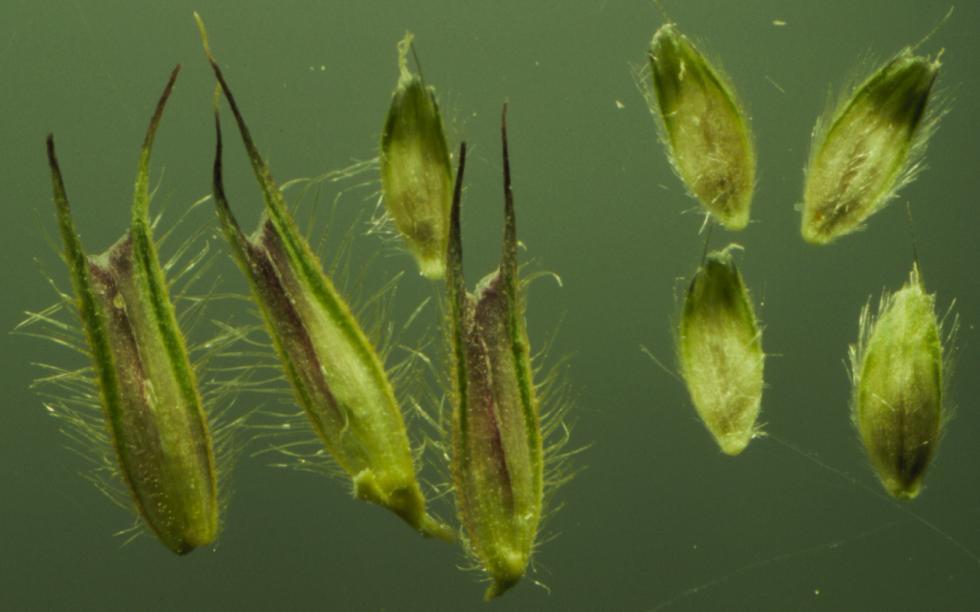
(c) Matt Lavin, some rights reserved (CC BY-SA) · licence
Family: Poaceae · Type: Grass · Not Native
Phleum pratense (Cultivated timothy) is a non-native California grass in the Poaceae family, recognized by (P. alpinum). Key differences: non-native status, swollen stem base, habitat preference for disturbed sites, and taller stature.
Cultivated timothy is a naturalized perennial grass found in the California Floristic Province and Great Basin in disturbed sites, roadsides, and cultivated fields at elevations below 2,750 meters. Flowering from May to June, this plant produces pale green to greenish-white flower spikes in dense, compact clusters approximately 5 to 8 millimeters wide. Growing with loosely clumped stems 50 to 100 centimeters tall, the plant has a distinctively swollen base and spreads in dense tufts. Its basal leaves are few and spreading, with stem blades 4 to 20 centimeters long and 3 to 6 millimeters wide. The flower spikes have small glumes with rough backs and delicate lemmas with soft, puberulent veins.
Identification and appearance
Key characters: 1 sympatric species (P. alpinum). Key differences: non-native status, swollen stem base, habitat preference for disturbed sites, and taller stature
Habitat and range
Habitat: Disturbed sites, roadsides, cultivated fields
Elevation: < 2750 m
California counties: Alpine, El Dorado, Modoc, Del Norte, Plumas, Siskiyou, Mono, Fresno, Los Angeles, San Bernardino, Humboldt, Ventura, Placer, Inyo, Lake, Tuolumne, Butte, San Diego, Mendocino, Riverside, Santa Clara, Trinity, Amador, Shasta, Lassen, Madera, Marin, Napa, San Luis Obispo, Santa Barbara, Sierra, Tehama, Nevada, Yolo, San Francisco, Kern, Santa Cruz, Mariposa, Sonoma, Tulare, San Mateo, Kings, Alameda, Yuba, Sacramento, Monterey
Outside California: North America, Mexico, native to Eurasia
Bloom period
Phleum pratense blooms May-Jun.
How to tell it apart
vs Phalaris: Phleum has a perfectly cylindrical spike; Phalaris spikes are more oval or egg-shaped.; vs Alopecurus: Phleum seeds lack awns entirely; Alopecurus has a bristle from each flower creating a softer look.; vs Plantago: Phleum is a grass with split leaf blades; Plantago has broad, uncut leaves in a basal rosette.; vs Holcus: Phleum has a tight cylinder; Holcus has a looser, more branched flower cluster.; vs Setaria: Phleum's spike lacks bristles beyond the flowers; Setaria has long bristles creating a foxtail.
Frequently asked questions
Is Phleum pratense native to California?
No. Phleum pratense is not native to California (recorded as not native).
When does Phleum pratense bloom?
Phleum pratense blooms May-Jun.
Where in California does Phleum pratense grow?
Phleum pratense occurs in Alpine, El Dorado, Modoc, Del Norte, Plumas, Siskiyou, Mono, Fresno and other counties, at elevations of < 2750 m.
What plant family does Phleum pratense belong to?
Phleum pratense is in the Poaceae family, genus Phleum.
What habitat does Phleum pratense grow in?
Phleum pratense grows in Disturbed sites, roadsides, cultivated fields.
Related species
Other California species in the same genus, family, or bioregion.
Sources: Jepson eFlora · Index of California Plant Names · CalPhotos
Last updated 2026-10-07
Data from The California Species Project — 14,000+ California species with verified data from CNPS, CDFW, USFWS, Cal-IPC, and more.