Phlox austromontana
Southern mountain phlox
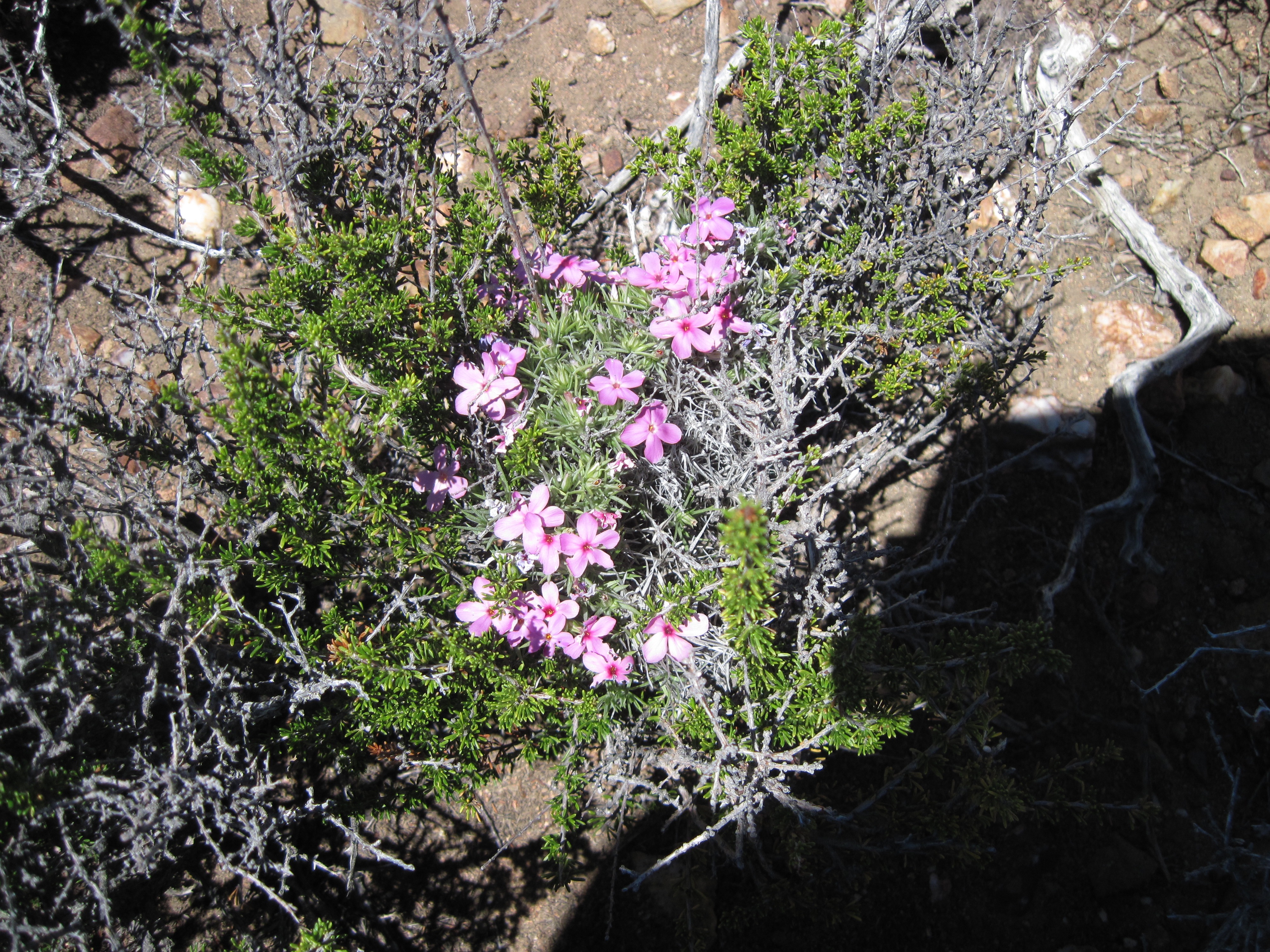
Photo by Chez Brungraber
Family: Polemoniaceae · Type: Subshrub · Native
Phlox austromontana (Southern mountain phlox) is a native California subshrub in the Polemoniaceae family, recognized by matted to cushion-like habit with sharp-tipped lanceolate leaves.
Southern mountain phlox is a California native perennial found in the Sierra Nevada Boundary, Sierra Nevada Gabilan, and Peninsular Ranges in dry, rocky areas, pinyon and juniper woodland, conifer forest, and sagebrush scrub at elevations of 1,500 to 2,700 meters. Flowering from May to June, this plant produces white to pink or lavender flowers with rounded lobes and a delicate 11 to 14 millimeter tube. Growing as a low-growing, mat-like or cushion-like perennial with minimal height, it develops stiff, sharp-tipped stems that are nearly glabrous. Its leaves are lanceolate, approximately 10 to 15 millimeters long, with hairy upper surfaces and generally smooth undersides. The plant forms compact clusters with individual flowers emerging from terminal points, creating a dense, structured appearance in its rocky mountain habitats.
Identification and appearance
Key characters: 3 sympatric species; key features are matted to cushion-like habit with sharp-tipped lanceolate leaves
Habitat and range
Habitat: Dry, rocky areas, pinyon/juniper woodland, conifer forest, sagebrush scrub
Elevation: 1500-2700 m
California counties: San Bernardino, San Diego, Riverside, Tulare, Modoc, Nevada, Siskiyou, Placer, Ventura, Inyo, Butte, El Dorado, Madera, Lassen, Fresno, Mono, Mendocino
Outside California: to western Colorado, Arizona, Baja California
Bloom period
Phlox austromontana blooms May-Jun.
How to tell it apart
vs Linanthus: Phlox has opposite leaves; Linanthus has alternate leaves arranged singly along the stem.; vs Leptosiphon: Phlox leaves are completely undivided blades; Leptosiphon leaves are deeply cut into finger-like segments.; vs Pelargonium: Phlox has opposite, narrow unlobed leaves; Pelargonium has alternate, round lobed leaves with strong scent.; vs Catharanthus: Phlox is native with opposite leaves; Catharanthus (periwinkle) has glossy opposite leaves with white midvein.; vs Dianthus: Phlox has spreading 5-petaled flowers with tube; Dianthus has fringed or toothed petals emerging from tubular calyx.
Frequently asked questions
Is Phlox austromontana native to California?
Yes. Phlox austromontana is native to California (recorded as native).
When does Phlox austromontana bloom?
Phlox austromontana blooms May-Jun.
Where in California does Phlox austromontana grow?
Phlox austromontana occurs in San Bernardino, San Diego, Riverside, Tulare, Modoc, Nevada, Siskiyou, Placer and other counties, at elevations of 1500-2700 m.
What plant family does Phlox austromontana belong to?
Phlox austromontana is in the Polemoniaceae family, genus Phlox.
What habitat does Phlox austromontana grow in?
Phlox austromontana grows in Dry, rocky areas, pinyon/juniper woodland, conifer forest, sagebrush scrub.
Related species
Other California species in the same genus, family, or bioregion.
Sources: Jepson eFlora · Index of California Plant Names · CalPhotos
Last updated 2026-10-07
Data from The California Species Project — 14,000+ California species with verified data from CNPS, CDFW, USFWS, Cal-IPC, and more.