Phlox diffusa
Spreading phlox
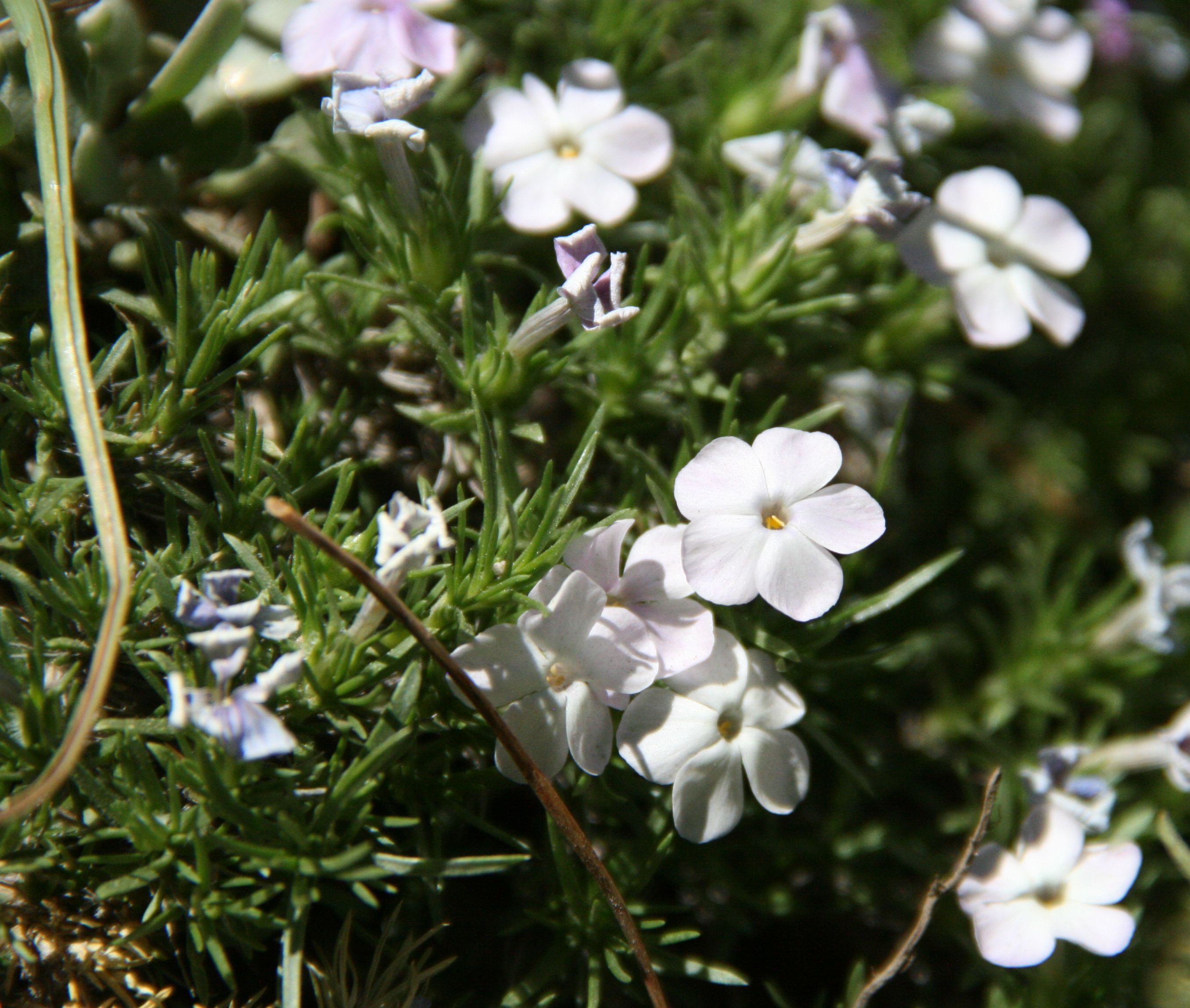
Photo by Chez Brungraber
Family: Polemoniaceae · Type: Subshrub · Native
Phlox diffusa (Spreading phlox) is a native California subshrub in the Polemoniaceae family, recognized by matted habit with lance-linear leaves that are not sharp-tipped and white-woolly at base.
Spreading phlox is a California native perennial found in areas excluding the desert, primarily in dry, open mountain habitats at elevations of 1,100 to 3,600 meters. Flowering from May to August, this plant produces delicate white to pink or pale blue flowers with slender tubular corollas 9 to 13 millimeters long. Growing with decumbent stems that form a nearly matted ground cover, it spreads in low, compact clusters with a somewhat prostrate growth habit. Its leaves are narrow lance-linear, 10 to 15 millimeters long, predominantly glabrous with a distinctive white-woolly base, creating a soft textural appearance across rocky mountain landscapes. The plant's compact, low-growing form makes it well-adapted to high-elevation, exposed mountain environments.
Identification and appearance
Key characters: 13 sympatric species; key features are matted habit with lance-linear leaves that are not sharp-tipped and white-woolly at base
Habitat and range
Habitat: Dry, open areas
Elevation: 1100-3600 m
California counties: Fresno, Kern, San Bernardino, Los Angeles, Tulare, Madera, Mono, Alpine, Plumas, Ventura, Siskiyou, Mariposa, Amador, Sierra, Nevada, Modoc, Shasta, Trinity, El Dorado, Lassen, Butte, Del Norte, Glenn, Mendocino, Tuolumne, Placer, Tehama, Humboldt, Lake, Calaveras
Outside California: western North America
Bloom period
Phlox diffusa blooms May-Aug.
How to tell it apart
vs Linanthus: Phlox has opposite leaves; Linanthus has alternate leaves arranged singly along the stem.; vs Leptosiphon: Phlox leaves are completely undivided blades; Leptosiphon leaves are deeply cut into finger-like segments.; vs Pelargonium: Phlox has opposite, narrow unlobed leaves; Pelargonium has alternate, round lobed leaves with strong scent.; vs Catharanthus: Phlox is native with opposite leaves; Catharanthus (periwinkle) has glossy opposite leaves with white midvein.; vs Dianthus: Phlox has spreading 5-petaled flowers with tube; Dianthus has fringed or toothed petals emerging from tubular calyx.
Frequently asked questions
Is Phlox diffusa native to California?
Yes. Phlox diffusa is native to California (recorded as native).
When does Phlox diffusa bloom?
Phlox diffusa blooms May-Aug.
Where in California does Phlox diffusa grow?
Phlox diffusa occurs in Fresno, Kern, San Bernardino, Los Angeles, Tulare, Madera, Mono, Alpine and other counties, at elevations of 1100-3600 m.
What plant family does Phlox diffusa belong to?
Phlox diffusa is in the Polemoniaceae family, genus Phlox.
What habitat does Phlox diffusa grow in?
Phlox diffusa grows in Dry, open areas.
Related species
Other California species in the same genus, family, or bioregion.
Sources: Jepson eFlora · Index of California Plant Names · CalPhotos
Last updated 2026-10-07
Data from The California Species Project — 14,000+ California species with verified data from CNPS, CDFW, USFWS, Cal-IPC, and more.