Phoenicaulis cheiranthoides
Common phoenicaulis
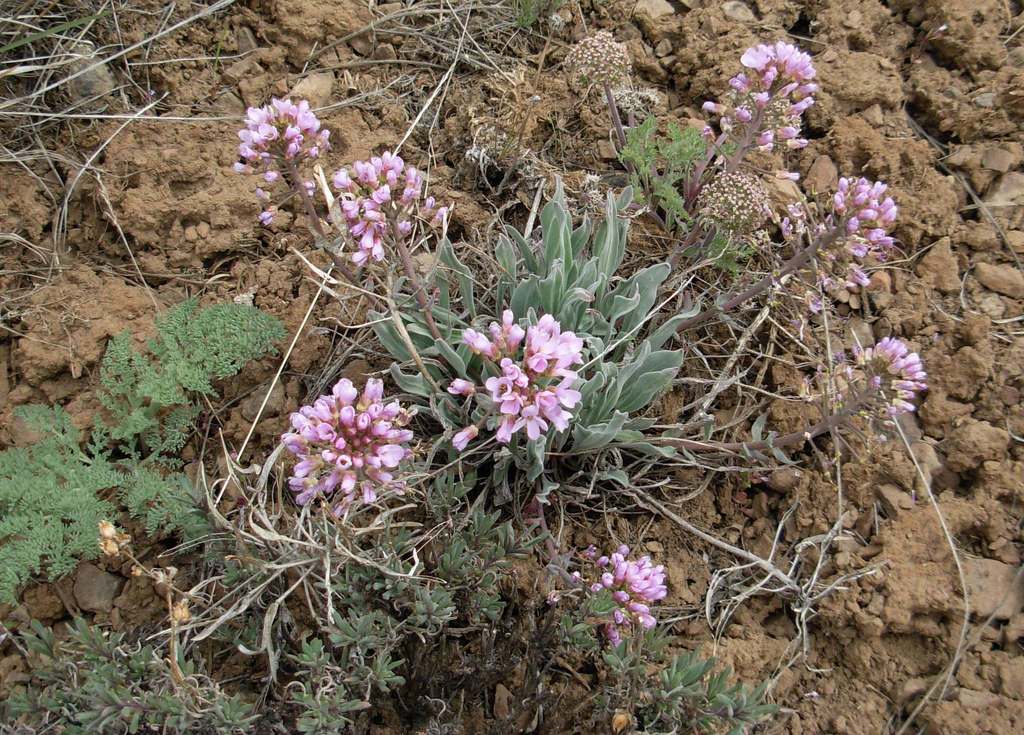
(c) brewbooks, some rights reserved (CC BY-SA), uploaded by brewbooks · licence
Family: Brassicaceae · Type: Herb · Native
Phoenicaulis cheiranthoides (Common phoenicaulis) is a native California herb in the Brassicaceae family, recognized by Northwestern montane distribution, distinctive tree-like trichomes.
Common phoenicaulis is a California native perennial found in the Klamath Ranges, northern Coast Ranges, California Ranges, Sierra Nevada, and Great Basin in volcanic, rocky areas, meadows, and sagebrush scrub at elevations of 1,000 to 3,200 meters. Flowering from April to June, this plant produces pink to purple flowers 9 to 13 millimeters long with obovate-oblanceolate petals. Growing with simple stems 12 to 25 centimeters tall, it develops a well-developed woody caudex covered in many-branched, tree-like hairs. Its basal leaves form a rosette of linear-oblanceolate to obovate blades 2 to 7 centimeters long, while cauline leaves are smaller, ovate to oblong, and sessile. The plant produces elongated siliques 2 to 6 centimeters long with 8 to 16 seeds arranged in a single row.
Identification and appearance
Key characters: Northwestern montane distribution, distinctive tree-like trichomes
Habitat and range
Habitat: Volcanic, rocky areas, barren clay slopes, sandy banks, meadows, hillsides, sagebrush scrub
Elevation: 1000-3200 m
California counties: Alpine, Inyo, Lassen, Mendocino, Modoc, Mono, Nevada, Plumas, Siskiyou, Trinity, Tuolumne, Humboldt, Sierra, Placer, Mariposa, Lake, Marin, Shasta, Tulare, Madera, Tehama
Outside California: to Washington, Idaho
Bloom period
Phoenicaulis cheiranthoides blooms Apr-Jun.
How to tell it apart
vs Boechera: Phoenicaulis has exclusively tree-like branched hairs and fewer seeds per pod (6-16 vs 24+).; vs Arabis: Phoenicaulis has tree-like hairs on stalks, while Arabis has star-shaped hairs radiating from stalks.; vs Caulanthus: Phoenicaulis is perennial with woody base and many-branched hairs; Caulanthus is annual with simple hairs.; vs Transberingia: Phoenicaulis has flattened pods, while Transberingia has cylindrical pods sticking out at angles.; vs Turritis: Phoenicaulis lacks waxy blue-gray coating and its pods aren't pressed tightly against the stem.
Frequently asked questions
Is Phoenicaulis cheiranthoides native to California?
Yes. Phoenicaulis cheiranthoides is native to California (recorded as native).
When does Phoenicaulis cheiranthoides bloom?
Phoenicaulis cheiranthoides blooms Apr-Jun.
Where in California does Phoenicaulis cheiranthoides grow?
Phoenicaulis cheiranthoides occurs in Alpine, Inyo, Lassen, Mendocino, Modoc, Mono, Nevada, Plumas and other counties, at elevations of 1000-3200 m.
What plant family does Phoenicaulis cheiranthoides belong to?
Phoenicaulis cheiranthoides is in the Brassicaceae family, genus Phoenicaulis.
What habitat does Phoenicaulis cheiranthoides grow in?
Phoenicaulis cheiranthoides grows in Volcanic, rocky areas, barren clay slopes, sandy banks, meadows, hillsides, sagebrush scrub.
Related species
Other California species in the same genus, family, or bioregion.
Sources: Jepson eFlora · Index of California Plant Names · CalPhotos
Last updated 2026-10-07
Data from The California Species Project — 14,000+ California species with verified data from CNPS, CDFW, USFWS, Cal-IPC, and more.