Phoradendron juniperinum
Juniper or incense cedar mistletoe, Juniper Or Incense Cedar Mistletoe
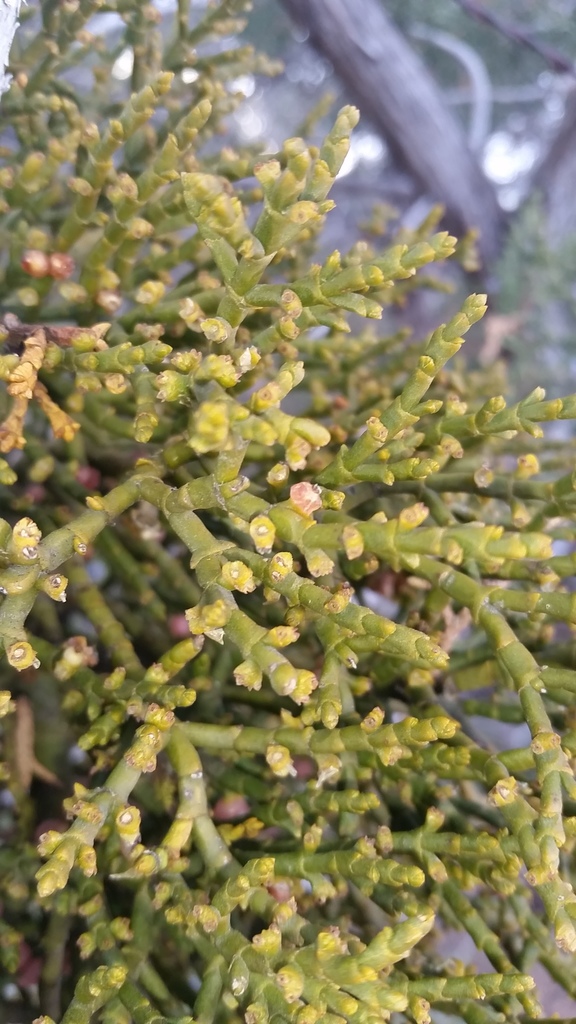
no rights reserved, uploaded by aiwendil · CC0
Family: Viscaceae · Type: Shrub · Native
Phoradendron juniperinum (Juniper or incense cedar mistletoe) is a native California shrub in the Viscaceae family, recognized by high elevation montane habitat vs desert.
Juniper or incense cedar mistletoe is a California native perennial found in the Klamath Ranges, northern California Coast Ranges, Cascade Range, northern Sierra Nevada Foothills, Sierra Nevada, southern Coast Ranges, Transverse Ranges, Peninsular Ranges, Great Basin, and Mojave Desert in pinyon/juniper woodland and ponderosa-pine forest at elevations of 1,700 to 2,600 meters. Flowering from July to September, this plant produces pink-white flowers on small, green or yellow-green stems. Growing 2 to 8 decimeters tall with erect or pendent stems that are generally woody only at the base, it appears delicate and sparse. Its leaves are extremely reduced, appearing as tiny scale-like structures less than one millimeter long. The fruit develops as small pink-white structures approximately 4 millimeters long, characteristic of mistletoe parasitic growth.
Identification and appearance
Key characters: 5 sympatric species; distinguished by high elevation montane habitat vs desert
Habitat and range
Habitat: Pinyon/juniper woodland, ponderosa-pine forest, on
Elevation: 1700-2600 m
California counties: San Bernardino, Inyo, Kern, Fresno, Lassen, Alpine, Tulare, El Dorado, Modoc, Plumas, Los Angeles, Madera, Nevada, Tuolumne, Mono, Amador, Placer, San Diego, Butte, Mariposa, Mendocino, San Benito, Riverside, Siskiyou, Humboldt, Calaveras, Sierra, Tehama, Del Norte, Ventura, Santa Barbara, Yuba
Outside California: to Oregon, Colorado, Texas, Mexico
Bloom period
Phoradendron juniperinum blooms Jul-Sep.
How to tell it apart
vs Viscum: Phoradendron has smaller leaves (<47mm) and berries (3-6mm); Viscum has thick waxy leaves (50-80mm) and large berries (6-10mm).; vs Arceuthobium: Phoradendron has obvious oval leaves and grows >8 inches; Arceuthobium has tiny scales and stays <8 inches on conifers.; vs Eriogonum: Phoradendron grows as leafy mistletoe up in trees; Eriogonum is a ground-level shrub or herb with flower clusters.; vs Quercus: Phoradendron is the leafy parasite growing on the oak; Quercus is the host tree with acorns.; vs Euphorbia: Phoradendron grows as mistletoe in tree canopy; Euphorbia grows at ground level with milky sap when broken.
Frequently asked questions
Is Phoradendron juniperinum native to California?
Yes. Phoradendron juniperinum is native to California (recorded as native).
When does Phoradendron juniperinum bloom?
Phoradendron juniperinum blooms Jul-Sep.
Where in California does Phoradendron juniperinum grow?
Phoradendron juniperinum occurs in San Bernardino, Inyo, Kern, Fresno, Lassen, Alpine, Tulare, El Dorado and other counties, at elevations of 1700-2600 m.
What plant family does Phoradendron juniperinum belong to?
Phoradendron juniperinum is in the Viscaceae family, genus Phoradendron.
What habitat does Phoradendron juniperinum grow in?
Phoradendron juniperinum grows in Pinyon/juniper woodland, ponderosa-pine forest, on.
Related species
Other California species in the same genus, family, or bioregion.
Sources: Jepson eFlora · Index of California Plant Names · CalPhotos
Last updated 2026-10-07
Data from The California Species Project — 14,000+ California species with verified data from CNPS, CDFW, USFWS, Cal-IPC, and more.