Phragmites australis
Common reed
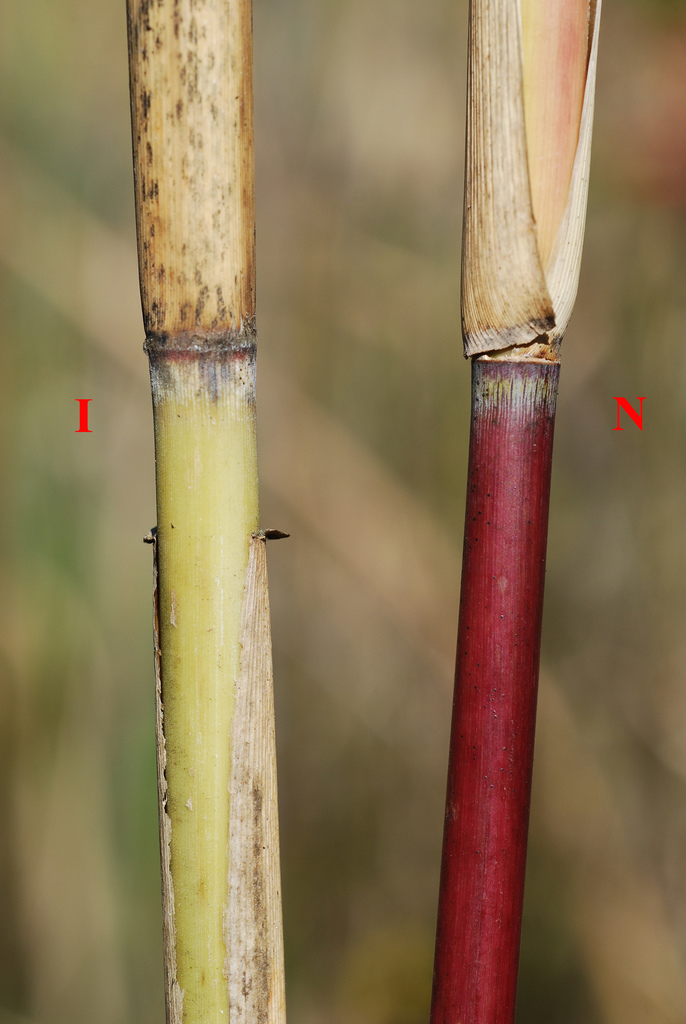
(c) Douglas Goldman, some rights reserved (CC BY-SA), uploaded by Douglas Goldman · licence
Family: Poaceae · Type: Shrub · Native
Phragmites australis (Common reed) is a native California shrub in the Poaceae family, recognized by Widespread wetland species, both native and introduced populations present.
Common reed is a California native perennial found in pond and lake margins, sloughs, and marshes throughout California at elevations generally below 1,600 meters. Flowering from July to November, this plant produces purple to white flowers in large plume-like inflorescences 15 to 50 centimeters long. Growing with tall stems 2 to 4 meters in height, it forms dense, robust stands in wetland environments. Its leaves are long and narrow, measuring 20 to 45 centimeters in length and 1 to 5 centimeters wide, with rough margins that often break at the leaf collar. The plant's feathery flowering heads create distinctive landscape-scale colonies in wetland habitats.
Identification and appearance
Key characters: Widespread wetland species, both native and introduced populations present
Habitat and range
Habitat: Pond and lake margins, sloughs, marshes
Elevation: generally < 1600 m
California counties: San Bernardino, Riverside, Imperial, San Diego, Inyo, San Joaquin, Kern, San Luis Obispo, Contra Costa, Fresno, Ventura, Lassen, Solano, Lake, Los Angeles, Mono, Santa Barbara, Siskiyou, Modoc, Alpine, Mendocino, Sacramento, Tulare, Shasta, Merced, Colusa, Napa, Humboldt, Stanislaus, Del Norte, Monterey, Yolo, Sonoma, San Benito
Outside California: worldwide
Bloom period
Phragmites australis blooms Jul-Nov.
How to tell it apart
vs Arundo: Phragmites has smooth lemma on silky-hairy spikelet axis; Arundo has hairy lemma on smooth axis.; vs Typha: Phragmites has feathery plumes; Typha (cattail) has brown cylindrical seed heads.; vs Cortaderia: Phragmites grows in marshes up to 12 feet; Cortaderia forms massive dry-ground clumps.; vs Leymus: Phragmites has silky feathery plumes in wetlands; Leymus has wheat-like spikes in drier areas.; vs Bromus: Phragmites reaches 12 feet with feathery plumes; Bromus is much shorter with drooping spikelets.
Frequently asked questions
Is Phragmites australis native to California?
Yes. Phragmites australis is native to California (recorded as native).
When does Phragmites australis bloom?
Phragmites australis blooms Jul-Nov.
Where in California does Phragmites australis grow?
Phragmites australis occurs in San Bernardino, Riverside, Imperial, San Diego, Inyo, San Joaquin, Kern, San Luis Obispo and other counties, at elevations of generally < 1600 m.
What plant family does Phragmites australis belong to?
Phragmites australis is in the Poaceae family, genus Phragmites.
What habitat does Phragmites australis grow in?
Phragmites australis grows in Pond and lake margins, sloughs, marshes.
Related species
Other California species in the same genus, family, or bioregion.
Sources: Jepson eFlora · Index of California Plant Names · CalPhotos
Last updated 2026-10-07
Data from The California Species Project — 14,000+ California species with verified data from CNPS, CDFW, USFWS, Cal-IPC, and more.