Phyllostachys aurea
Fishpole bamboo, golden bamboo, Golden Bamboo
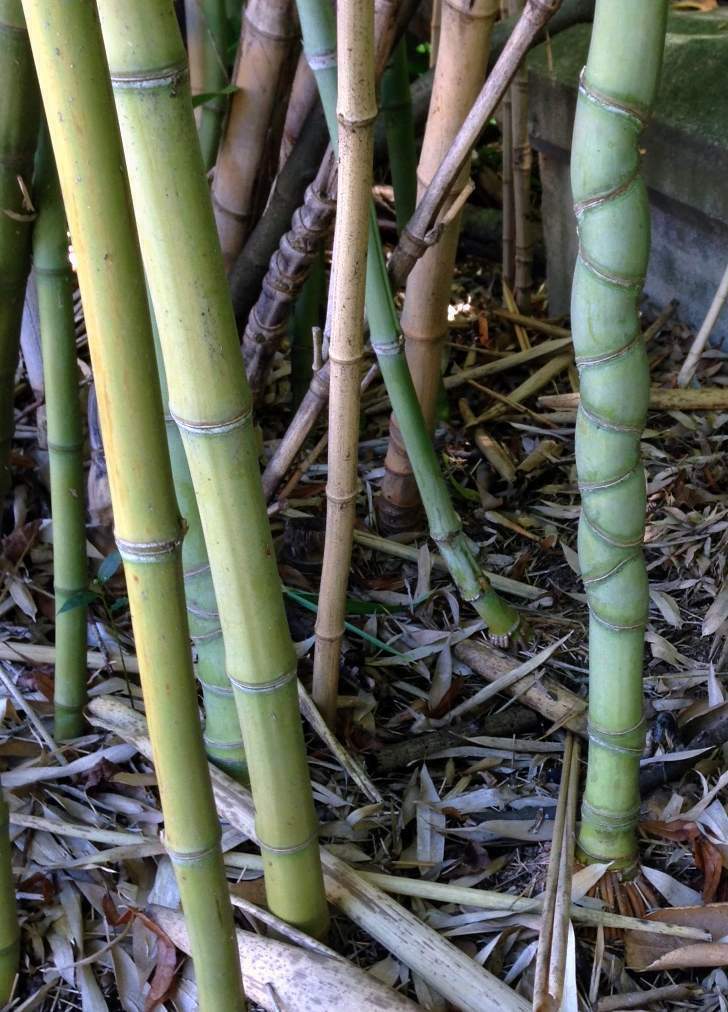
(c) Abrahami, some rights reserved (CC BY-SA) · licence
Family: Poaceae · Type: Shrub · Not Native
Phyllostachys aurea (Fishpole bamboo) is a non-native California shrub in the Poaceae family, recognized by Escaped ornamental bamboo, forms vegetative colonies.
Fishpole bamboo is a naturalized perennial found in the Central Coast region in urban and riparian areas at elevations below 100 meters. Flowering from December to May, this bamboo produces small, inconspicuous flowers typical of grass-like plants. Growing up to 10 meters tall with stiff, erect stems 1 to 4 centimeters thick, it forms dense thickets that turn yellow-green in strong sunlight. Its leaves are smooth and elongated, measuring 4 to 15 centimeters long and 0.5 to 2 centimeters wide, with nodes that are slightly swollen. This aggressive ornamental species spreads quickly by underground rhizomes, often escaping cultivation and establishing along riverbanks and disturbed landscapes.
Identification and appearance
Key characters: Escaped ornamental bamboo, forms vegetative colonies
Habitat and range
Habitat: Escaped ornamental, spreading by rhizomes along riverbanks
Elevation: < 100 m
Outside California: Oregon, southeastern United States, China, Japan, widely cultivated
Bloom period
Phyllostachys aurea blooms Dec-May.
How to tell it apart
vs Arundo: Phyllostachys has woody stems branching extensively above base; Arundo has unbranched hollow stems with single plume.; vs Dracaena: Phyllostachys has jointed, segmented bamboo stems; Dracaena has woody trunk with leaf clusters at top.; vs Salix: Phyllostachys has hollow, jointed bamboo canes; Salix has solid woody branches with catkins.; vs Cortaderia: Phyllostachys has branching woody stems; Cortaderia has unbranched hollow stems from basal clump.; vs Phragmites: Phyllostachys has woody branching bamboo stems; Phragmites has unbranched stems with feathery plume.
Frequently asked questions
Is Phyllostachys aurea native to California?
No. Phyllostachys aurea is not native to California (recorded as not native).
When does Phyllostachys aurea bloom?
Phyllostachys aurea blooms Dec-May.
What plant family does Phyllostachys aurea belong to?
Phyllostachys aurea is in the Poaceae family, genus Phyllostachys.
What habitat does Phyllostachys aurea grow in?
Phyllostachys aurea grows in Escaped ornamental, spreading by rhizomes along riverbanks.
Related species
Other California species in the same genus, family, or bioregion.
Sources: Jepson eFlora · CalPhotos
Last updated 2026-10-07
Data from The California Species Project — 14,000+ California species with verified data from CNPS, CDFW, USFWS, Cal-IPC, and more.