Physalis crassifolia
Thickleaf ground-cherry
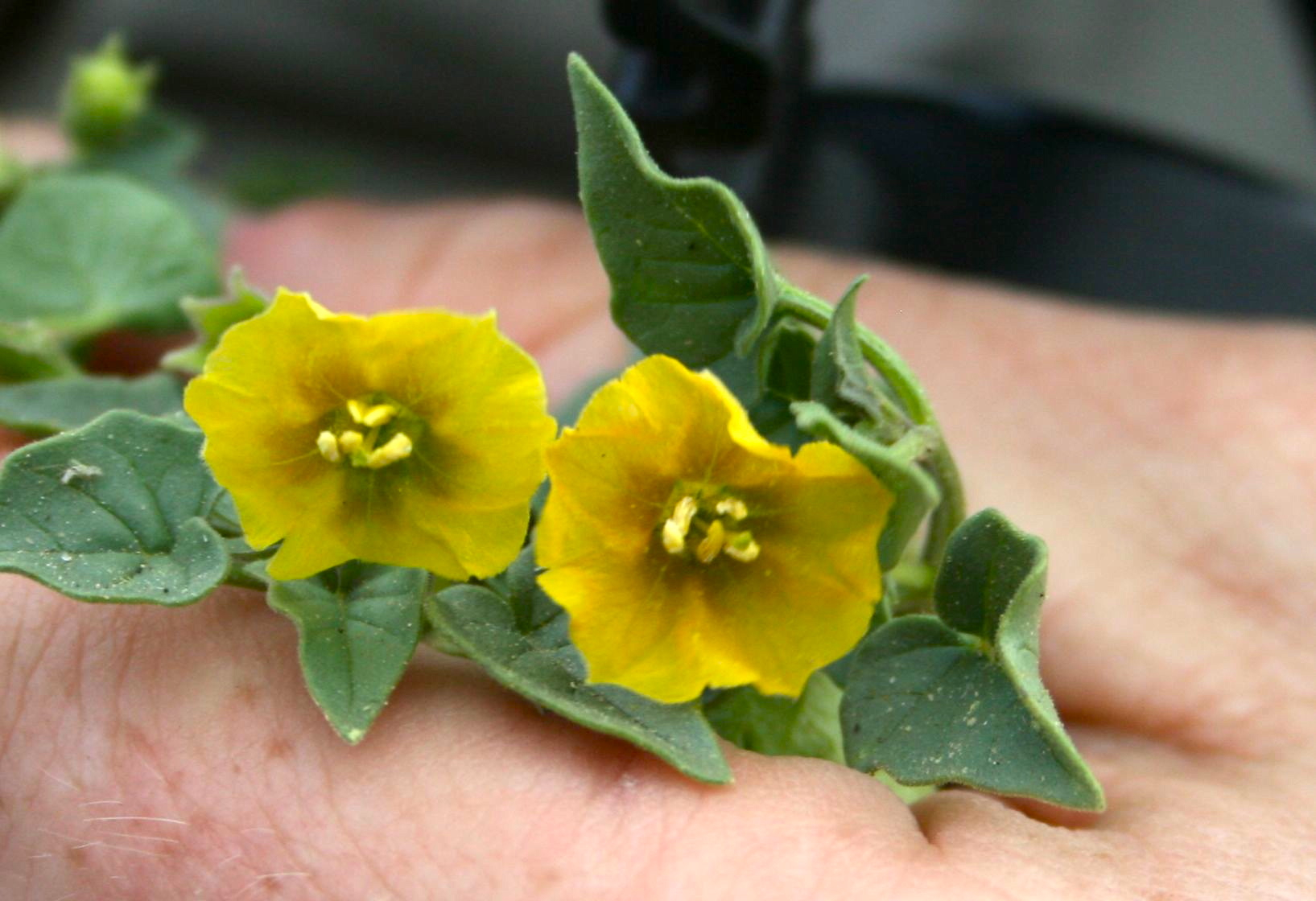
Photo by Chez Brungraber
Family: Solanaceae · Type: Subshrub · Native
Physalis crassifolia (Thickleaf ground-cherry) is a native California subshrub in the Solanaceae family, recognized by (P. acutifolia, P. philadelphica). Key features: perennial habit, thick fleshy leaves, plain yellow flowers.
Thickleaf ground-cherry is a California native perennial found in southern Sierra Nevada, Peninsular Ranges, and Desert regions in gravelly to rocky habitats at elevations below 1,800 meters. Flowering from March to May, this plant produces yellow flowers widely bell-shaped, approximately 11 to 20 millimeters wide. Growing as a subshrub up to 80 centimeters tall with fleshy, finely puberulent herbage that appears nearly smooth, it develops dense, short unbranched hairs. Its leaves are ovate, 1 to 3.5 centimeters long with rounded or truncate bases and entire or slightly wavy margins. The plant develops fruit with an enlarged calyx 20 to 25 millimeters long, significantly expanding from its original flowering size.
Identification and appearance
Key characters: 2 sympatric species (P. acutifolia, P. philadelphica). Key features: perennial habit, thick fleshy leaves, plain yellow flowers.
Habitat and range
Habitat: Gravelly to rocky flats, washes, slopes, rock outcrops
Elevation: < 1800 m
California counties: Riverside, San Diego, San Bernardino, Inyo, Imperial, Orange
Outside California: Nevada, southwestern Utah, Arizona, northwestern Mexico
Bloom period
Physalis crassifolia blooms Mar-May.
How to tell it apart
vs Solanum: Physalis fruit is enclosed in a papery lantern; Solanum berries are exposed.; vs Datura: Physalis has small flowers and papery lantern fruits; Datura has huge trumpet flowers and spiny capsules.; vs Chylismia: Physalis has 5-petaled flowers and lantern fruits; Chylismia has 4 petals and elongated capsules.; vs Mirabilis: Physalis has papery lantern fruits; Mirabilis has hard, ribbed fruits without any husk.; vs Capsicum: Physalis lantern completely encloses fruit; Capsicum peppers are fully exposed when ripe.
Frequently asked questions
Is Physalis crassifolia native to California?
Yes. Physalis crassifolia is native to California (recorded as native).
When does Physalis crassifolia bloom?
Physalis crassifolia blooms Mar-May.
Where in California does Physalis crassifolia grow?
Physalis crassifolia occurs in Riverside, San Diego, San Bernardino, Inyo, Imperial, Orange, at elevations of < 1800 m.
What plant family does Physalis crassifolia belong to?
Physalis crassifolia is in the Solanaceae family, genus Physalis.
What habitat does Physalis crassifolia grow in?
Physalis crassifolia grows in Gravelly to rocky flats, washes, slopes, rock outcrops.
Related species
Other California species in the same genus, family, or bioregion.
Sources: Jepson eFlora · Index of California Plant Names · CalPhotos
Last updated 2026-10-07
Data from The California Species Project — 14,000+ California species with verified data from CNPS, CDFW, USFWS, Cal-IPC, and more.