Physaria kingii subsp. kingii
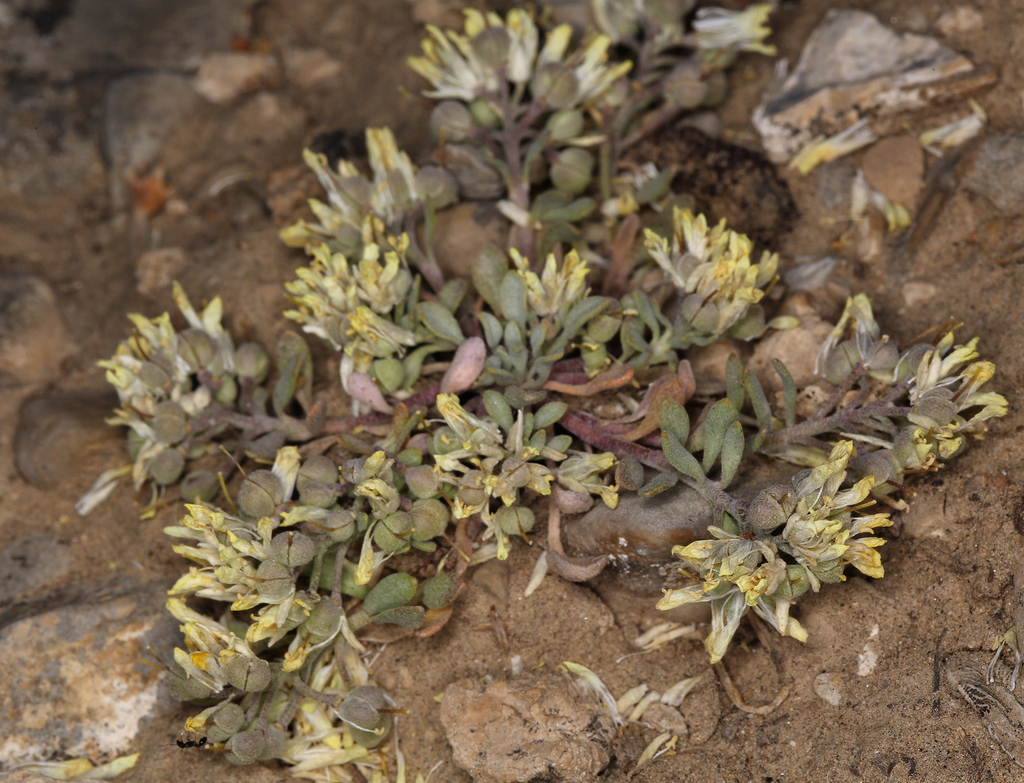
Photo: parent species Physaria kingii · (c) Steve Matson, some rights reserved (CC BY) · licence
Family: Brassicaceae · Type: Herb · Native
Physaria kingii subsp. kingii is a native California herb in the Brassicaceae family, recognized by fruit shape and truncate tip help distinguish from congeners.
King's bladderpod is a California native perennial found in the eastern Sierra Nevada and desert mountains in dry rocky soils, limestone gravel, sagebrush hillsides, and pinyon/juniper woodland at elevations of 1,700 to 3,800 meters. Flowering from May to June, this plant produces pale yellow to white flowers with distinctive fruit tips. Growing with slender stems up to 30 centimeters tall, it forms compact clusters in harsh desert and mountain environments. Its leaves are small and arranged along the stem, providing minimal surface area to conserve moisture in arid conditions. The fruit features truncate or slightly notched tips with sparsely hairy valves, containing 4 to 8 seeds within its distinctive bladder-like pods.
Identification and appearance
Key characters: 3 sympatric species; fruit shape and truncate tip help distinguish from congeners
Habitat and range
Habitat: dry rocky soils, limestone gravel, sagebrush hillsides, pinyon/juniper woodland
Elevation: 1700-3800 m
California counties: Inyo, Mono, San Bernardino
Outside California: Oregon, Idaho, Nevada
Bloom period
Physaria kingii subsp. kingii blooms May-Jun.
How to tell it apart
vs Cleomella: Physaria has 4 petals and inflated pods; Cleomella has 4 petals with long stamens extending far beyond and narrow capsules.; vs Draba: Physaria has consistently silvery webbed star-hairs; Draba has mixed simple and branched hairs creating a rougher texture.; vs Astragalus: Physaria has 4 petals and round cross-shaped flowers; Astragalus has pea-like flowers with banner, wings, and keel.; vs Erysimum: Physaria has inflated bladder fruits and silvery foliage; Erysimum has narrow cylindrical pods and green linear leaves.; vs Eriogonum: Physaria has 4-petaled flowers with visible stamens; Eriogonum has tiny flowers in ball-like clusters with papery bracts below.
Frequently asked questions
Is Physaria kingii subsp. kingii native to California?
Yes. Physaria kingii subsp. kingii is native to California (recorded as native).
When does Physaria kingii subsp. kingii bloom?
Physaria kingii subsp. kingii blooms May-Jun.
Where in California does Physaria kingii subsp. kingii grow?
Physaria kingii subsp. kingii occurs in Inyo, Mono, San Bernardino, at elevations of 1700-3800 m.
What plant family does Physaria kingii subsp. kingii belong to?
Physaria kingii subsp. kingii is in the Brassicaceae family, genus Physaria.
What habitat does Physaria kingii subsp. kingii grow in?
Physaria kingii subsp. kingii grows in dry rocky soils, limestone gravel, sagebrush hillsides, pinyon/juniper woodland.
Related species
Other California species in the same genus, family, or bioregion.
Sources: Jepson eFlora · Index of California Plant Names · CalPhotos
Last updated 2026-10-07
Data from The California Species Project — 14,000+ California species with verified data from CNPS, CDFW, USFWS, Cal-IPC, and more.