Physaria ludoviciana
Silver bladderpod
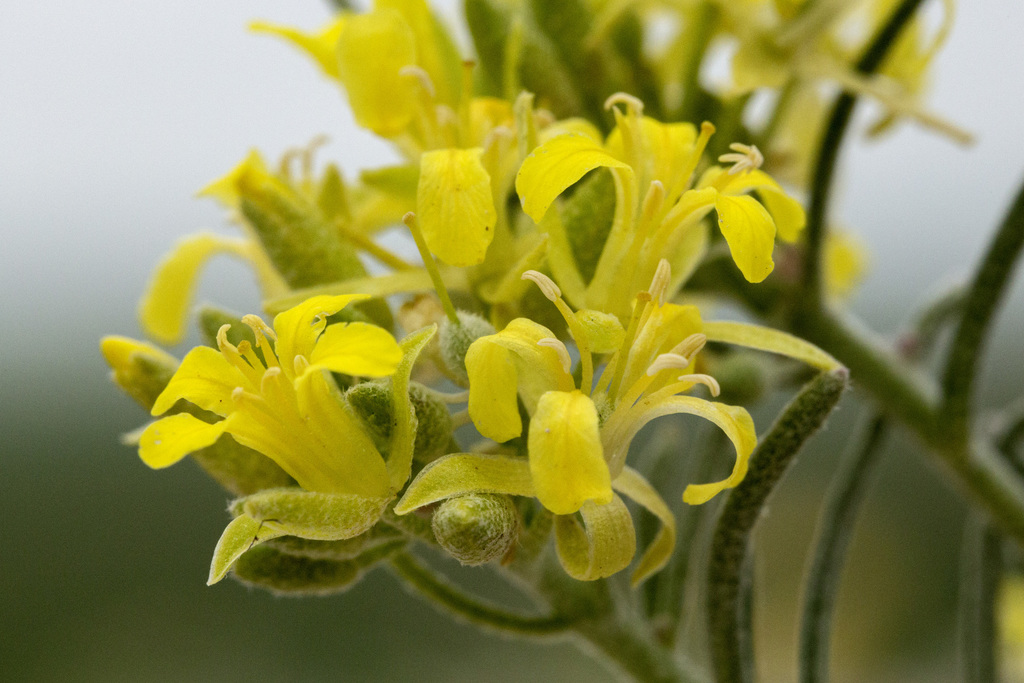
no rights reserved · CC0
Family: Brassicaceae · Type: Herb · Native
Conservation status: CNPS 2B.2
Physaria ludoviciana (Silver bladderpod) is a native California herb in the Brassicaceae family, recognized by no sympatric species.
Silver bladderpod is a rare (CNPS 2B.2) California native perennial found in eastern central Sierra Nevada Mountains, specifically in the Anchorite Hills of Mono County, on sandy and gravelly soils at elevations around 2,150 meters. Flowering from April to August, this plant produces white to yellow flowers with oblanceolate to obovate petals 6.5 to 9.5 millimeters long. Growing with decumbent stems 10 to 35 centimeters tall, it develops a simple or branched caudex. Its leaves are distinctive, with basal and cauline leaves ranging from 1 to 9 centimeters long, oblanceolate to linear in shape, and either entire or slightly dentate. The fruit is nearly spheric or obovoid, 4 to 5.5 millimeters long, covered in fine hairs and containing 8 to 12 flat seeds.
Identification and appearance
Key characters: Geographically isolated; no sympatric species
Habitat and range
Habitat: Sandy, gravelly soils, pastures, hillsides, limestone outcrops
Elevation: 2150 m
California counties: Mono, Kern
Outside California: to Oregon, Idaho, Minnesota, Oklahoma, New Mexico
Bloom period
Physaria ludoviciana blooms Apr-Aug.
Conservation status
CNPS 2B.2
How to tell it apart
vs Cleomella: Physaria has 4 petals and inflated pods; Cleomella has 4 petals with long stamens extending far beyond and narrow capsules.; vs Draba: Physaria has consistently silvery webbed star-hairs; Draba has mixed simple and branched hairs creating a rougher texture.; vs Astragalus: Physaria has 4 petals and round cross-shaped flowers; Astragalus has pea-like flowers with banner, wings, and keel.; vs Erysimum: Physaria has inflated bladder fruits and silvery foliage; Erysimum has narrow cylindrical pods and green linear leaves.; vs Eriogonum: Physaria has 4-petaled flowers with visible stamens; Eriogonum has tiny flowers in ball-like clusters with papery bracts below.
Frequently asked questions
Is Physaria ludoviciana native to California?
Yes. Physaria ludoviciana is native to California (recorded as native).
When does Physaria ludoviciana bloom?
Physaria ludoviciana blooms Apr-Aug.
Where in California does Physaria ludoviciana grow?
Physaria ludoviciana occurs in Mono, Kern, at elevations of 2150 m.
What plant family does Physaria ludoviciana belong to?
Physaria ludoviciana is in the Brassicaceae family, genus Physaria.
Is Physaria ludoviciana rare or endangered?
Physaria ludoviciana carries California Rare Plant Rank 2B.2, state rank S1.
Related species
Other California species in the same genus, family, or bioregion.
Sources: Jepson eFlora · CNPS Rare Plant Inventory · Index of California Plant Names · CalPhotos · CDFW CNDDB
Last updated 2026-10-07
Data from The California Species Project — 14,000+ California species with verified data from CNPS, CDFW, USFWS, Cal-IPC, and more.