Physocarpus capitatus
Ninebark
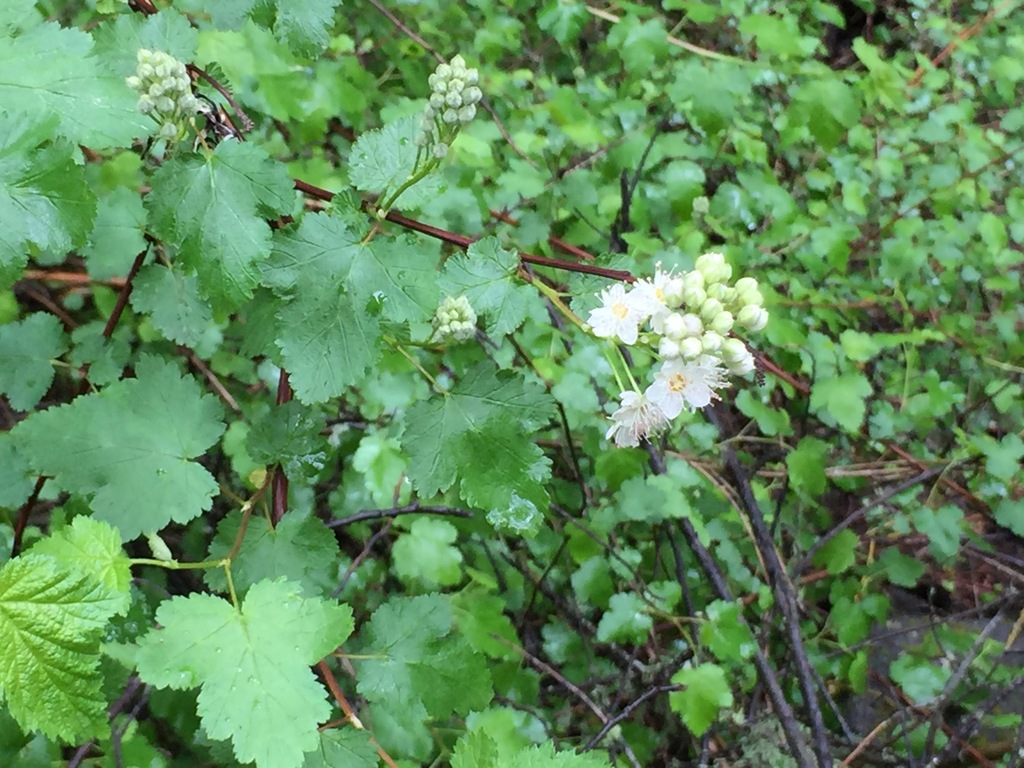
no rights reserved · CC0
Family: Rosaceae · Type: Shrub · Native
Physocarpus capitatus (Ninebark) is a native California shrub in the Rosaceae family.
Ninebark is a California native shrub found in the California Floristic Province (excluding the Great Valley) on moist banks and north-facing slopes in mixed-conifer forest at elevations below 1,400 meters. Flowering from May to July, this plant produces white flowers in clusters with multiple blossoms. Growing 1 to 2.5 meters tall with erect, spreading branches, it forms a dense multi-stemmed shrub with distinctively peeling bark. Its leaves are glabrous to moderately hairy, featuring 3 to 5 lobes that are generally serrate, creating a textured green canopy. The fruit develops as 3 to 5 seed pods approximately 8 to 10 millimeters long, which are glabrous or slightly hairy.
Identification and appearance
Key characters: 0 sympatric species - geographically isolated in California Floristic Province
Habitat and range
Habitat: Moist banks, n-facing slopes, mixed-conifer forest
Elevation: < 1400 m
California counties: Plumas, Trinity, Siskiyou, Napa, El Dorado, Lake, Marin, Santa Clara, Shasta, Butte, Del Norte, Alameda, Humboldt, Sonoma, San Luis Obispo, San Mateo, Madera, Tuolumne, Sierra, Placer, Amador, Mariposa, Monterey, Santa Cruz, Mendocino, Nevada, Fresno, Yuba, Calaveras, Tulare, Contra Costa, Mono, San Diego, Tehama
Outside California: to Alaska, Idaho
Bloom period
Physocarpus capitatus blooms May-Jul.
How to tell it apart
vs Ribes: Physocarpus has umbel-like flower clusters and dry pods; currants have racemes and juicy berries.; vs Rubus: Physocarpus has tiny 2.5-3mm petals and dry pods; Rubus has larger petals and fleshy raspberry-like fruits.; vs Viburnum: Physocarpus has dry splitting pods; viburnum has fleshy drupes.; vs Acer: Physocarpus has rounded flower clusters and follicles; maples have drooping clusters and winged samaras.; vs Sidalcea: Physocarpus has tiny flowers in dense rounded clusters; checkerbloom has larger flowers in elongated spikes.
Frequently asked questions
Is Physocarpus capitatus native to California?
Yes. Physocarpus capitatus is native to California (recorded as native).
When does Physocarpus capitatus bloom?
Physocarpus capitatus blooms May-Jul.
Where in California does Physocarpus capitatus grow?
Physocarpus capitatus occurs in Plumas, Trinity, Siskiyou, Napa, El Dorado, Lake, Marin, Santa Clara and other counties, at elevations of < 1400 m.
What plant family does Physocarpus capitatus belong to?
Physocarpus capitatus is in the Rosaceae family, genus Physocarpus.
What habitat does Physocarpus capitatus grow in?
Physocarpus capitatus grows in Moist banks, n-facing slopes, mixed-conifer forest.
Related species
Other California species in the same genus, family, or bioregion.
Sources: Jepson eFlora · Index of California Plant Names · CalPhotos
Last updated 2026-10-07
Data from The California Species Project — 14,000+ California species with verified data from CNPS, CDFW, USFWS, Cal-IPC, and more.