Pinus attenuata
Knobcone pine
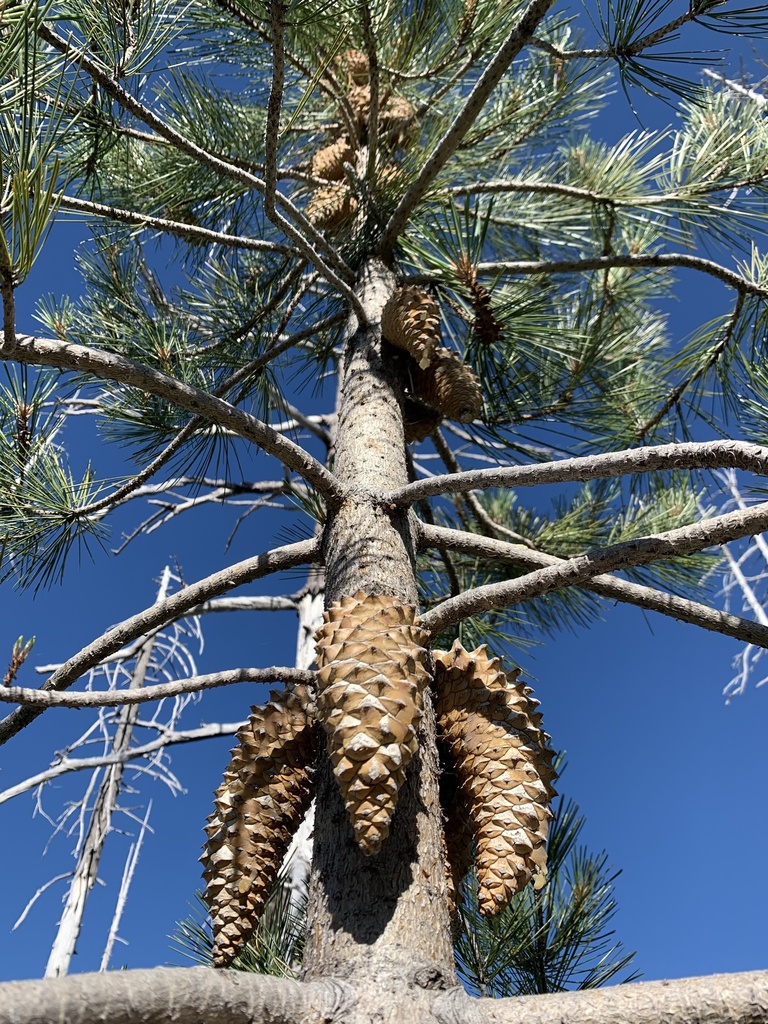
no rights reserved, uploaded by Kate Manning · CC0
Family: Pinaceae · Type: Tree · Native
Pinus attenuata (Knobcone pine) is a native California tree in the Pinaceae family, recognized by Co-occurs with several others in its genus, uniquely identified by asymmetric closed cones with large knobs.
Knobcone pine is a California native tree found in northwestern California, the California Cascade Range, Sierra Nevada, eastern San Francisco Bay Area, southern Coast Ranges, San Bernardino Mountains, Peninsular Ranges, and Modoc Plateau in closed-cone pine forest and chaparral at elevations below 2,000 meters. Its distinctive seed cones remain tightly closed for many years, only opening after fire, creating a dramatic 6 to 18 centimeters long asymmetric cone with prominent knobby scale tips. Growing with a trunk less than 36 meters tall and less than 1.1 meters wide, the tree develops a complex crown with multiple tops and many branches covered in gray-brown bark. Its needles grow in clusters of three, reaching 6 to 16 centimeters long and displaying a distinctive yellow-green color with persistent sheaths. The tree's unique adaptation of serotinous cones allows it to regenerate quickly after wildfire, with seeds dispersing only when the intense heat breaks open the tightly sealed cones.
Identification and appearance
Key characters: Co-occurs with several others in its genus, uniquely identified by asymmetric closed cones with large knobs
Habitat and range
Habitat: Closed-cone-pine forest, chaparral
Elevation: < 2000 m
California counties: Los Angeles, Lake, Orange, Placer, Napa, Humboldt, Del Norte, Alameda, Mariposa, Glenn, San Bernardino, Monterey, Nevada, Modoc, Mendocino, Riverside, Fresno, Marin, Santa Cruz, Siskiyou, San Luis Obispo, Shasta, San Diego, Santa Clara, El Dorado, Sonoma, Butte, Contra Costa, San Mateo, San Francisco, Colusa, Sierra, Trinity, Santa Barbara, Tehama, Plumas
Outside California: southwestern Oregon, Baja California
How to tell it apart
vs Pseudotsuga: Pine needles come bundled in groups with papery sheaths; Douglas-fir needles attach individually to smooth twigs.; vs Abies: Pine needles come bundled in groups of 2-5; fir needles attach individually and directly to twigs.; vs Sequoia: Pine has bundled needles in groups of 2-5; redwood has individual scale-like or awl-shaped leaves on flat sprays.; vs Casuarina: Pine has true needles bundled in groups; Casuarina has jointed branchlets with whorls of tiny scale leaves.; vs Cedrus: Pine needles are bundled in tight clusters of 2-5; cedar needles grow in dense rosette-like clusters on short shoots.
Frequently asked questions
Is Pinus attenuata native to California?
Yes. Pinus attenuata is native to California (recorded as native).
Where in California does Pinus attenuata grow?
Pinus attenuata occurs in Los Angeles, Lake, Orange, Placer, Napa, Humboldt, Del Norte, Alameda and other counties, at elevations of < 2000 m.
What plant family does Pinus attenuata belong to?
Pinus attenuata is in the Pinaceae family, genus Pinus.
What habitat does Pinus attenuata grow in?
Pinus attenuata grows in Closed-cone-pine forest, chaparral.
Related species
Other California species in the same genus, family, or bioregion.
Sources: Jepson eFlora · Index of California Plant Names · CalPhotos
Last updated 2026-10-07
Data from The California Species Project — 14,000+ California species with verified data from CNPS, CDFW, USFWS, Cal-IPC, and more.