Pinus contorta subsp. murrayana
Lodgepole pine, Lodgepole Pine
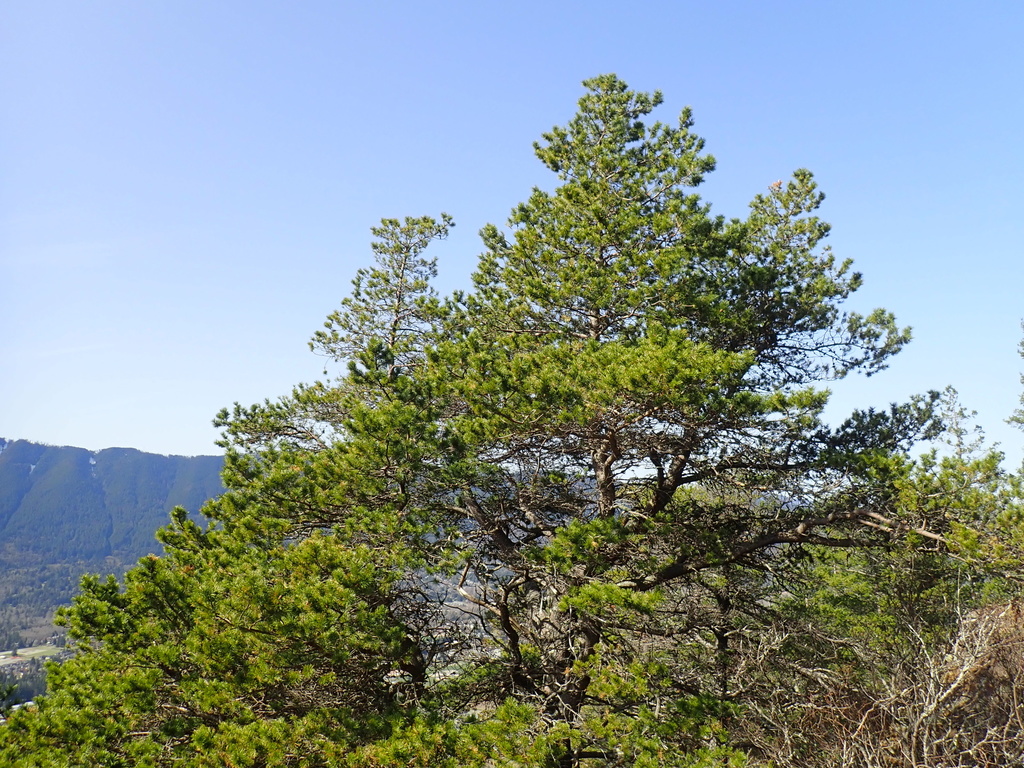
(c) John Brew, some rights reserved (CC BY), uploaded by John Brew · licence
Family: Pinaceae · Type: Tree · Native
Pinus contorta subsp. murrayana (Lodgepole pine) is a native California tree in the Pinaceae family, recognized by Montane habitat and deciduous symmetric cones distinguish from coastal subspecies.
Lodgepole pine is a California native tree found in the Klamath Ranges, Cascade Range, Sierra Nevada, southern Sierra Nevada, San Bernardino Mountains, San Jacinto Mountains, and Great Basin in lodgepole forests, wet meadows, and cold mixed-conifer forest environments at elevations of 1,000 to 3,500 meters. While flowering time is not specified, this coniferous tree forms distinctive trunks typically less than 34 meters tall with a characteristic pyramidal shape. Growing with multiple stems that can cluster together, it develops a dense, compact form adapted to high-elevation and cold mountain environments. Its needles are typically dark green, appearing in bundles of two, and create a thick, bushy crown that provides excellent wind and cold resistance. The tree produces small, symmetrical seed cones that are deciduous, dropping soon after opening to spread its seeds across its alpine and subalpine habitats.
Identification and appearance
Key characters: Montane habitat and deciduous symmetric cones distinguish from coastal subspecies
Habitat and range
Habitat: Lodgepole forest, wet meadows, cold places in mixed-conifer forest
Elevation: 1000-3500 m
California counties: Riverside, San Bernardino, Tulare, Los Angeles, Mariposa, Mono, Kern, Placer, El Dorado, Nevada, Alpine, Inyo, Amador, Plumas, Modoc, Shasta, Sierra, Fresno, Siskiyou, Contra Costa, Butte, Tuolumne, Calaveras, Del Norte, Tehama, Madera, Lassen, Trinity, San Luis Obispo, San Diego
Outside California: Oregon, northern Baja California
How to tell it apart
vs Pseudotsuga: Pine needles come bundled in groups with papery sheaths; Douglas-fir needles attach individually to smooth twigs.; vs Abies: Pine needles come bundled in groups of 2-5; fir needles attach individually and directly to twigs.; vs Sequoia: Pine has bundled needles in groups of 2-5; redwood has individual scale-like or awl-shaped leaves on flat sprays.; vs Casuarina: Pine has true needles bundled in groups; Casuarina has jointed branchlets with whorls of tiny scale leaves.; vs Cedrus: Pine needles are bundled in tight clusters of 2-5; cedar needles grow in dense rosette-like clusters on short shoots.
Frequently asked questions
Is Pinus contorta subsp. murrayana native to California?
Yes. Pinus contorta subsp. murrayana is native to California (recorded as native).
Where in California does Pinus contorta subsp. murrayana grow?
Pinus contorta subsp. murrayana occurs in Riverside, San Bernardino, Tulare, Los Angeles, Mariposa, Mono, Kern, Placer and other counties, at elevations of 1000-3500 m.
What plant family does Pinus contorta subsp. murrayana belong to?
Pinus contorta subsp. murrayana is in the Pinaceae family, genus Pinus.
What habitat does Pinus contorta subsp. murrayana grow in?
Pinus contorta subsp. murrayana grows in Lodgepole forest, wet meadows, cold places in mixed-conifer forest.
Related species
Other California species in the same genus, family, or bioregion.
Sources: Jepson eFlora · Index of California Plant Names · CalPhotos
Last updated 2026-10-07
Data from The California Species Project — 14,000+ California species with verified data from CNPS, CDFW, USFWS, Cal-IPC, and more.