Pinus jeffreyi
Jeffrey pine
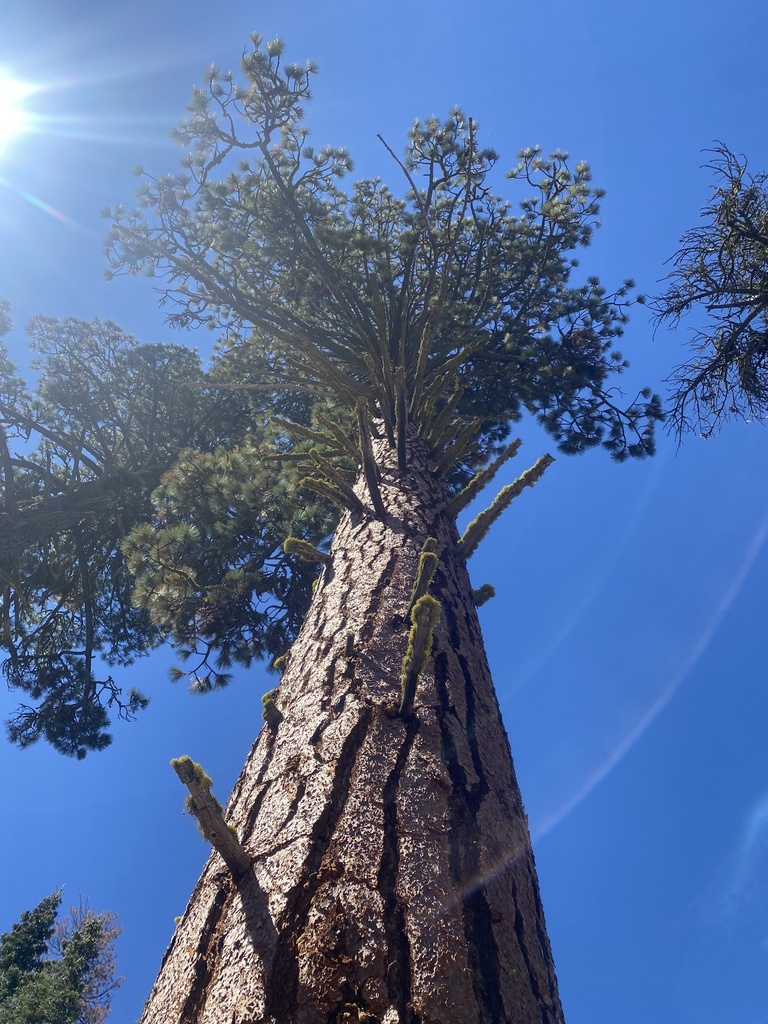
(c) Skyler K, some rights reserved (CC BY), uploaded by Skyler K · licence
Family: Pinaceae · Type: Tree · Native
Pinus jeffreyi (Jeffrey pine) is a native California tree in the Pinaceae family, recognized by Bark fragrance and cone characteristics distinguish from closely related ponderosa pine.
Jeffrey pine is a California native conifer found in the Klamath Ranges, North Coast Ranges, Cascade Ranges, Sierra Nevada, southern Coast Ranges, Transverse Ranges, Peninsular Ranges, and Great Basin in upper mixed-conifer and red-fir forests at elevations of 450 to 3,100 meters. Growing with massive trunks up to 53 meters tall and rounded mature crowns, this pine has distinctive red-brown bark with close-spaced deep furrows that emit a remarkable vanilla or banana scent, especially on warm days. Its needles grow in clusters of three, reaching 12 to 27 centimeters long and displaying a distinctive gray-blue-green color with a glaucous surface. The seed cones are large and spreading, generally 13 to 25 centimeters long, ranging from ovate to oblong and colored brown with light green to red-purple when immature. Mature cones feature scales with recurved tips and white-fringed bracts, creating an intricate and textured appearance characteristic of this majestic mountain pine.
Identification and appearance
Key characters: Bark fragrance and cone characteristics distinguish from closely related ponderosa pine
Habitat and range
Habitat: Upper mixed-conifer, red-fir forests, elsewhere on serpentine
Elevation: 450-3100 m
California counties: Mono, Butte, El Dorado, Fresno, Lassen, Humboldt, Riverside, Inyo, Madera, Nevada, Los Angeles, Kern, Mendocino, San Bernardino, Alpine, Sierra, Siskiyou, Ventura, Tuolumne, San Diego, Tulare, Amador, Shasta, Modoc, Lake, Plumas, Tehama, San Benito, Trinity, Mariposa, Placer, Santa Barbara, Monterey, Del Norte, Kings
Outside California: southwestern Oregon, western Nevada, northern Baja California
How to tell it apart
vs Pseudotsuga: Pine needles come bundled in groups with papery sheaths; Douglas-fir needles attach individually to smooth twigs.; vs Abies: Pine needles come bundled in groups of 2-5; fir needles attach individually and directly to twigs.; vs Sequoia: Pine has bundled needles in groups of 2-5; redwood has individual scale-like or awl-shaped leaves on flat sprays.; vs Casuarina: Pine has true needles bundled in groups; Casuarina has jointed branchlets with whorls of tiny scale leaves.; vs Cedrus: Pine needles are bundled in tight clusters of 2-5; cedar needles grow in dense rosette-like clusters on short shoots.
Frequently asked questions
Is Pinus jeffreyi native to California?
Yes. Pinus jeffreyi is native to California (recorded as native).
Where in California does Pinus jeffreyi grow?
Pinus jeffreyi occurs in Mono, Butte, El Dorado, Fresno, Lassen, Humboldt, Riverside, Inyo and other counties, at elevations of 450-3100 m.
What plant family does Pinus jeffreyi belong to?
Pinus jeffreyi is in the Pinaceae family, genus Pinus.
What habitat does Pinus jeffreyi grow in?
Pinus jeffreyi grows in Upper mixed-conifer, red-fir forests, elsewhere on serpentine.
Related species
Other California species in the same genus, family, or bioregion.
Sources: Jepson eFlora · Index of California Plant Names · CalPhotos
Last updated 2026-10-07
Data from The California Species Project — 14,000+ California species with verified data from CNPS, CDFW, USFWS, Cal-IPC, and more.