Pinus torreyana subsp. insularis
Santa rosa island torrey pine, Santa Rosa Island Torrey Pine
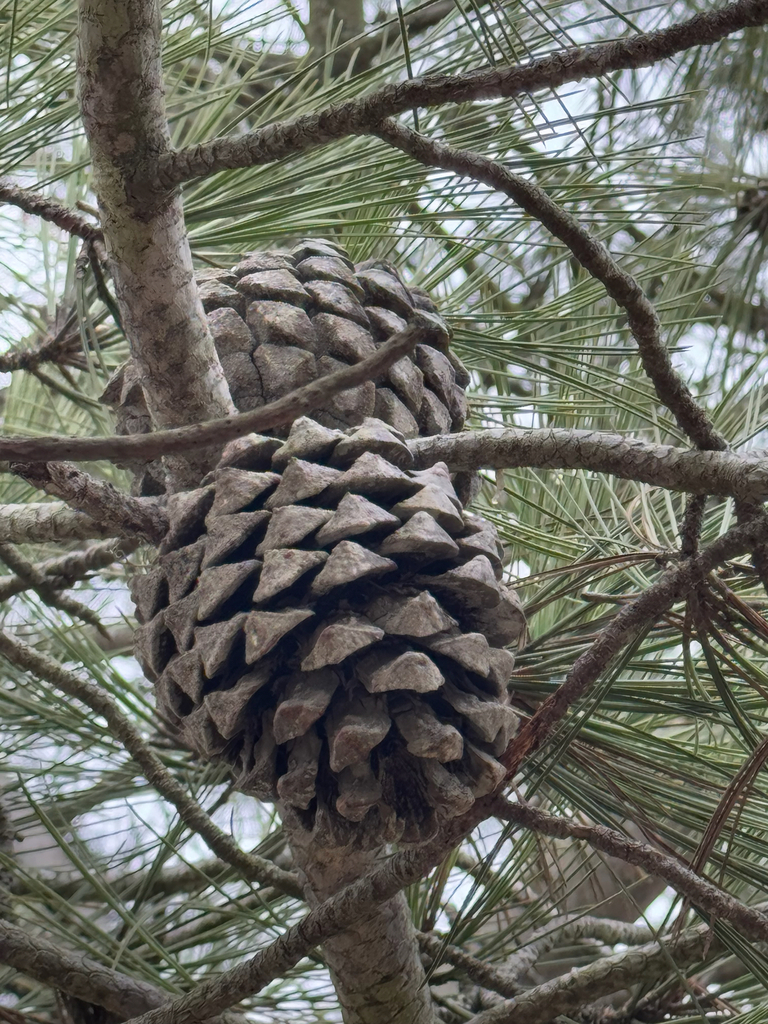
Photo: parent species Pinus torreyana · (c) CK2AZ, some rights reserved (CC BY) · licence
Family: Pinaceae · Type: Tree · Native
Conservation status: CNPS 1B.2
Pinus torreyana subsp. insularis (Santa rosa island torrey pine) is a native California tree in the Pinaceae family, recognized by island location, cone size/shape, and scale knob characteristics.
Santa rosa island torrey pine is a rare (CNPS 1B.2) California native shrub found in the northern Channel Islands on Santa Rosa Island in coastal woodland at elevations below 150 meters. Producing no flower data, this pine displays distinctive gray-blue-green needles characteristic of its unique island habitat. Growing as a compact tree with mature crowns often wider than its height and densely crowded branches, it reaches trunk heights under 15 meters. Its seed cones are remarkably large, typically over 13.5 centimeters wide, with prominent scale tip knobs exceeding 6 millimeters that curve outward. The pine produces substantial seeds generally more than 11 millimeters wide, ranging from medium brown to nearly black in color.
Identification and appearance
Key characters: 4 sympatric species; distinguished by island location, cone size/shape, and scale knob characteristics
Habitat and range
Habitat: Forming densely forested strip on +- n-facing slope parallel to coast, with scattered chaparral, island woodland components
Elevation: < 150 m
California counties: Santa Barbara
Conservation status
CNPS 1B.2
How to tell it apart
vs Pseudotsuga: Pine needles come bundled in groups with papery sheaths; Douglas-fir needles attach individually to smooth twigs.; vs Abies: Pine needles come bundled in groups of 2-5; fir needles attach individually and directly to twigs.; vs Sequoia: Pine has bundled needles in groups of 2-5; redwood has individual scale-like or awl-shaped leaves on flat sprays.; vs Casuarina: Pine has true needles bundled in groups; Casuarina has jointed branchlets with whorls of tiny scale leaves.; vs Cedrus: Pine needles are bundled in tight clusters of 2-5; cedar needles grow in dense rosette-like clusters on short shoots.
Frequently asked questions
Is Pinus torreyana subsp. insularis native to California?
Yes. Pinus torreyana subsp. insularis is native to California (recorded as native).
Where in California does Pinus torreyana subsp. insularis grow?
Pinus torreyana subsp. insularis occurs in Santa Barbara, at elevations of < 150 m.
What plant family does Pinus torreyana subsp. insularis belong to?
Pinus torreyana subsp. insularis is in the Pinaceae family, genus Pinus.
Is Pinus torreyana subsp. insularis rare or endangered?
Pinus torreyana subsp. insularis carries California Rare Plant Rank 1B.2, state rank S1.
What habitat does Pinus torreyana subsp. insularis grow in?
Pinus torreyana subsp. insularis grows in Forming densely forested strip on +- n-facing slope parallel to coast, with scattered chaparral, island woodland components.
Related species
Other California species in the same genus, family, or bioregion.
- Pinus torreyana subsp. torreyana — Torrey pine
- Pinus albicaulis — Whitebark pine
- Pinus attenuata — Knobcone pine
- Pinus balfouriana — Foxtail pine
- Pinus balfouriana subsp. austrina
- Pinus balfouriana subsp. balfouriana
- Pseudotsuga macrocarpa — Bigcone douglas-fir
- Pseudotsuga menziesii var. menziesii — Douglas-fir
- Pseudotsuga sp.
Sources: Jepson eFlora · CNPS Rare Plant Inventory · Index of California Plant Names · CalPhotos · CDFW CNDDB
Last updated 2026-10-07
Data from The California Species Project — 14,000+ California species with verified data from CNPS, CDFW, USFWS, Cal-IPC, and more.