Pisum sativum
Common pea
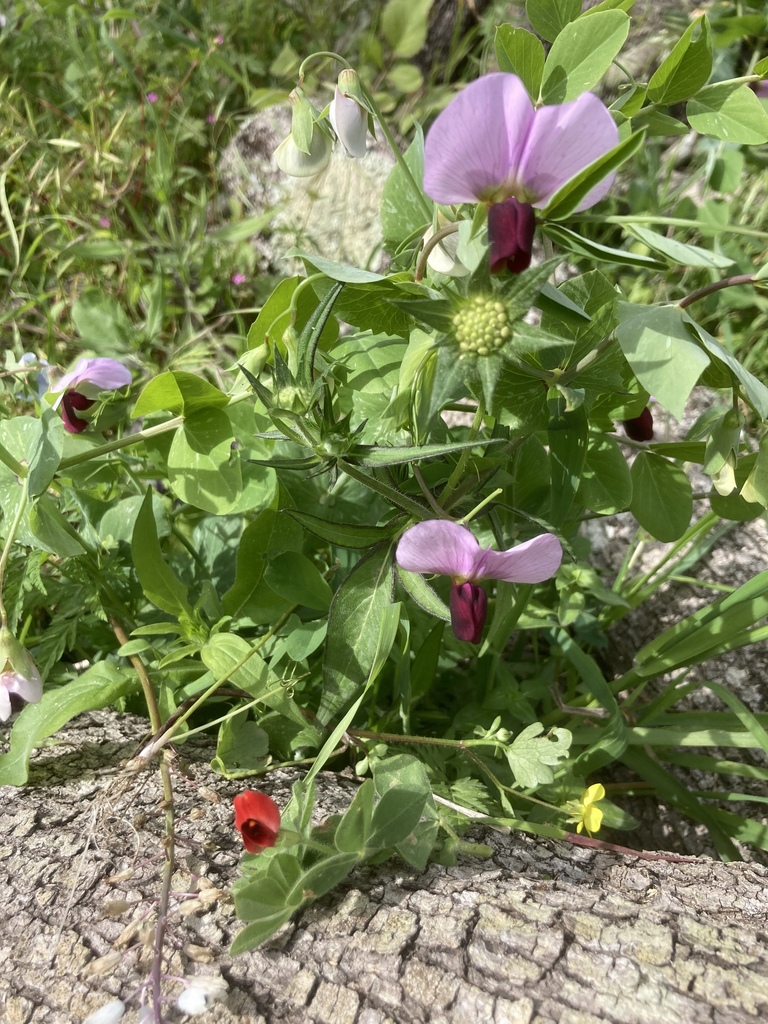
(c) Andre Hosper, some rights reserved (CC BY) · licence
Family: Fabaceae · Type: Vine · Not Native
Pisum sativum (Common pea) is a non-native California vine in the Fabaceae family, recognized by Domesticated crop occasionally persisting from cultivation - ancestral wild forms from Mediterranean.
Common pea is a naturalized annual found in coastal and central California regions, including the North Coast, North Coast Ranges, Central Valley, coastal Southern California, and Peninsular Ranges, typically in disturbed areas at elevations below 1,000 meters. Flowering from February to May, this plant produces white, pink, or purple flowers 10 to 25 millimeters long, often displaying multiple colors within a single flower cluster. Growing with often climbing stems, it develops a flexible growth habit that can reach substantial lengths in suitable conditions. Its compound leaves feature distinctive stipules with toothed or wavy margins, and leaflets that are ovate or elliptic, measuring 2 to 4 centimeters long. The plant's adaptable nature allows it to thrive in various disturbed habitats, making it a resilient introduced species in California landscapes.
Identification and appearance
Key characters: Domesticated crop occasionally persisting from cultivation - ancestral wild forms from Mediterranean
Habitat and range
Habitat: Uncommon. Disturbed areas
Elevation: < 1000 m
California counties: San Bernardino, Riverside, Los Angeles, Santa Barbara, Ventura, San Luis Obispo, Orange, Yuba, Sacramento, Butte, Colusa, Humboldt, Sonoma, San Mateo, Sierra, San Diego, Yolo, Solano, Sutter, Fresno
Outside California: to eastern United States, native to Mediterranean, western Asia
Bloom period
Pisum sativum blooms Feb-May.
How to tell it apart
vs Lathyrus: Pisum has giant leafy stipules larger than leaflets; Lathyrus stipules are small and ordinary.; vs Vicia: Pisum has only 4-6 leaflets with huge stipules; Vicia has many more leaflets and tiny stipules.; vs Lupinus: Pisum has tendril-tipped leaves with paired leaflets; Lupinus has palmate leaves radiating from one point.; vs Acmispon: Pisum has tendrils and oversized stipules; Acmispon has no tendrils and tiny glandular stipules.; vs Raphanus: Pisum has compound leaves with tendrils; Raphanus has simple lobed leaves and four-petaled flowers.
Frequently asked questions
Is Pisum sativum native to California?
No. Pisum sativum is not native to California (recorded as not native).
When does Pisum sativum bloom?
Pisum sativum blooms Feb-May.
Where in California does Pisum sativum grow?
Pisum sativum occurs in San Bernardino, Riverside, Los Angeles, Santa Barbara, Ventura, San Luis Obispo, Orange, Yuba and other counties, at elevations of < 1000 m.
What plant family does Pisum sativum belong to?
Pisum sativum is in the Fabaceae family, genus Pisum.
What habitat does Pisum sativum grow in?
Pisum sativum grows in Uncommon. Disturbed areas.
Related species
Other California species in the same genus, family, or bioregion.
Sources: Jepson eFlora · Index of California Plant Names · CalPhotos
Last updated 2026-10-07
Data from The California Species Project — 14,000+ California species with verified data from CNPS, CDFW, USFWS, Cal-IPC, and more.