Pittosporum crassifolium
Stiffleaf cheesewood
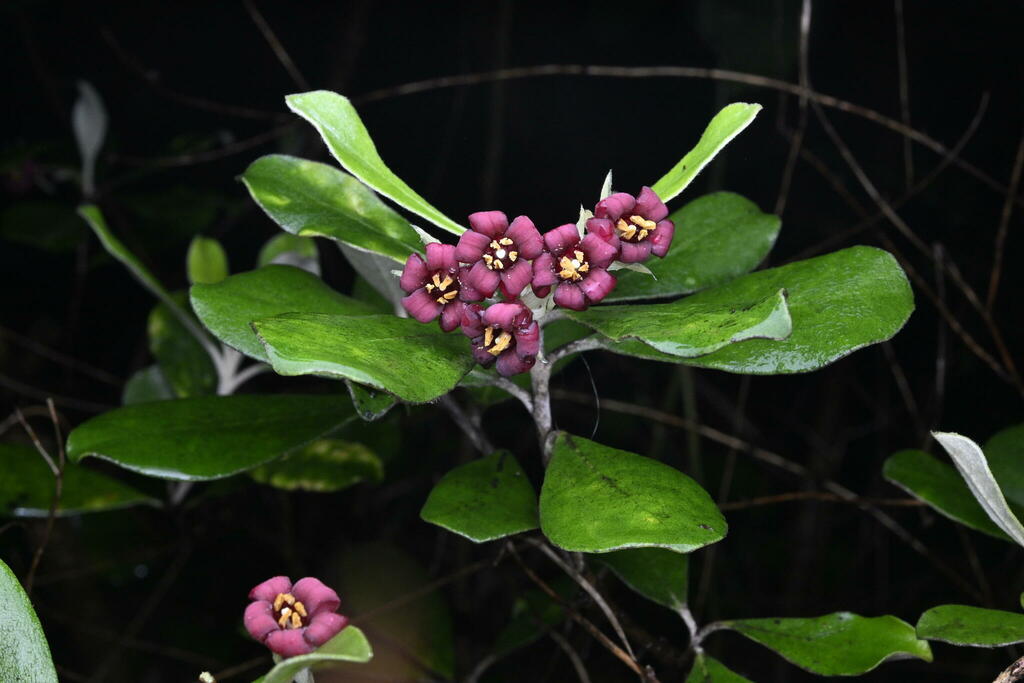
(c) Saryu Mae 前 朝琉, some rights reserved (CC BY) · licence
Family: Pittosporaceae · Type: Shrub / Tree · Not Native
Pittosporum crassifolium (Stiffleaf cheesewood) is a non-native California shrub / tree in the Pittosporaceae family, recognized by leaf texture, size, and abaxial pubescence.
Stiffleaf cheesewood is a naturalized shrub found in the central Coast Ranges at elevations below 200 meters in disturbed areas. Flowering from November to May, this plant produces dark red to purple-black flowers approximately 1 centimeter long in terminal umbels. Growing as a small shrub or tree up to 9 meters tall with densely hairy twigs, it has a distinctive branching habit. Its leathery leaves are 4.5 to 7 centimeters long, oblong to obovate, with white undersides densely covered in hair and margins slightly turned under. The fruit is a spheric or ovoid capsule 1.5 to 3 centimeters long, covered in dense hair and typically splitting into three valves.
Identification and appearance
Key characters: 2 sympatric species; key features are leaf texture, size, and abaxial pubescence
Habitat and range
Habitat: Uncommon. Disturbed areas
Elevation: < 200 m
California counties: Santa Cruz, San Francisco, Alameda, Ventura, Los Angeles, Orange, Contra Costa, San Mateo, San Diego, Santa Barbara, Monterey, Santa Clara
Outside California: native to New Zealand
Bloom period
Pittosporum crassifolium blooms Nov-May.
How to tell it apart
vs Heptapleurum: Pittosporum has simple leaves; Heptapleurum has compound leaves with leaflets radiating like fingers.; vs Eriobotrya: Pittosporum has smooth leaf edges; Eriobotrya has toothed leaves and fuzzy undersides.; vs Quercus: Pittosporum has smooth leathery leaves; Quercus has lobed or toothed leaves and acorns.; vs Philadelphus: Pittosporum has leathery evergreen leaves; Philadelphus has deciduous leaves and showy 4-petaled flowers.; vs Coprosma: Pittosporum has flowers with visible petals; Coprosma has tiny inconspicuous flowers and colorful berries.
Frequently asked questions
Is Pittosporum crassifolium native to California?
No. Pittosporum crassifolium is not native to California (recorded as not native).
When does Pittosporum crassifolium bloom?
Pittosporum crassifolium blooms Nov-May.
Where in California does Pittosporum crassifolium grow?
Pittosporum crassifolium occurs in Santa Cruz, San Francisco, Alameda, Ventura, Los Angeles, Orange, Contra Costa, San Mateo and other counties, at elevations of < 200 m.
What plant family does Pittosporum crassifolium belong to?
Pittosporum crassifolium is in the Pittosporaceae family, genus Pittosporum.
What habitat does Pittosporum crassifolium grow in?
Pittosporum crassifolium grows in Uncommon. Disturbed areas.
Related species
Other California species in the same genus, family, or bioregion.
Sources: Jepson eFlora · Index of California Plant Names · CalPhotos
Last updated 2026-10-07
Data from The California Species Project — 14,000+ California species with verified data from CNPS, CDFW, USFWS, Cal-IPC, and more.