Pityopus californicus
California pinefoot, California Pinefoot
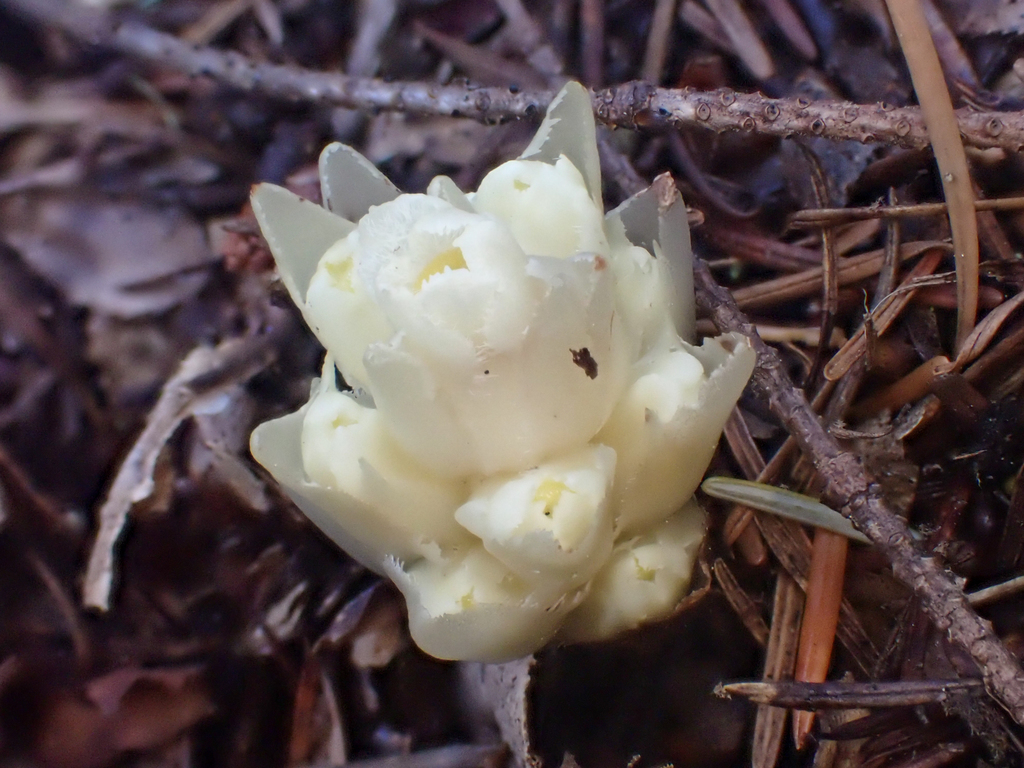
(c) Trevor Van Loon, some rights reserved (CC BY) · licence
Family: Ericaceae · Type: Perennial · Native
Conservation status: CNPS 4.2
Pityopus californicus (California pinefoot) is a native California perennial in the Ericaceae family, recognized by Distinctive member of heath family's parasitic/saprophytic lineage - differs from related genera by flower structure and coloration.
California pinefoot is a rare (CNPS 4.2) California native perennial found in northern coastal, Klamath Ranges, northern coastal ranges, southern Sierra Nevada, central coastal, and San Francisco Bay Area regions in mixed or conifer forest at elevations below 1,800 meters. Flowering from May to July, this unusual plant produces cream to pale yellow flowers emerging directly from the ground in small racemes or solitary blooms. Growing as a non-green, fleshy perennial without visible stems or leaves, it develops brittle roots that support delicate floral structures. Its flowers feature distinctive cream to yellow petals with a cylindric shape, densely hairy interior, and eight erect horseshoe-shaped anthers. The plant produces small berries less than one centimeter long containing numerous ovate seeds.
Identification and appearance
Key characters: Distinctive member of heath family's parasitic/saprophytic lineage - differs from related genera by flower structure and coloration
Habitat and range
Habitat: Mixed or conifer forest
Elevation: < 1800 m
California counties: Mendocino, Del Norte, Siskiyou, Humboldt, Kern, Marin, Fresno, Sonoma, Tulare
Outside California: to Washington
Bloom period
Pityopus californicus blooms May-Jul.
Conservation status
CNPS 4.2
How to tell it apart
vs Pleuricospora: Pityopus flowers densely hairy inside; Pleuricospora flowers completely smooth inside.; vs Hemitomes: Pityopus has separate hairy petals; Hemitomes has fused petals forming a smooth tube.; vs Sarcodes: Pityopus is reddish-brown with hairy flower interiors; Sarcodes is bright red with smooth flowers.; vs Pterospora: Pityopus produces fleshy berries; Pterospora has dry capsules.; vs Allotropa: Pityopus is uniformly colored with hairy flowers; Allotropa has stripes and smooth flowers with protruding stamens.
Frequently asked questions
Is Pityopus californicus native to California?
Yes. Pityopus californicus is native to California (recorded as native).
When does Pityopus californicus bloom?
Pityopus californicus blooms May-Jul.
Where in California does Pityopus californicus grow?
Pityopus californicus occurs in Mendocino, Del Norte, Siskiyou, Humboldt, Kern, Marin, Fresno, Sonoma and other counties, at elevations of < 1800 m.
What plant family does Pityopus californicus belong to?
Pityopus californicus is in the Ericaceae family, genus Pityopus.
Is Pityopus californicus rare or endangered?
Pityopus californicus carries California Rare Plant Rank 4.2, state rank S4.
Related species
Other California species in the same genus, family, or bioregion.
Sources: Jepson eFlora · CNPS Rare Plant Inventory · Index of California Plant Names · CalPhotos · CDFW CNDDB
Last updated 2026-04-09
Data from The California Species Project — 14,000+ California species with verified data from CNPS, CDFW, USFWS, Cal-IPC, and more.