Plagiobothrys chorisianus var. chorisianus
Choris' popcornflower, Choris' Popcornflower
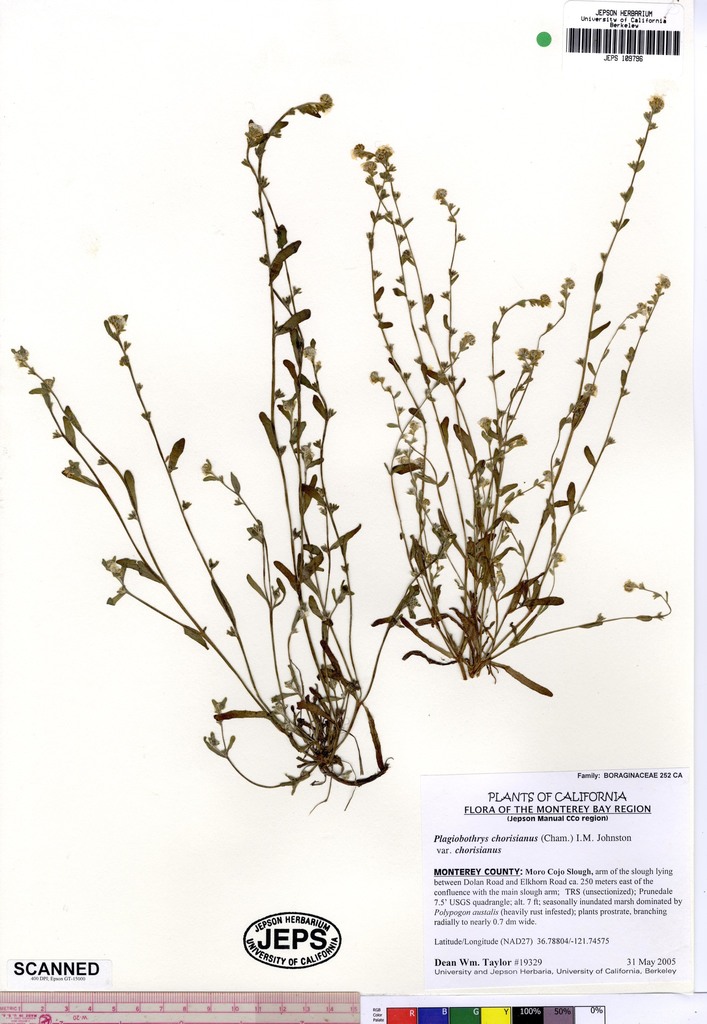
(c) Dean Wm. Taylor, some rights reserved (CC BY) · licence
Family: Boraginaceae · Type: Herb · Native
Conservation status: CNPS 1B.2
Plagiobothrys chorisianus var. chorisianus (Choris' popcornflower) is a native California herb in the Boraginaceae family, recognized by largest flowers (6-10mm) and fused lower leaves.
Choris' popcornflower is a rare (CNPS 1B.2) California native annual found in the Klamath Ranges, northern Coast Ranges, northern central Coast, and western San Francisco Bay Area in grassy, moist places, ephemeral drainages, coastal scrub, and chaparral at elevations below 650 meters. Flowering from March to June, this plant produces small white flowers with corolla limbs 6 to 10 millimeters wide. Growing with decumbent to erect stems that branch from upper axils, it spreads in delicate clusters across moist landscapes. Its lower leaf pair is generally fused at the base, partially sheathing the stem, with a characteristic arrangement that helps distinguish this tiny annual. The flower's pedicels are notably longer than the calyx, creating a distinctive branching pattern in its subtle, understated growth.
Identification and appearance
Key characters: 32 sympatric species; largest flowers (6-10mm) and fused lower leaves
Habitat and range
Habitat: Grassy, moist places, ephemeral drainages, coastal scrub, chaparral
Elevation: < 650 m
California counties: San Mateo, Mendocino, San Francisco, Santa Cruz, Monterey
Bloom period
Plagiobothrys chorisianus var. chorisianus blooms Mar-Jun.
Conservation status
CNPS 1B.2
How to tell it apart
vs Cryptantha: Seeds have a raised ridge down the inner face, not a groove like Cryptantha.; vs Pectocarya: Seeds lack the comb-like marginal barbs of Pectocarya; attachment scar is raised.; vs Myosotis: Flowers are smaller and more tubular; Myosotis has wider, flatter blue flowers with yellow centers.; vs Nemophila: Nemophila has much larger, showier blue-white flowers and broader leaves.; vs Leptosiphon: Leptosiphon has needle-like divided leaves; Plagiobothrys has simple narrow leaves.
Frequently asked questions
Is Plagiobothrys chorisianus var. chorisianus native to California?
Yes. Plagiobothrys chorisianus var. chorisianus is native to California (recorded as native).
When does Plagiobothrys chorisianus var. chorisianus bloom?
Plagiobothrys chorisianus var. chorisianus blooms Mar-Jun.
Where in California does Plagiobothrys chorisianus var. chorisianus grow?
Plagiobothrys chorisianus var. chorisianus occurs in San Mateo, Mendocino, San Francisco, Santa Cruz, Monterey, at elevations of < 650 m.
What plant family does Plagiobothrys chorisianus var. chorisianus belong to?
Plagiobothrys chorisianus var. chorisianus is in the Boraginaceae family, genus Plagiobothrys.
Is Plagiobothrys chorisianus var. chorisianus rare or endangered?
Plagiobothrys chorisianus var. chorisianus carries California Rare Plant Rank 1B.2, state rank S1.
Related species
Other California species in the same genus, family, or bioregion.
- Plagiobothrys chorisianus var. hickmanii — Hickman's popcornflower
- Plagiobothrys cognatus — Cognate popcornflower
- Plagiobothrys collinus — Cooper's popcornflower
- Plagiobothrys collinus var. californicus — California popcornflower
- Plagiobothrys collinus var. fulvescens — Rough-stemmed popcornflower
- Plagiobothrys collinus var. gracilis — San diego popcornflower
Sources: Jepson eFlora · CNPS Rare Plant Inventory · Index of California Plant Names · CalPhotos · CDFW CNDDB
Last updated 2026-10-07
Data from The California Species Project — 14,000+ California species with verified data from CNPS, CDFW, USFWS, Cal-IPC, and more.