Plagiobothrys collinus var. californicus
California popcornflower
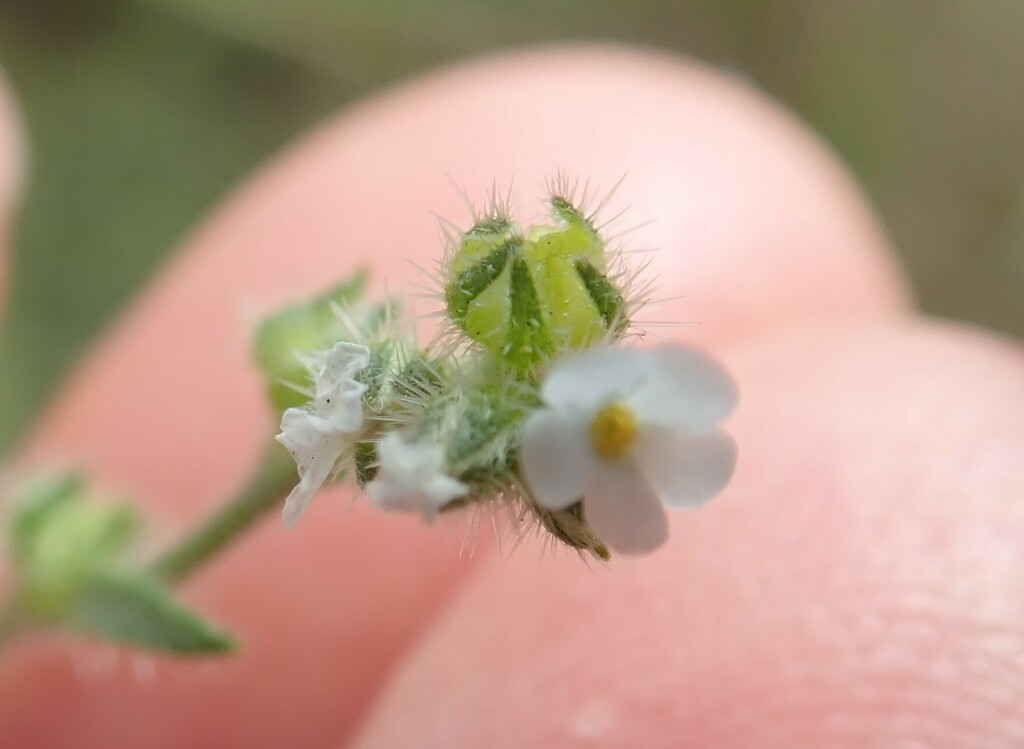
Photo: parent species Plagiobothrys collinus · (c) Millie Basden, some rights reserved (CC BY) · licence
Family: Boraginaceae · Type: Herb · Native
Plagiobothrys collinus var. californicus (California popcornflower) is a native California herb in the Boraginaceae family, recognized by prostrate habit, large flowers (4-8mm), fine soft hairs.
California popcornflower is a California native annual found in southern San Joaquin Valley, central western California, southwestern California, and the northwestern edge of the Sonoran Desert near San Gorgonio Pass in openings of coastal scrub and occasionally chaparral at elevations generally below 700 meters. Flowering from February to May, this plant produces small white flowers with yellow appendages about 4 to 8 millimeters in diameter. Growing with somewhat prostrate stems 10 to 40 centimeters long covered in fine, soft hairs, it has a delicate spreading form. Its leaves are oblanceolate, measuring 1 to 3 centimeters long and 2 to 5 millimeters wide, with inflorescences that extend beyond the leaf length. Small nutlets 1.5 to 2 millimeters long form after flowering, completing the plant's reproductive cycle.
Identification and appearance
Key characters: 36 sympatric species; prostrate habit, large flowers (4-8mm), fine soft hairs
Habitat and range
Habitat: Openings in coastal scrub, occasionally chaparral
Elevation: generally < 700(2300) m
California counties: Riverside, Orange, San Diego, Los Angeles, San Bernardino, Monterey, Santa Barbara, Ventura, Tulare, Kern, San Benito, Colusa, Sonoma, Marin, Santa Cruz, San Luis Obispo
Outside California: Mexico
Bloom period
Plagiobothrys collinus var. californicus blooms Feb-May.
How to tell it apart
vs Cryptantha: Seeds have a raised ridge down the inner face, not a groove like Cryptantha.; vs Pectocarya: Seeds lack the comb-like marginal barbs of Pectocarya; attachment scar is raised.; vs Myosotis: Flowers are smaller and more tubular; Myosotis has wider, flatter blue flowers with yellow centers.; vs Nemophila: Nemophila has much larger, showier blue-white flowers and broader leaves.; vs Leptosiphon: Leptosiphon has needle-like divided leaves; Plagiobothrys has simple narrow leaves.
Frequently asked questions
Is Plagiobothrys collinus var. californicus native to California?
Yes. Plagiobothrys collinus var. californicus is native to California (recorded as native).
When does Plagiobothrys collinus var. californicus bloom?
Plagiobothrys collinus var. californicus blooms Feb-May.
Where in California does Plagiobothrys collinus var. californicus grow?
Plagiobothrys collinus var. californicus occurs in Riverside, Orange, San Diego, Los Angeles, San Bernardino, Monterey, Santa Barbara, Ventura and other counties, at elevations of generally < 700(2300) m.
What plant family does Plagiobothrys collinus var. californicus belong to?
Plagiobothrys collinus var. californicus is in the Boraginaceae family, genus Plagiobothrys.
What habitat does Plagiobothrys collinus var. californicus grow in?
Plagiobothrys collinus var. californicus grows in Openings in coastal scrub, occasionally chaparral.
Related species
Other California species in the same genus, family, or bioregion.
- Plagiobothrys collinus var. fulvescens — Rough-stemmed popcornflower
- Plagiobothrys collinus var. gracilis — San diego popcornflower
- Plagiobothrys collinus var. ursinus — Bear valley popcornflower
- Plagiobothrys cusickii — Cusick's popcornflower
- Plagiobothrys diffusus — San francisco popcornflower
- Plagiobothrys distantiflorus — Madera popcornflower
Sources: Jepson eFlora · Index of California Plant Names · CalPhotos
Last updated 2026-10-07
Data from The California Species Project — 14,000+ California species with verified data from CNPS, CDFW, USFWS, Cal-IPC, and more.