Plagiobothrys collinus var. ursinus
Bear valley popcornflower, Bear Valley Popcornflower
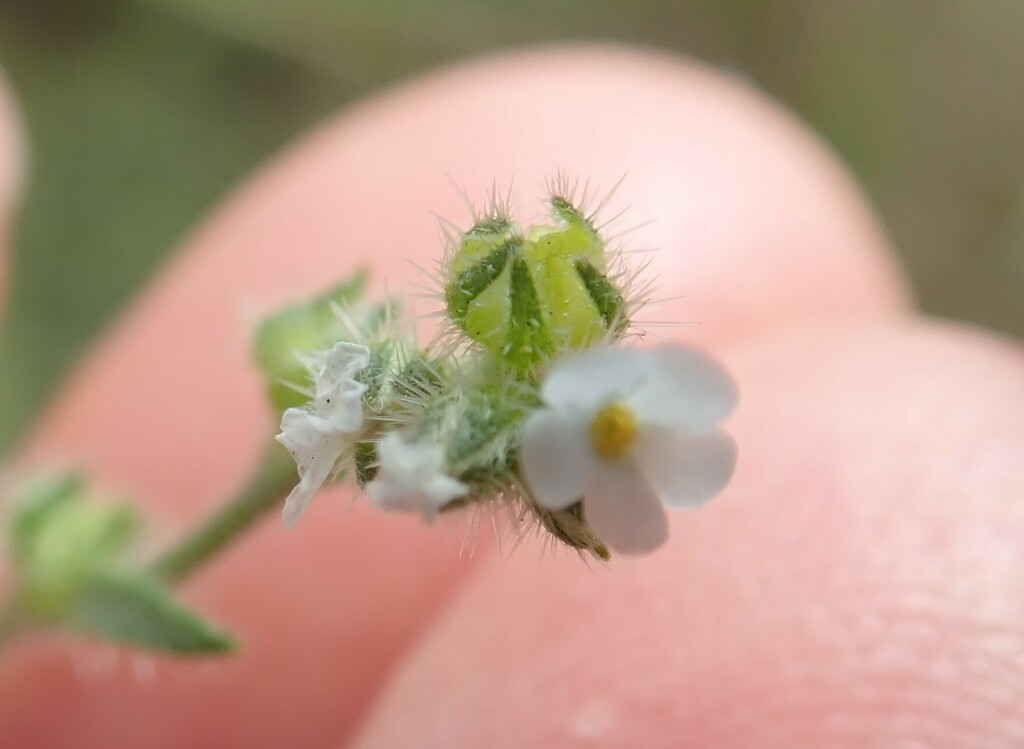
Photo: parent species Plagiobothrys collinus · (c) Millie Basden, some rights reserved (CC BY) · licence
Family: Boraginaceae · Type: Herb · Native
Plagiobothrys collinus var. ursinus (Bear valley popcornflower) is a native California herb in the Boraginaceae family, recognized by montane conifer forest, cespitose habit, short dense inflorescences.
Bear valley popcornflower is a California native annual found in the Tehachapi Mountains, San Jacinto Mountains, and southern Peninsular Ranges near Tecate Mountain in open conifer forest on sandy or gravelly granite-based soils at elevations of 1,100 to 2,400 meters. Flowering from April to June, this plant produces small white flowers with delicate corolla limbs about 1 to 2 millimeters in diameter, arranged in compact clusters among its leaves. Growing in dense tufts with nearly erect stems 2 to 8 centimeters tall and covered in coarse hairs, it forms small, clustered populations. Its leaves are oblanceolate, 1 to 2.5 centimeters long and 3 to 5 millimeters wide, spreading near the base of the plant. The fruit consists of small nutlets 1.5 to 2 millimeters long, characteristic of its popcornflower genus.
Identification and appearance
Key characters: 16 sympatric species; montane conifer forest, cespitose habit, short dense inflorescences
Habitat and range
Habitat: Sandy or gravelly granite-based soils, open conifer forest
Elevation: generally 1100-2400 m
Outside California: Mexico?
Bloom period
Plagiobothrys collinus var. ursinus blooms Apr-Jun.
How to tell it apart
vs Cryptantha: Seeds have a raised ridge down the inner face, not a groove like Cryptantha.; vs Pectocarya: Seeds lack the comb-like marginal barbs of Pectocarya; attachment scar is raised.; vs Myosotis: Flowers are smaller and more tubular; Myosotis has wider, flatter blue flowers with yellow centers.; vs Nemophila: Nemophila has much larger, showier blue-white flowers and broader leaves.; vs Leptosiphon: Leptosiphon has needle-like divided leaves; Plagiobothrys has simple narrow leaves.
Frequently asked questions
Is Plagiobothrys collinus var. ursinus native to California?
Yes. Plagiobothrys collinus var. ursinus is native to California (recorded as native).
When does Plagiobothrys collinus var. ursinus bloom?
Plagiobothrys collinus var. ursinus blooms Apr-Jun.
What plant family does Plagiobothrys collinus var. ursinus belong to?
Plagiobothrys collinus var. ursinus is in the Boraginaceae family, genus Plagiobothrys.
What habitat does Plagiobothrys collinus var. ursinus grow in?
Plagiobothrys collinus var. ursinus grows in Sandy or gravelly granite-based soils, open conifer forest.
Related species
Other California species in the same genus, family, or bioregion.
- Plagiobothrys cusickii — Cusick's popcornflower
- Plagiobothrys diffusus — San francisco popcornflower
- Plagiobothrys distantiflorus — Madera popcornflower
- Plagiobothrys fulvus var. campestris — Field popcornflower
- Plagiobothrys glaber — Hairless popcornflower
- Plagiobothrys glyptocarpus — Sculptured-nut popcornflower
Sources: Jepson eFlora · CalPhotos
Last updated 2026-10-07
Data from The California Species Project — 14,000+ California species with verified data from CNPS, CDFW, USFWS, Cal-IPC, and more.