Plagiobothrys leptocladus
Alkali plagiobothrys
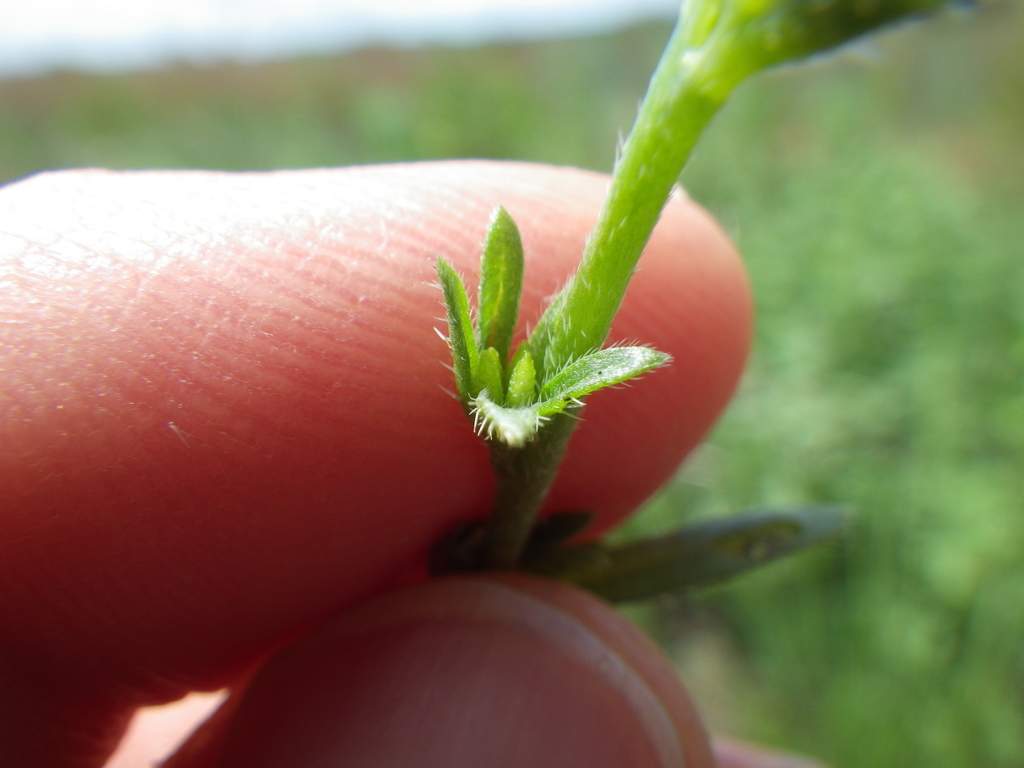
(c) Matt Lavin, some rights reserved (CC BY-SA) · licence
Family: Boraginaceae · Type: Herb · Native
Plagiobothrys leptocladus (Alkali plagiobothrys) is a native California herb in the Boraginaceae family, recognized by alkaline habitat preference and bent fruiting calyces.
Alkali plagiobothrys is a California native annual found in the Central Valley, San Francisco Bay Area, southern coastal ranges, southern deserts, Great Basin, and western Mojave Desert in alkaline or saline clay soils, vernal pools, and wet places at elevations below 1,400 meters. Flowering from March to July, this plant produces small white flowers with pale yellow appendages, forming delicate open clusters. Growing with prostrate to decumbent stems 10 to 30 centimeters long, it develops sparse to dense strigose hairs and may have a taproot. Its cauline leaves are 3 to 10 centimeters long, spreading along the slender stems. The fruit consists of small, lanceolate nutlets 1 to 1.8 millimeters long, which are grayish to brown with rounded margins.
Identification and appearance
Key characters: 45 sympatric species - alkaline habitat preference and bent fruiting calyces help distinguish
Habitat and range
Habitat: Generally alkaline or saline clay soils, vernal pools, wet places
Elevation: < 1400 m
California counties: Fresno, Los Angeles, Kern, San Luis Obispo, Monterey, Riverside, San Benito, Tulare, Kings, Contra Costa, Yolo, Solano, Merced, Alpine, Inyo, Modoc, San Joaquin, Alameda, Tehama, Butte, Colusa, Glenn, Lassen, Shasta, Madera, Mono, Stanislaus, San Bernardino, Ventura, Sonoma, Mariposa
Outside California: to Alaska, central Canada, Nebraska, Colorado, Mexico
Bloom period
Plagiobothrys leptocladus blooms Mar-Jul.
How to tell it apart
vs Cryptantha: Seeds have a raised ridge down the inner face, not a groove like Cryptantha.; vs Pectocarya: Seeds lack the comb-like marginal barbs of Pectocarya; attachment scar is raised.; vs Myosotis: Flowers are smaller and more tubular; Myosotis has wider, flatter blue flowers with yellow centers.; vs Nemophila: Nemophila has much larger, showier blue-white flowers and broader leaves.; vs Leptosiphon: Leptosiphon has needle-like divided leaves; Plagiobothrys has simple narrow leaves.
Frequently asked questions
Is Plagiobothrys leptocladus native to California?
Yes. Plagiobothrys leptocladus is native to California (recorded as native).
When does Plagiobothrys leptocladus bloom?
Plagiobothrys leptocladus blooms Mar-Jul.
Where in California does Plagiobothrys leptocladus grow?
Plagiobothrys leptocladus occurs in Fresno, Los Angeles, Kern, San Luis Obispo, Monterey, Riverside, San Benito, Tulare and other counties, at elevations of < 1400 m.
What plant family does Plagiobothrys leptocladus belong to?
Plagiobothrys leptocladus is in the Boraginaceae family, genus Plagiobothrys.
What habitat does Plagiobothrys leptocladus grow in?
Plagiobothrys leptocladus grows in Generally alkaline or saline clay soils, vernal pools, wet places.
Related species
Other California species in the same genus, family, or bioregion.
- Plagiobothrys lithocaryus — Mayacamas popcornflower
- Plagiobothrys mollis — Creeping popcornflower
- Plagiobothrys mollis var. mollis — Downy popcorn flower
- Plagiobothrys mollis var. vestitus — Petaluma popcornflower
- Plagiobothrys nitens — Shiny-nutlet popcornflower
- Plagiobothrys nothofulvus — Rusty popcornflower
Sources: Jepson eFlora · Index of California Plant Names · CalPhotos
Last updated 2026-10-07
Data from The California Species Project — 14,000+ California species with verified data from CNPS, CDFW, USFWS, Cal-IPC, and more.