Plagiobothrys reticulatus var. rossianorum
Fort ross popcornflower, Fort Ross Popcornflower
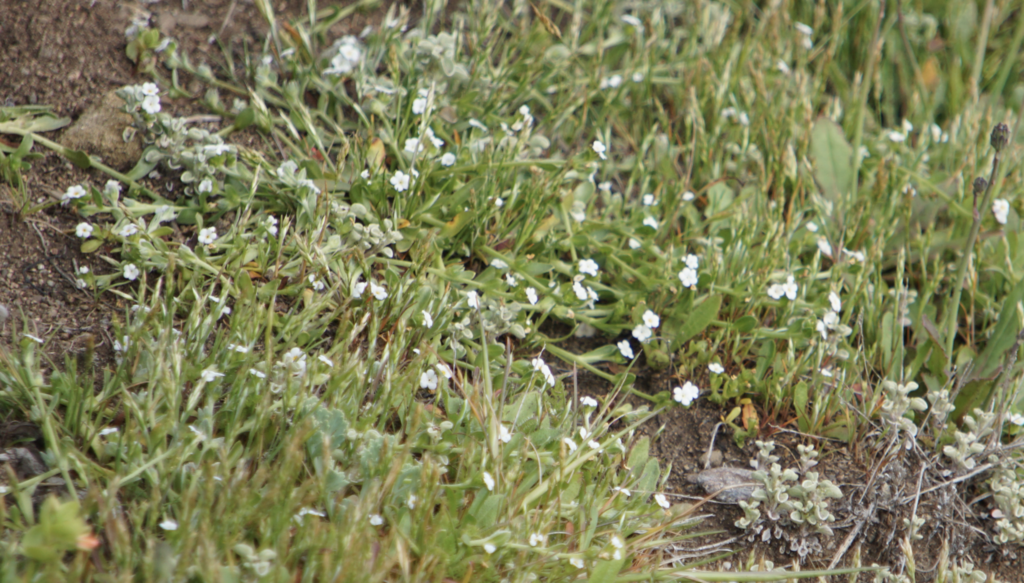
Photo: parent species Plagiobothrys reticulatus · (c) Karen (with occasional help from Mike), some rights reserved (CC BY) · licence
Family: Boraginaceae · Type: Annual · Native
Plagiobothrys reticulatus var. rossianorum (Fort ross popcornflower) is a native California annual in the Boraginaceae family, recognized by Coastal variety with reticulate nutlet surface; more restricted range than var. reticulatus.
Fort ross popcornflower is a California native annual found in northern coastal, central coastal, San Francisco Bay, and southern coastal ranges in moist coastal grasslands, beach deposits, and mud flats at elevations below 800 meters. Flowering from April to June, this plant produces white flowers in delicate clusters characteristic of the popcornflower family. Growing with partially decumbent or sprawling stems that occasionally ascend, it spreads low across the ground in coastal habitats. Its small nutlets are distinctively marked with scattered, irregular cross-ribs and dense surface tubercles, creating a netlike texture on the fruit. The plant's low-growing, sprawling habit allows it to thrive in the moist, open environments of California's coastal regions.
Identification and appearance
Key characters: Coastal variety with reticulate nutlet surface; more restricted range than var. reticulatus
Habitat and range
Habitat: Moist places in coastal grassland, beach deposits, mud flats
Elevation: < 800 m
California counties: Sonoma, Santa Clara, Monterey, Mendocino, Humboldt, Marin, San Diego, Trinity, Del Norte, San Francisco
Bloom period
Plagiobothrys reticulatus var. rossianorum blooms Apr-Jun.
How to tell it apart
vs Cryptantha: Seeds have a raised ridge down the inner face, not a groove like Cryptantha.; vs Pectocarya: Seeds lack the comb-like marginal barbs of Pectocarya; attachment scar is raised.; vs Myosotis: Flowers are smaller and more tubular; Myosotis has wider, flatter blue flowers with yellow centers.; vs Nemophila: Nemophila has much larger, showier blue-white flowers and broader leaves.; vs Leptosiphon: Leptosiphon has needle-like divided leaves; Plagiobothrys has simple narrow leaves.
Frequently asked questions
Is Plagiobothrys reticulatus var. rossianorum native to California?
Yes. Plagiobothrys reticulatus var. rossianorum is native to California (recorded as native).
When does Plagiobothrys reticulatus var. rossianorum bloom?
Plagiobothrys reticulatus var. rossianorum blooms Apr-Jun.
Where in California does Plagiobothrys reticulatus var. rossianorum grow?
Plagiobothrys reticulatus var. rossianorum occurs in Sonoma, Santa Clara, Monterey, Mendocino, Humboldt, Marin, San Diego, Trinity and other counties, at elevations of < 800 m.
What plant family does Plagiobothrys reticulatus var. rossianorum belong to?
Plagiobothrys reticulatus var. rossianorum is in the Boraginaceae family, genus Plagiobothrys.
What habitat does Plagiobothrys reticulatus var. rossianorum grow in?
Plagiobothrys reticulatus var. rossianorum grows in Moist places in coastal grassland, beach deposits, mud flats.
Related species
Other California species in the same genus, family, or bioregion.
Sources: Jepson eFlora · Index of California Plant Names · CalPhotos
Last updated 2026-10-06
Data from The California Species Project — 14,000+ California species with verified data from CNPS, CDFW, USFWS, Cal-IPC, and more.