Plagiobothrys stipitatus var. micranthus
Common vernal pool allocarya
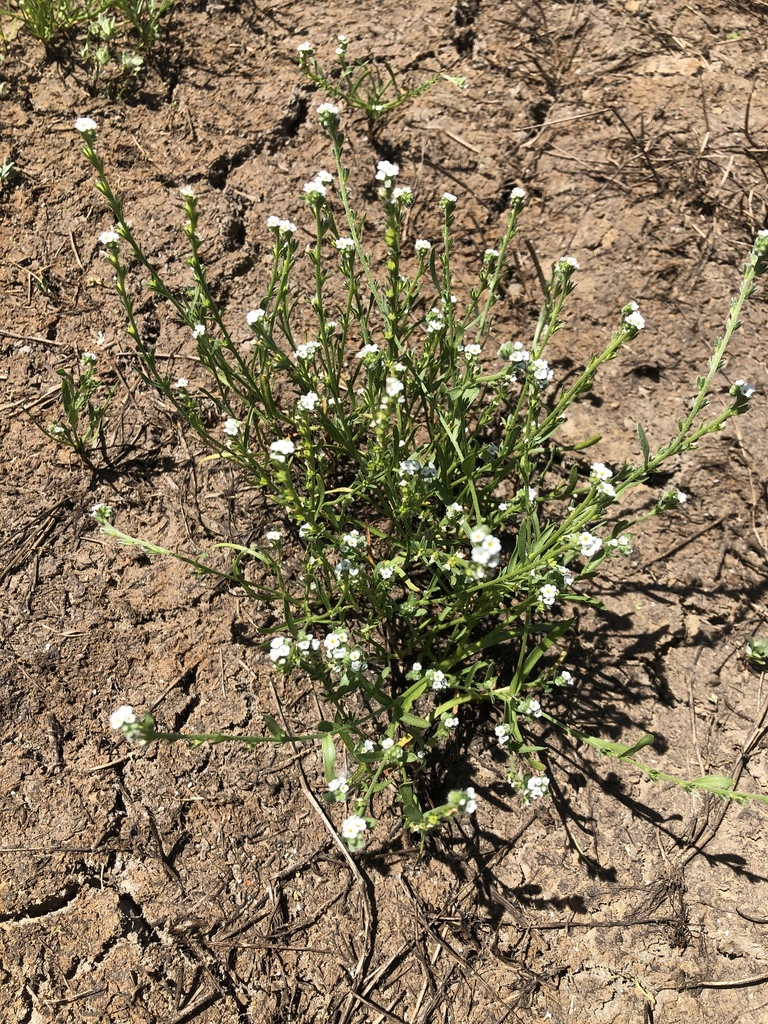
Photo: parent species Plagiobothrys stipitatus · (c) L. Wood, some rights reserved (CC BY) · licence
Family: Boraginaceae · Type: Herb · Native
Plagiobothrys stipitatus var. micranthus (Common vernal pool allocarya) is a native California herb in the Boraginaceae family, recognized by Stipitate nutlets like var. stipitatus but with smaller flowers.
Common vernal pool allocarya is a California native annual found in the Klamath Ranges, North Coast, Cascade Range, Sierra Nevada Foothills, northern and central Sierra Nevada, Great Valley, San Francisco Bay Area, South Coast, Peninsular Ranges, and Great Basin in vernal pools, wet grasslands, conifer forests, and sagebrush scrub at elevations below 2,130 meters. Flowering from April to July, this delicate plant produces small white flowers with a corolla limb 2 to 4 millimeters in diameter. Growing with slender branching stems that spread close to the ground, it forms dense low-growing clusters in seasonal wetland habitats. Its small leaves are typically narrow and clustered along the stems, adapting to the ephemeral wet environments where it thrives. The plant's diminutive size and ability to complete its lifecycle in the brief window of seasonal pools make it a characteristic species of California's unique vernal ecosystems.
Identification and appearance
Key characters: Stipitate nutlets like var. stipitatus but with smaller flowers
Habitat and range
Habitat: Common. Vernal pools, wet sites in grassland, conifer forest, sagebrush scrub
Elevation: < 2130 m
California counties: Placer, Butte, Madera, Amador, Stanislaus, Monterey, San Joaquin, Fresno, Merced, Lake, Contra Costa, Sacramento, Modoc, Humboldt, Glenn, Solano, El Dorado, Colusa, Sonoma, Tehama, San Benito, Yuba, Sutter, Calaveras, Mariposa, Lassen, Yolo, Tulare, San Luis Obispo, Alameda, Shasta, Napa, Trinity, Tuolumne, San Diego, Nevada, Santa Clara, Riverside
Outside California: southeastern Oregon, western Nevada
Bloom period
Plagiobothrys stipitatus var. micranthus blooms Apr-Jul.
How to tell it apart
vs Cryptantha: Seeds have a raised ridge down the inner face, not a groove like Cryptantha.; vs Pectocarya: Seeds lack the comb-like marginal barbs of Pectocarya; attachment scar is raised.; vs Myosotis: Flowers are smaller and more tubular; Myosotis has wider, flatter blue flowers with yellow centers.; vs Nemophila: Nemophila has much larger, showier blue-white flowers and broader leaves.; vs Leptosiphon: Leptosiphon has needle-like divided leaves; Plagiobothrys has simple narrow leaves.
Frequently asked questions
Is Plagiobothrys stipitatus var. micranthus native to California?
Yes. Plagiobothrys stipitatus var. micranthus is native to California (recorded as native).
When does Plagiobothrys stipitatus var. micranthus bloom?
Plagiobothrys stipitatus var. micranthus blooms Apr-Jul.
Where in California does Plagiobothrys stipitatus var. micranthus grow?
Plagiobothrys stipitatus var. micranthus occurs in Placer, Butte, Madera, Amador, Stanislaus, Monterey, San Joaquin, Fresno and other counties, at elevations of < 2130 m.
What plant family does Plagiobothrys stipitatus var. micranthus belong to?
Plagiobothrys stipitatus var. micranthus is in the Boraginaceae family, genus Plagiobothrys.
What habitat does Plagiobothrys stipitatus var. micranthus grow in?
Plagiobothrys stipitatus var. micranthus grows in Common. Vernal pools, wet sites in grassland, conifer forest, sagebrush scrub.
Related species
Other California species in the same genus, family, or bioregion.
- Plagiobothrys stipitatus var. stipitatus — Showy great valley popcornflower
- Plagiobothrys strictus — Calistoga popcornflower
- Plagiobothrys tenellus — Pacific popcornflower
- Plagiobothrys tener — Slender popcornflower
- Plagiobothrys tener var. subglaber — Serpentine popcornflower
- Plagiobothrys tener var. tener — Slender popcornflower
Sources: Jepson eFlora · Index of California Plant Names · CalPhotos
Last updated 2026-10-07
Data from The California Species Project — 14,000+ California species with verified data from CNPS, CDFW, USFWS, Cal-IPC, and more.