Plagiobothrys tenellus
Pacific popcornflower
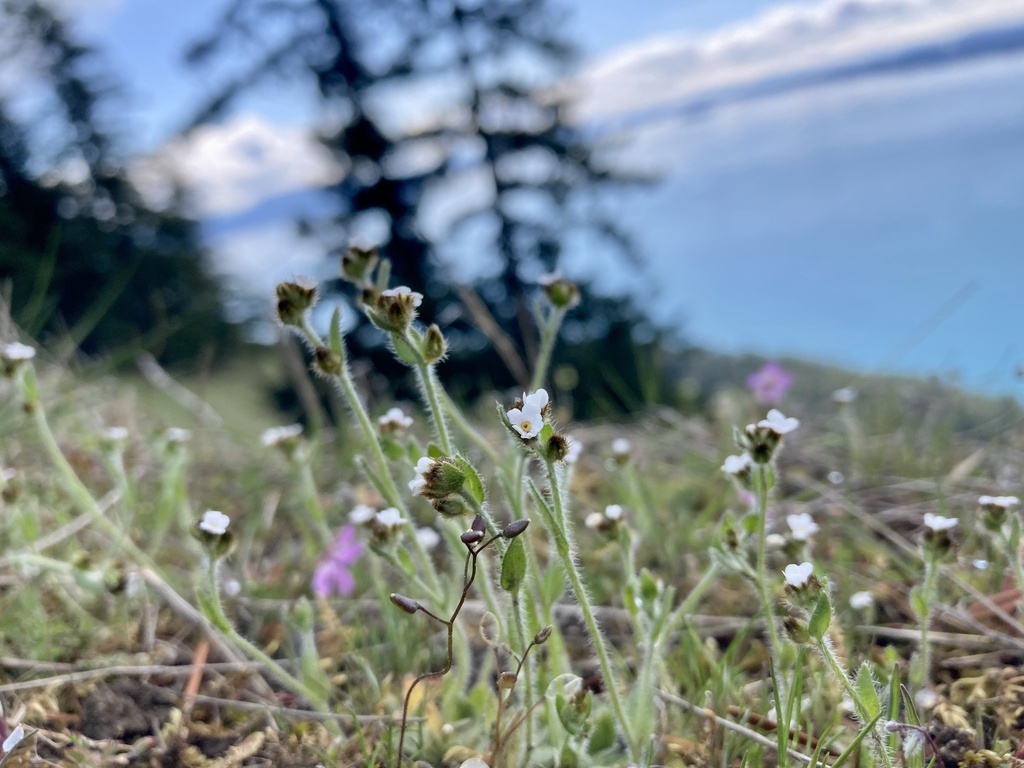
(c) Caleb Catto, some rights reserved (CC BY) · licence
Family: Boraginaceae · Type: Herb · Native
Plagiobothrys tenellus (Pacific popcornflower) is a native California herb in the Boraginaceae family, recognized by most widespread; strongly coiled inflorescences and >10 flowers per branch.
Pacific popcornflower is a California native annual found in the California Floristic Province, Modoc Plateau, and western deserts on dry, open slopes in grassland, scrub, woodland, and forest at elevations below 1,700 meters. Flowering from March to June, this plant produces small white flowers with pale yellow appendages in delicate clusters. Growing with erect stems 5 to 30 centimeters tall, it forms 1 to many slender stems with sparse spreading hairs. Its leaves form a basal rosette 1 to 5 centimeters long, with a few alternate cauline leaves along the stem. The distinctive fruits are tiny cross-shaped nutlets 1 to 2 millimeters long, with shiny surfaces and intricate ridged textures.
Identification and appearance
Key characters: 53 sympatric species - most widespread; strongly coiled inflorescences and >10 flowers per branch
Habitat and range
Habitat: Common. Dry, open slopes in grassland, scrub, woodland, forest
Elevation: < 1700 m
California counties: San Luis Obispo, Kern, Tulare, Fresno, Lake, San Diego, Lassen, San Benito, Butte, Nevada, Santa Barbara, Monterey, Plumas, San Bernardino, Santa Clara, Riverside, Mendocino, Napa, Siskiyou, Modoc, Orange, Los Angeles, Madera, Tuolumne, Trinity, San Joaquin, Santa Cruz, Mariposa, Ventura, El Dorado, Sonoma, Colusa, San Mateo, Marin, Sierra, Shasta, Tehama, Yuba, Glenn, Yolo, Humboldt, Contra Costa, Alameda, Calaveras, Stanislaus, Sacramento, Sutter, Del Norte, Alpine, Amador, Solano
Outside California: to British Columbia, Idaho, Utah, Arizona, Mexico
Bloom period
Plagiobothrys tenellus blooms Mar-Jun.
How to tell it apart
vs Cryptantha: Seeds have a raised ridge down the inner face, not a groove like Cryptantha.; vs Pectocarya: Seeds lack the comb-like marginal barbs of Pectocarya; attachment scar is raised.; vs Myosotis: Flowers are smaller and more tubular; Myosotis has wider, flatter blue flowers with yellow centers.; vs Nemophila: Nemophila has much larger, showier blue-white flowers and broader leaves.; vs Leptosiphon: Leptosiphon has needle-like divided leaves; Plagiobothrys has simple narrow leaves.
Frequently asked questions
Is Plagiobothrys tenellus native to California?
Yes. Plagiobothrys tenellus is native to California (recorded as native).
When does Plagiobothrys tenellus bloom?
Plagiobothrys tenellus blooms Mar-Jun.
Where in California does Plagiobothrys tenellus grow?
Plagiobothrys tenellus occurs in San Luis Obispo, Kern, Tulare, Fresno, Lake, San Diego, Lassen, San Benito and other counties, at elevations of < 1700 m.
What plant family does Plagiobothrys tenellus belong to?
Plagiobothrys tenellus is in the Boraginaceae family, genus Plagiobothrys.
What habitat does Plagiobothrys tenellus grow in?
Plagiobothrys tenellus grows in Common. Dry, open slopes in grassland, scrub, woodland, forest.
Related species
Other California species in the same genus, family, or bioregion.
- Plagiobothrys tener — Slender popcornflower
- Plagiobothrys tener var. subglaber — Serpentine popcornflower
- Plagiobothrys tener var. tener — Slender popcornflower
- Plagiobothrys torreyi — High sierra popcornflower
- Plagiobothrys torreyi var. diffusus — Torrey's popcornflower
- Plagiobothrys torreyi var. perplexans — Chaparral popcornflower
Sources: Jepson eFlora · Index of California Plant Names · CalPhotos
Last updated 2026-10-07
Data from The California Species Project — 14,000+ California species with verified data from CNPS, CDFW, USFWS, Cal-IPC, and more.