Plantago erecta
California plantain
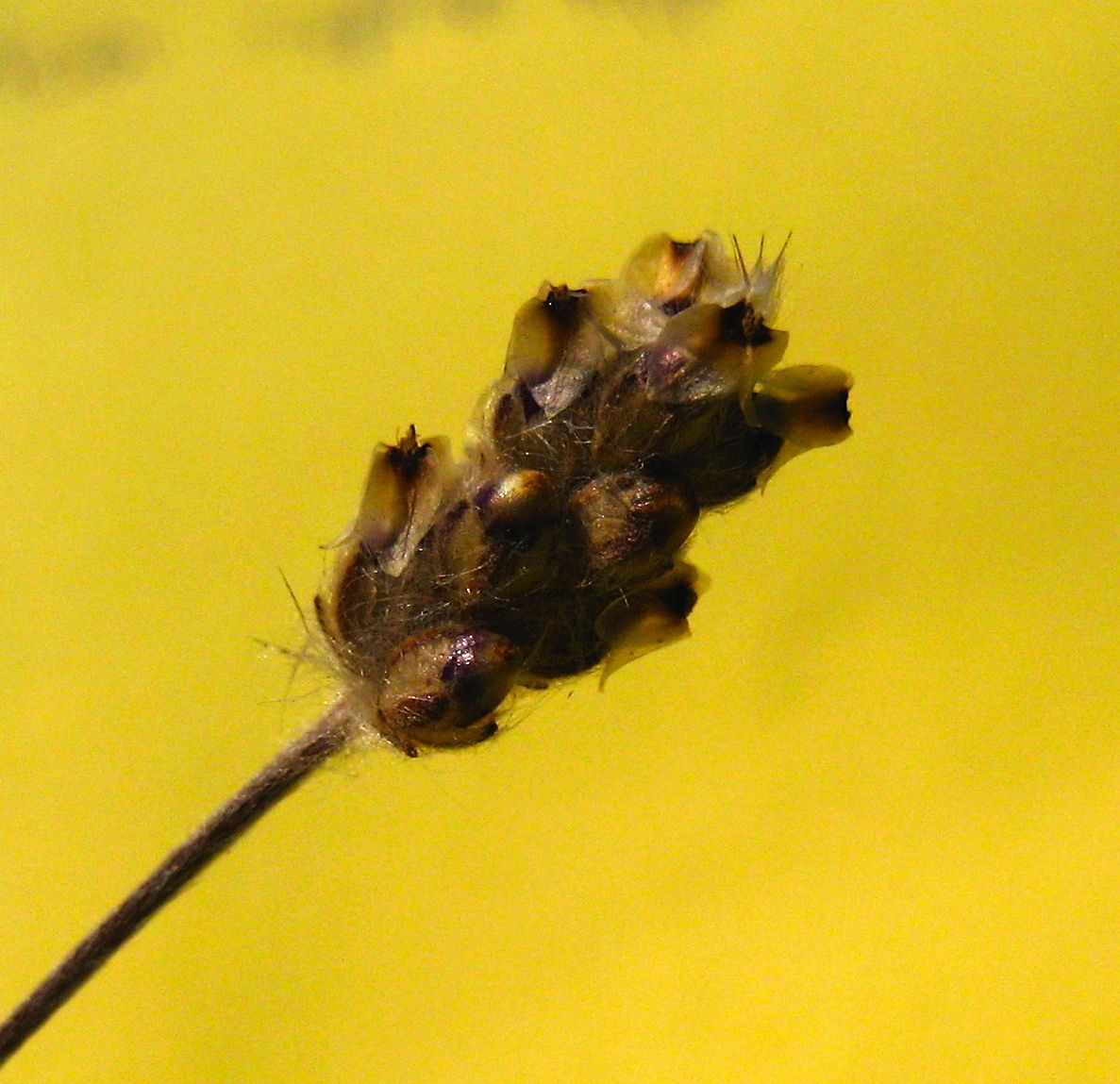
Photo by Chez Brungraber
Family: Plantaginaceae · Type: Herb · Native
Plantago erecta (California plantain) is a native California herb in the Plantaginaceae family, recognized by distinctive short head-like spikes and large corolla lobes.
California plantain is a native annual found in California's Central Coast, Coast Ranges, and Southwestern California in sandy, clay, or serpentine substrates, grassy slopes, and open woodlands at elevations below 700 meters. Flowering from March to May, this plant produces small, delicate white to pale green flowers in dense, compact spikes 3 to 30 centimeters tall. Growing with thin, thread-like stems 15 to 30 centimeters tall and scattered silky hairs, it has a slender, upright habit. Its leaves are narrow and elongated, measuring 3 to 13 centimeters long, with thread-like to oblanceolate shapes and occasional small teeth along the margins. Each plant produces two small seeds, approximately 2 to 2.5 millimeters long, nestled within its compact flower head.
Identification and appearance
Key characters: 16 sympatric species; distinctive short head-like spikes and large corolla lobes
Habitat and range
Habitat: Sandy, clay, or serpentine substrates, grassy slopes, flats, open woodland
Elevation: < 700 m
California counties: San Luis Obispo, Orange, Ventura, Lake, Butte, Contra Costa, Kern, Los Angeles, Santa Barbara, Tulare, Monterey, Marin, Yuba, Riverside, Fresno, San Diego, Sutter, San Bernardino, Tuolumne, Santa Clara, Colusa, Napa, San Joaquin, Mendocino, San Francisco, Tehama, Placer, Humboldt, Mariposa, San Mateo, Yolo, San Benito, Shasta, Calaveras, Sacramento, El Dorado, Merced, Santa Cruz, Sonoma, Amador, Solano, Alameda, Glenn, Nevada, Stanislaus, Del Norte, Madera, Kings, Inyo, Trinity, Imperial
Outside California: to Oregon, Baja California
Bloom period
Plantago erecta blooms Mar-May.
How to tell it apart
vs Carex: Plantago has broad ribbed leaves in rosettes; Carex has narrow grass-like leaves in 3 ranks.; vs Rumex: Plantago leaves have parallel veins; Rumex leaves have a prominent central midvein with branching veins.; vs Dudleya: Plantago has thin ribbed leaves; Dudleya has thick succulent leaves.; vs Micropus: Plantago has dense cylindrical spikes; Micropus has woolly flower heads in leaf axils.; vs Amsinckia: Plantago has parallel-veined leaves in rosettes; Amsinckia has bristly alternate leaves on upright stems.
Frequently asked questions
Is Plantago erecta native to California?
Yes. Plantago erecta is native to California (recorded as native).
When does Plantago erecta bloom?
Plantago erecta blooms Mar-May.
Where in California does Plantago erecta grow?
Plantago erecta occurs in San Luis Obispo, Orange, Ventura, Lake, Butte, Contra Costa, Kern, Los Angeles and other counties, at elevations of < 700 m.
What plant family does Plantago erecta belong to?
Plantago erecta is in the Plantaginaceae family, genus Plantago.
What habitat does Plantago erecta grow in?
Plantago erecta grows in Sandy, clay, or serpentine substrates, grassy slopes, flats, open woodland.
Related species
Other California species in the same genus, family, or bioregion.
Sources: Jepson eFlora · Index of California Plant Names · CalPhotos
Last updated 2026-10-07
Data from The California Species Project — 14,000+ California species with verified data from CNPS, CDFW, USFWS, Cal-IPC, and more.