Plantago major
Common plantain
no rights reserved · CC0
Family: Plantaginaceae · Type: Herb · Not Native
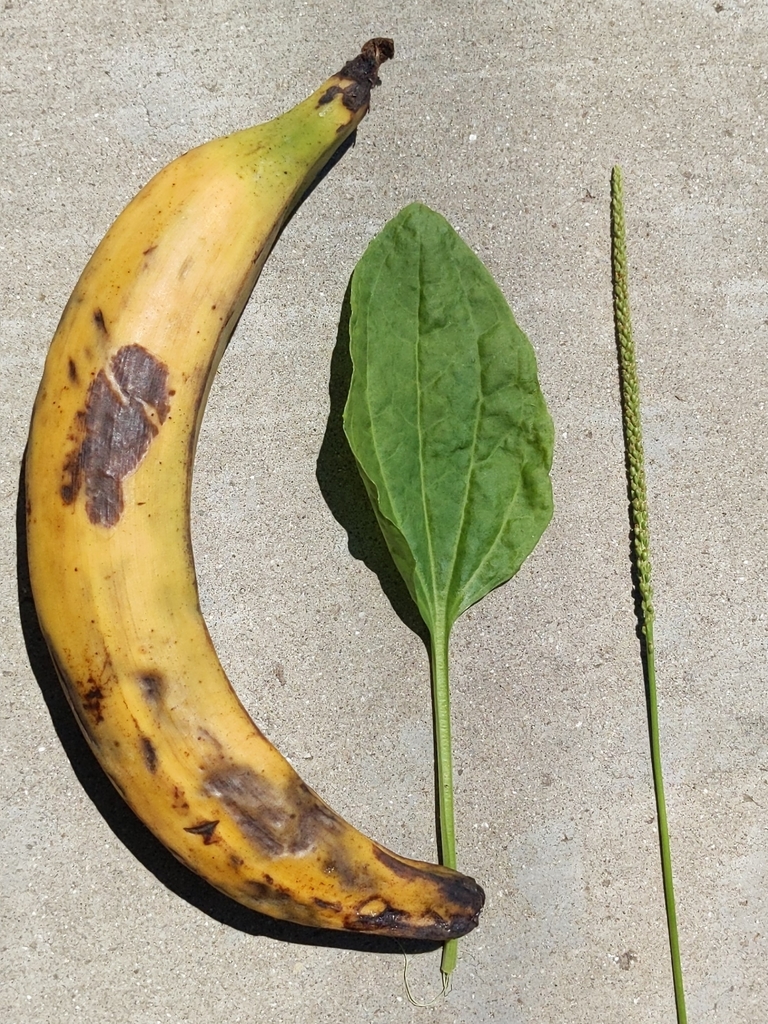
Plantago major (Common plantain) is a non-native California herb in the Plantaginaceae family, recognized by broad cordate leaves and high seed count.
Common plantain is a naturalized perennial herb found in California's Foothill Provinces, Great Basin, and southern Mojave Desert in disturbed areas at elevations below 2,200 meters. Flowering from April to September, this plant produces small, inconspicuous greenish-white flowers in dense linear spikes 5 to 60 centimeters tall. Growing with a short caudex and fibrous roots, it forms a low-growing rosette with broad leaves 5 to 18 centimeters long. Its leaf blades are widely elliptical to slightly heart-shaped, narrowing abruptly to the petiole and often with fine teeth along the margins. The plant produces numerous small seeds, typically 5 to 16 per flower spike, and is commonly found in disturbed ground, roadsides, and urban landscapes.
Identification and appearance
Key characters: 16 sympatric species; diagnostic broad cordate leaves and high seed count
Habitat and range
Habitat: Disturbed areas
Elevation: < 2200 m
California counties: Los Angeles, San Bernardino, Mendocino, Santa Barbara, Orange, Riverside, Siskiyou, Inyo, Kern, San Diego, Trinity, Lake, San Francisco, Mono, Santa Clara, Modoc, Humboldt, Colusa, Plumas, Ventura, San Mateo, Santa Cruz, El Dorado, Tuolumne, Fresno, Contra Costa, Nevada, Yolo, Alpine, Sonoma, Placer, Sacramento, Alameda, Butte, San Luis Obispo, Tehama, Sierra, Napa, Glenn, Monterey, Merced, San Joaquin, Mariposa, Stanislaus, Shasta, Yuba, Solano
Outside California: to eastern United States, native to Europe
Bloom period
Plantago major blooms Apr-Sep.
How to tell it apart
vs Carex: Plantago has broad ribbed leaves in rosettes; Carex has narrow grass-like leaves in 3 ranks.; vs Rumex: Plantago leaves have parallel veins; Rumex leaves have a prominent central midvein with branching veins.; vs Dudleya: Plantago has thin ribbed leaves; Dudleya has thick succulent leaves.; vs Micropus: Plantago has dense cylindrical spikes; Micropus has woolly flower heads in leaf axils.; vs Amsinckia: Plantago has parallel-veined leaves in rosettes; Amsinckia has bristly alternate leaves on upright stems.
Frequently asked questions
Is Plantago major native to California?
No. Plantago major is not native to California (recorded as not native).
When does Plantago major bloom?
Plantago major blooms Apr-Sep.
Where in California does Plantago major grow?
Plantago major occurs in Los Angeles, San Bernardino, Mendocino, Santa Barbara, Orange, Riverside, Siskiyou, Inyo and other counties, at elevations of < 2200 m.
What plant family does Plantago major belong to?
Plantago major is in the Plantaginaceae family, genus Plantago.
What habitat does Plantago major grow in?
Plantago major grows in Disturbed areas.
Related species
Other California species in the same genus, family, or bioregion.
Sources: Jepson eFlora · Index of California Plant Names · CalPhotos
Last updated 2026-10-07
Data from The California Species Project — 14,000+ California species with verified data from CNPS, CDFW, USFWS, Cal-IPC, and more.