Plantago ovata var. fastigiata
Desert plantain
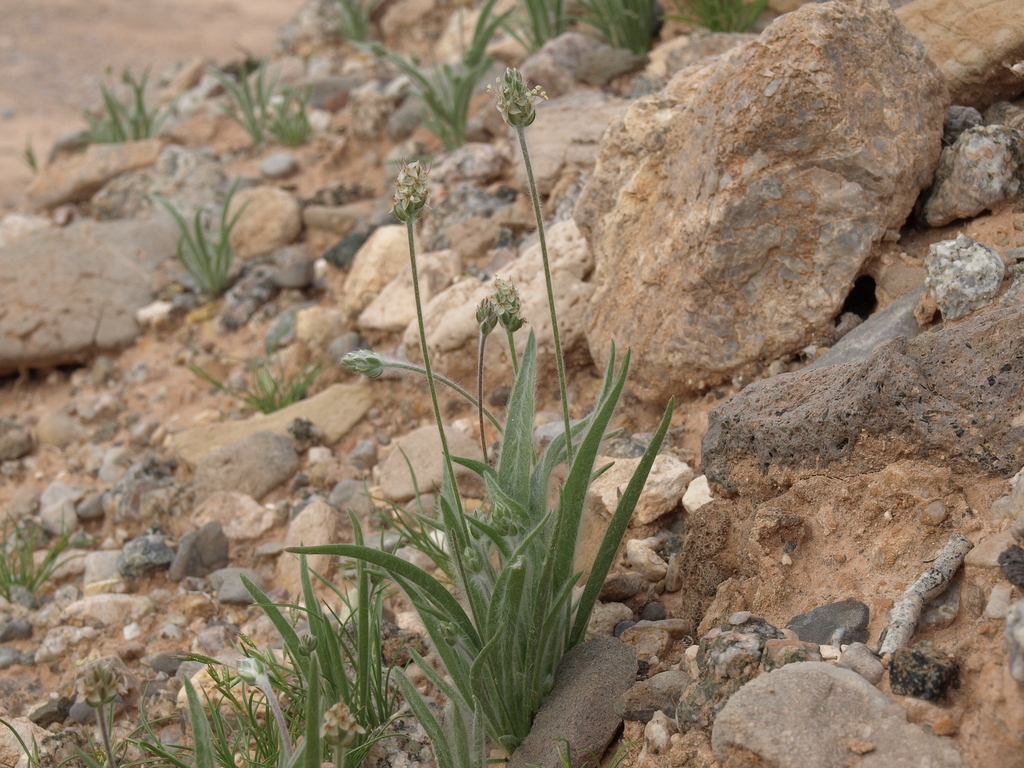
(c) Jim Morefield, some rights reserved (CC BY), uploaded by Jim Morefield · licence
Family: Plantaginaceae · Type: Annual · Native
Plantago ovata var. fastigiata (Desert plantain) is a native California annual in the Plantaginaceae family, recognized by var. insularis by green bract midribs.
Desert plantain is a California native annual found in the San Joaquin Valley, central western California, southern California (excluding Channel Islands), southeastern Sierra Nevada, and desert regions in sandy or gravelly areas, creosote-bush scrub, Joshua-tree woodland, and sagebrush scrub at elevations below 1,400 meters. Flowering from January to April, this plant produces small white to cream-colored flowers with green bract midribs arranged in distinctive compact spikes. Growing with slender stems 5 to 20 centimeters tall, it forms delicate, upright clusters in arid landscapes. Its leaves are narrow and elongated, forming basal rosettes typically 2 to 10 centimeters long, with smooth or slightly toothed margins. The fruits are small capsules containing numerous tiny seeds adapted to dry, open habitats.
Identification and appearance
Key characters: 15 sympatric species; distinguished from var. insularis by green bract midribs
Habitat and range
Habitat: Sandy or gravelly areas, creosote-bush scrub, Joshua-tree woodland, sagebrush scrub
Elevation: < 1400 m
California counties: Kern, Santa Barbara, San Bernardino, Inyo, Imperial, Riverside, San Diego, Orange, Kings, Los Angeles, Ventura, Fresno
Outside California: to Utah, Texas, Baja California, also Mediterranean
Bloom period
Plantago ovata var. fastigiata blooms Jan-Apr.
How to tell it apart
vs Carex: Plantago has broad ribbed leaves in rosettes; Carex has narrow grass-like leaves in 3 ranks.; vs Rumex: Plantago leaves have parallel veins; Rumex leaves have a prominent central midvein with branching veins.; vs Dudleya: Plantago has thin ribbed leaves; Dudleya has thick succulent leaves.; vs Micropus: Plantago has dense cylindrical spikes; Micropus has woolly flower heads in leaf axils.; vs Amsinckia: Plantago has parallel-veined leaves in rosettes; Amsinckia has bristly alternate leaves on upright stems.
Frequently asked questions
Is Plantago ovata var. fastigiata native to California?
Yes. Plantago ovata var. fastigiata is native to California (recorded as native).
When does Plantago ovata var. fastigiata bloom?
Plantago ovata var. fastigiata blooms Jan-Apr.
Where in California does Plantago ovata var. fastigiata grow?
Plantago ovata var. fastigiata occurs in Kern, Santa Barbara, San Bernardino, Inyo, Imperial, Riverside, San Diego, Orange and other counties, at elevations of < 1400 m.
What plant family does Plantago ovata var. fastigiata belong to?
Plantago ovata var. fastigiata is in the Plantaginaceae family, genus Plantago.
What habitat does Plantago ovata var. fastigiata grow in?
Plantago ovata var. fastigiata grows in Sandy or gravelly areas, creosote-bush scrub, Joshua-tree woodland, sagebrush scrub.
Related species
Other California species in the same genus, family, or bioregion.
Sources: Jepson eFlora · Index of California Plant Names · CalPhotos
Last updated 2026-09-30
Data from The California Species Project — 14,000+ California species with verified data from CNPS, CDFW, USFWS, Cal-IPC, and more.