Platanthera dilatata var. leucostachys
White-flowered bog-orchid, White-Flowered Bog-Orchid
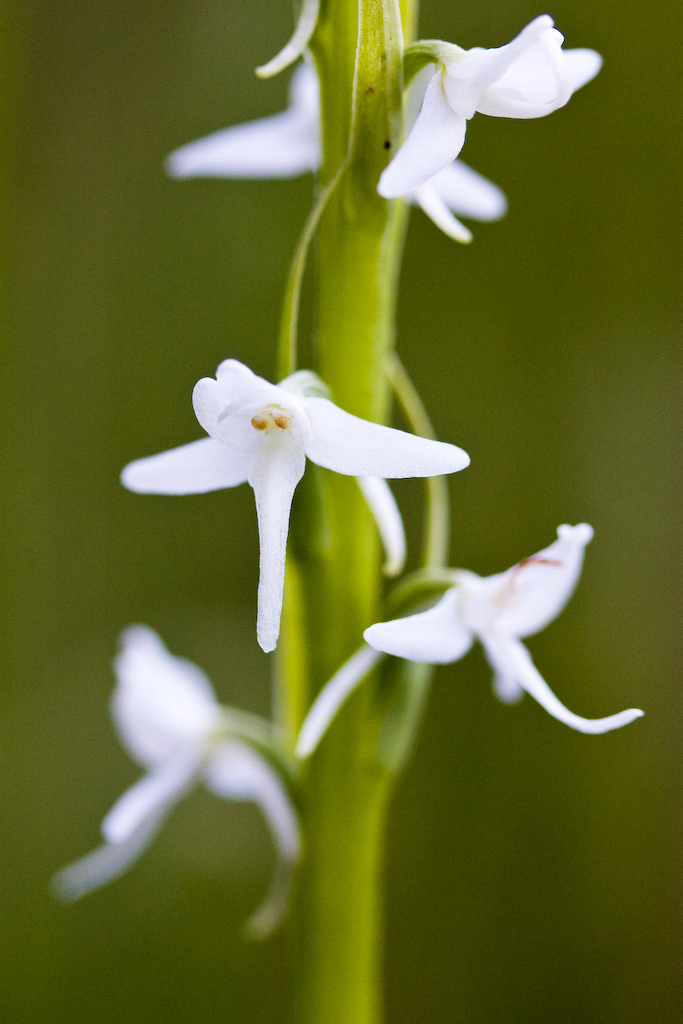
(c) Ken-ichi Ueda, some rights reserved (CC BY) · licence
Family: Orchidaceae · Type: Herb · Native
Platanthera dilatata var. leucostachys (White-flowered bog-orchid) is a native California herb in the Orchidaceae family, recognized by white flowers clearly diagnostic among all California bog-orchids.
White-flowered bog-orchid is a California native perennial found in the California Floristic Province (excluding the Great Valley), Great Basin, and northern Desert Mountains in Panamint Range, inhabiting wet, open places, meadows, seeps, and streambanks at elevations below 3,400 meters. Flowering from May to September, this orchid produces white to cream-colored flowers with delicate, elongated spurs up to 15 millimeters long arranged in dense inflorescences. Growing with tall stems 15 to 150 centimeters high, the plant develops robust and graceful vertical structures. Its long leaves measure 5 to 35 centimeters in length and 9 to 30 millimeters wide, providing a substantial green backdrop to the distinctive flowering spike. The flower's unique structure features a lanceolate lip 5 to 10 millimeters long and a curved spur that is typically one and a half times the length of the lip.
Identification and appearance
Key characters: 4 sympatric species; white flowers clearly diagnostic among all California bog-orchids
Habitat and range
Habitat: Wet, generally open places, meadows, seeps, streambanks
Elevation: < 3400 m
California counties: Lake, Mono, Los Angeles, Tulare, San Bernardino, Riverside, Inyo, Fresno, Humboldt, Modoc, Trinity, El Dorado, Placer, Alpine, Amador, Sierra, Plumas, Butte, Siskiyou, Del Norte, Madera, Lassen, Tehama, Mendocino, San Luis Obispo, Tuolumne, Shasta, Marin, Nevada, Ventura, Glenn, San Diego, San Mateo, Mariposa, Alameda, Colusa
Outside California: to Alaska, Montana, Utah, Nevada
Bloom period
Platanthera dilatata var. leucostachys blooms May-Sep.
How to tell it apart
vs Spiranthes: Platanthera flowers have spurs and grow in a regular spike, while Spiranthes flowers lack spurs and spiral up the stem.; vs Fritillaria: Platanthera has narrow leaves with a central fold and small spurred flowers, while Fritillaria has broader leaves and large nodding bell-shaped flowers.; vs Clintonia: Platanthera has flowers in a spike with spurs, while Clintonia has few large flowers without spurs and broad basal leaves.; vs Epipactis: Platanthera leaves have one central fold and flowers have spurs, while Epipactis leaves have multiple pleats and flowers lack spurs.; vs Habenaria: Habenaria is an outdated name for Platanthera - they are the same genus.
Frequently asked questions
Is Platanthera dilatata var. leucostachys native to California?
Yes. Platanthera dilatata var. leucostachys is native to California (recorded as native).
When does Platanthera dilatata var. leucostachys bloom?
Platanthera dilatata var. leucostachys blooms May-Sep.
Where in California does Platanthera dilatata var. leucostachys grow?
Platanthera dilatata var. leucostachys occurs in Lake, Mono, Los Angeles, Tulare, San Bernardino, Riverside, Inyo, Fresno and other counties, at elevations of < 3400 m.
What plant family does Platanthera dilatata var. leucostachys belong to?
Platanthera dilatata var. leucostachys is in the Orchidaceae family, genus Platanthera.
What habitat does Platanthera dilatata var. leucostachys grow in?
Platanthera dilatata var. leucostachys grows in Wet, generally open places, meadows, seeps, streambanks.
Related species
Other California species in the same genus, family, or bioregion.
- Platanthera elegans — Coast piperia
- Platanthera elegans subsp. decurtata — Point reyes rein-orchid
- Platanthera elegans subsp. elegans — Coast piperia
- Platanthera elongata — Chaparral orchid, wood rein-orchid
- Platanthera ephemerantha — White-flowered rein-orchid
- Platanthera leptopetala — Narrow-petaled rein-orchid
Sources: Jepson eFlora · Index of California Plant Names · CalPhotos
Last updated 2026-10-07
Data from The California Species Project — 14,000+ California species with verified data from CNPS, CDFW, USFWS, Cal-IPC, and more.