Platystemon californicus
Cream cups
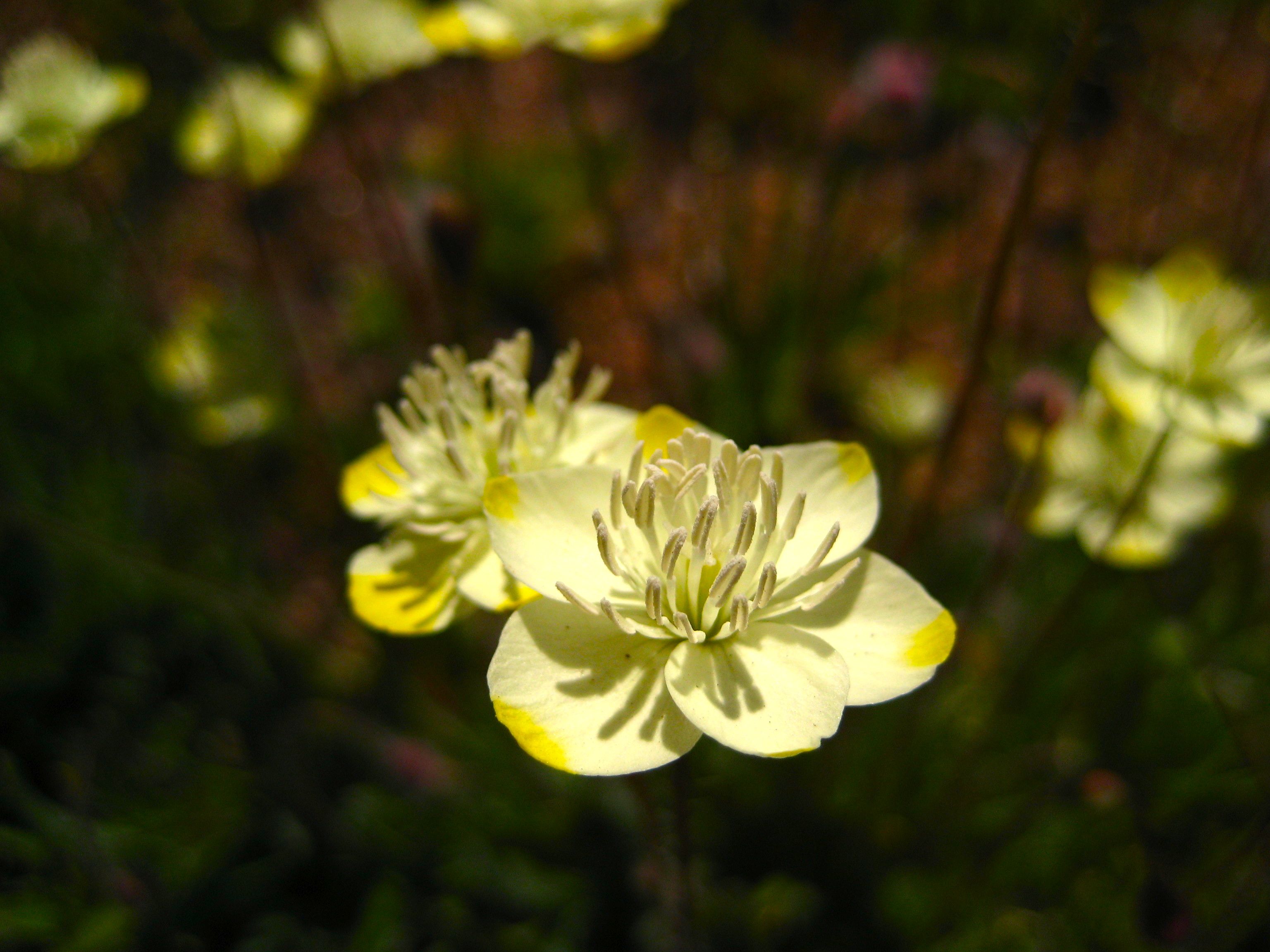
Photo by Chez Brungraber
Family: Papaveraceae · Type: Herb · Native
Conservation status: CNPS 1B.2
Platystemon californicus (Cream cups) is a native California herb in the Papaveraceae family, recognized by widespread distribution CA-FP and western deserts.
Cream cups is a rare (CNPS 1B.2) California native annual found in California Floristic Province and western Desert regions in open grasslands and sandy soil at elevations below 1,000 meters. Flowering from March to May, this delicate plant produces cream-colored flowers with yellow bases, featuring six narrow petals 6 to 19 millimeters long that often persist after blooming. Growing 3 to 30 centimeters tall with shaggy-hairy stems, it develops a distinctive branching habit with linear to lanceolate leaves arranged alternately and in whorls. Its leaves range from 1 to 9 centimeters long, spreading in a loose, airy pattern across the plant's slender structure. The fruit develops as an ovoid to linear pod 10 to 16 millimeters long, which breaks into individual seed-bearing segments.
Identification and appearance
Key characters: Geographically isolated from all congeners; widespread distribution CA-FP and western deserts
Habitat and range
Habitat: Open grassland, sandy soil, burns
Elevation: < 1000 m
California counties: Humboldt, Santa Barbara, San Bernardino, Kern, Los Angeles, Riverside, San Diego, Orange, Monterey, Sacramento, Ventura, San Luis Obispo, Tulare, San Francisco, Tuolumne, Colusa, Napa, Mendocino, Madera, Del Norte, San Mateo, Nevada, Merced, Santa Cruz, San Benito, Butte, San Joaquin, Fresno, Alameda, Inyo, El Dorado, Santa Clara, Marin, Amador, Sonoma, Lake, Calaveras, Glenn, Sutter, Contra Costa, Trinity, Sierra, Placer, Mariposa, Solano, Tehama, Shasta, Stanislaus, Kings, Yuba, Yolo
Outside California: to Oregon, Utah, Arizona, Baja California
Bloom period
Platystemon californicus blooms Mar-May.
Conservation status
CNPS 1B.2
How to tell it apart
vs Hesperomecon: Platystemon has 6+ stigmas clustered at center; Hesperomecon has 3 stigmas.; vs Ranunculus: Platystemon has 2-3 sepals that drop at flowering; Ranunculus has 5 persistent sepals.; vs Camissoniopsis: Platystemon has numerous stamens creating bushy center; Camissoniopsis has exactly 8 stamens.; vs Triteleia: Platystemon has separate petals; Triteleia petals are fused into a tube.; vs Calochortus: Platystemon leaves are narrow and hairy along stem; Calochortus has smooth basal grass-like leaves.
Frequently asked questions
Is Platystemon californicus native to California?
Yes. Platystemon californicus is native to California (recorded as native).
When does Platystemon californicus bloom?
Platystemon californicus blooms Mar-May.
Where in California does Platystemon californicus grow?
Platystemon californicus occurs in Humboldt, Santa Barbara, San Bernardino, Kern, Los Angeles, Riverside, San Diego, Orange and other counties, at elevations of < 1000 m.
What plant family does Platystemon californicus belong to?
Platystemon californicus is in the Papaveraceae family, genus Platystemon.
Is Platystemon californicus rare or endangered?
Platystemon californicus carries California Rare Plant Rank 1B.2, state rank S1.
Related species
Other California species in the same genus, family, or bioregion.
Sources: Jepson eFlora · Index of California Plant Names · CalPhotos · CDFW CNDDB
Last updated 2026-10-07
Data from The California Species Project — 14,000+ California species with verified data from CNPS, CDFW, USFWS, Cal-IPC, and more.